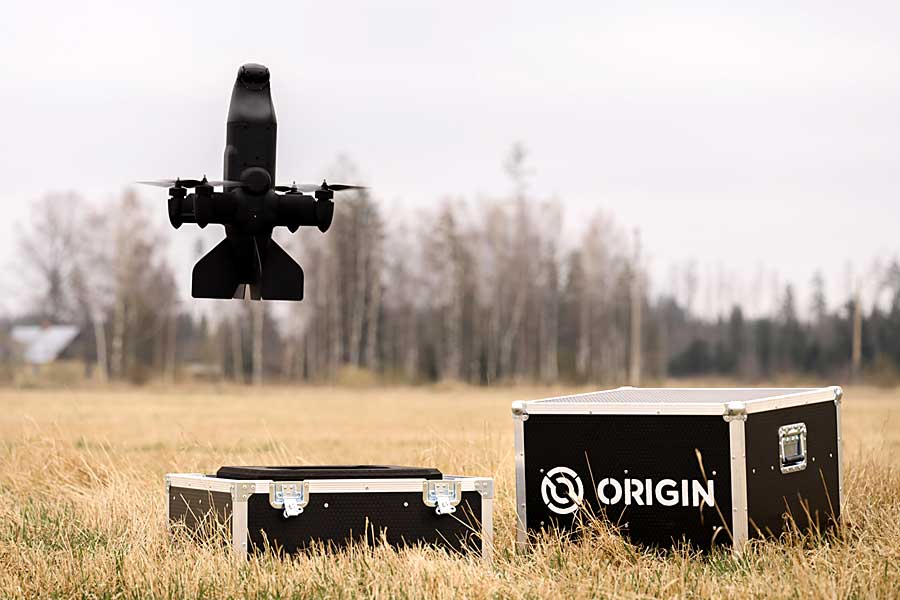
Anduril Industries and Latvia’s Origin Robotics signed a memorandum of understanding in Los Angeles on September 25, 2026, agreeing to explore integrating Origin’s BLAZE autonomous interceptor drone with Anduril’s Lattice command and control software. The companies describe the goal as a layered counter-unmanned aircraft system capability to reinforce Latvia’s air defense and NATO’s eastern flank more broadly.
The agreement was signed during a Latvian trade mission to the United States organized by the Investment and Development Agency of Latvia, coinciding with President Edgars Rinkēvičs’ official visit. It arrives four months after a crisis exposed gaps in Baltic air defense: on May 7, 2026, Russian jamming diverted Ukrainian one-way attack drones into Latvian airspace, and one struck an oil storage depot near Rēzekne. Slow detection and a delayed public alert led to the resignation of Defense Minister Andris Sprūds, and days later Prime Minister Evika Siliņa, whose coalition collapsed over the fallout. The episode followed the September 2025 Russian drone incursion into Poland that prompted NATO’s Operation Eastern Sentry, sharpening European demand for networked, software-defined counter-drone systems.
Inside the BLAZE Interceptor Drone and Lattice Data Link
BLAZE is a man-portable interceptor designed and built entirely in Latvia, packaged in a compact transport case that doubles as its launch platform and charging unit; Origin Robotics says setup requires no tools and takes under ten minutes. Once cued, the interceptor flies autonomously toward an inbound track, using radar guidance for the initial approach before switching to an onboard electro-optical and infrared sensor with AI-enabled computer vision for terminal homing. It carries a high-explosive fragmentation warhead; Origin has separately developed, with Poland’s WITU state armaments institute, a 700-gram directed-fragmentation variant. An operator retains engagement authority throughout, including a wave-off command that can divert the interceptor or trigger self-destruction.
Lattice, Anduril’s sensor-and-system-agnostic command and control layer, is built to fuse radar, camera, and other sensor feeds into a single operating picture and task connected assets accordingly. Under the MoU, a radar detecting an inbound drone would pass its track into Lattice, which would combine it with other sensor data and hand the target to an available BLAZE interceptor, shortening the chain between detection and engagement. Anduril has separately positioned Lattice as a command layer for US Army counter-drone efforts, giving Origin a partner with an established footprint in that mission set beyond Latvia.
BLAZE Fielding Across NATO and the Limits of This MoU
BLAZE is already in NATO service. Latvia received its first rounds in February 2026, alongside Belgium and Estonia, then signed a multi-year framework contract in April eligible for European Union Security Action Fund financing for follow-on deliveries. France ordered the system in mid-2026 after a competitive evaluation by its procurement agency, working with French integrator DSV. Origin describes BLAZE as the first autonomous interceptor drone to receive NATO codification, built around a warhead module compliant with NATO Standardization Agreement specifications, and has separately signed a comparable integration agreement with the European firm Alpine Eagle for its Sentinel architecture.
The Anduril agreement, however, is explicitly exploratory. It is a memorandum of understanding, not a procurement contract, and the companies have not set a date for the joint testing and demonstration work planned in Latvia. Origin’s commercial director, Martins Marenis, has said the Latvian Armed Forces will take part as an interested party, evaluating the combined system’s performance rather than committing to a purchase. What the MoU actually tests is basic interoperability: whether a European-built interceptor and a US-built command layer can exchange targeting data quickly and reliably enough to function as one kill chain against fast, low-cost drone threats.
Analysis: The agreement is best read as one data point in how NATO’s eastern flank is assembling counter-drone capacity from separate parts rather than a single program of record. Frontline states are fielding indigenous interceptors such as BLAZE largely for cost and industrial-sovereignty reasons, while reaching for an established US command layer rather than building bespoke battle-management software from scratch. For Origin, plugging into Lattice offers a route to interoperability with the wider set of allied systems the platform already touches, without ceding hardware production or its growing export base in Belgium, Estonia, and France. For Anduril, each additional interceptor wired into Lattice reinforces its position as a battlefield network of reference on NATO’s frontier, arguably a more durable asset than any single interceptor sale. The arrangement’s limits are real: it is non-binding, untested at operational scale, and driven as much by Latvia’s post-Rēzekne political urgency as by a settled requirement.
The companies have not disclosed a testing timeline, though Marenis has indicated the Latvia demonstrations will happen in the near term. Their outcome, together with the Latvian Armed Forces’ own assessment, will determine whether the MoU converts into a funded integration effort or lapses into one of the many exploratory agreements the counter-drone sector has produced. Estonia, Belgium, and France, all existing BLAZE operators, are the most likely candidates to inherit any Lattice-linked variant that emerges from the Latvian trials.