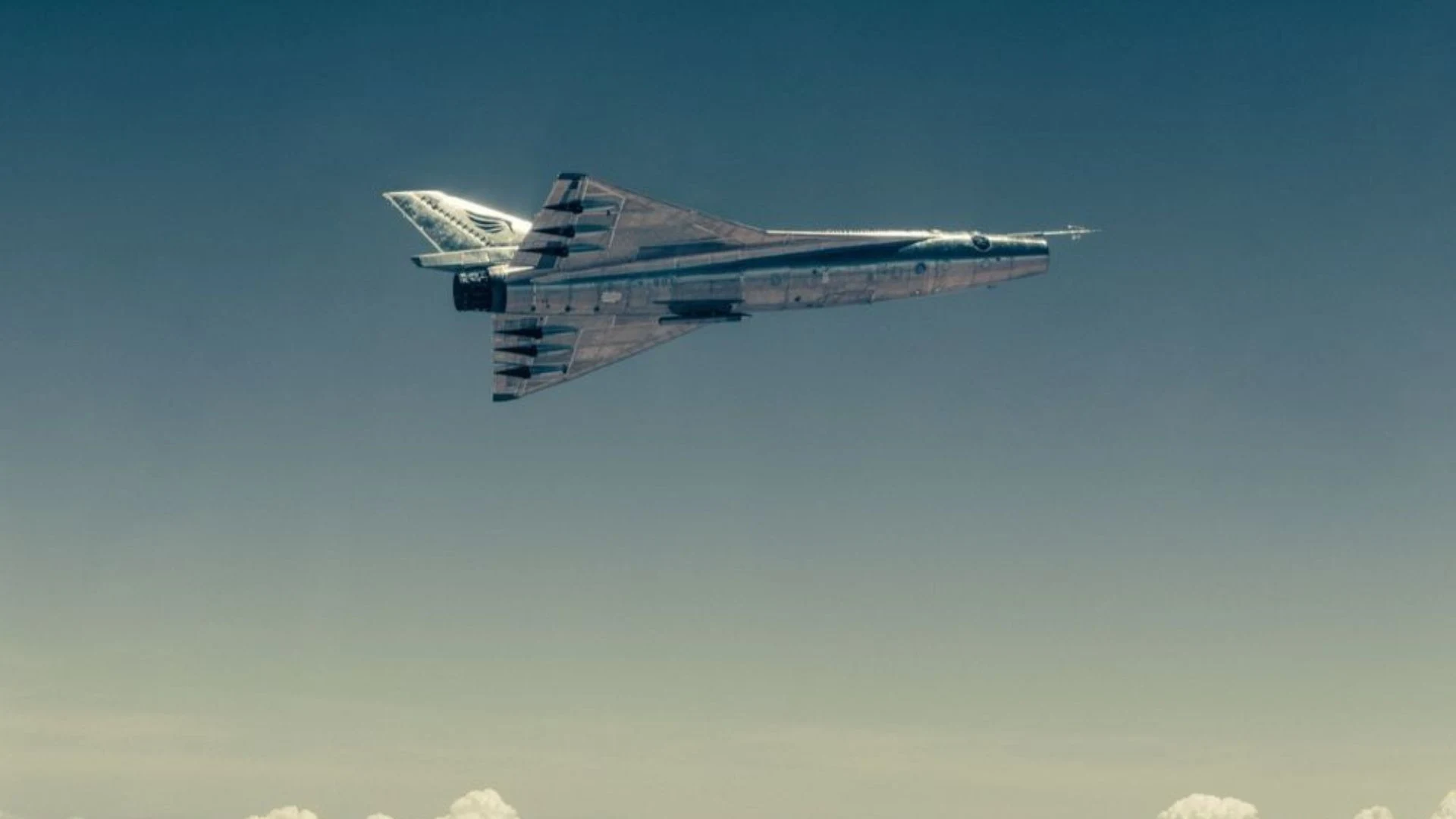
Northrop Grumman and Hermeus Corporation have signed a teaming agreement to field a new class of autonomous, high-Mach military aircraft, the companies announced on November 12, 2026. Northrop Grumman will provide integrated mission systems design, development, integration and sustainment for Hermeus’ reusable uncrewed platforms, beginning with the F100-powered Quarterhorse.
The deal comes as the Department of War presses for autonomous systems fielded in months rather than years, and as Quarterhorse shifts from technology demonstrator toward candidate weapon system. In May 2026, the Defense Innovation Unit (DIU) added $159 million to Hermeus’ contract, raising its ceiling to $219 million for flight tests through 2027 in which the aircraft will release externally mounted payloads at speeds up to Mach 3. Neither company disclosed the value of the teaming arrangement.
Inside the Teaming Deal: Mission Systems for Hermeus Quarterhorse
Northrop Grumman describes its contribution as combat-proven mission systems and “ready-now” electronic warfare, communication, sensing and autonomy expertise. Hermeus frames the scope around sensing, communications, navigation, and command and control. Neither company has identified the specific sensors, jammers or datalinks slated for integration.
The technical hinge is Hermeus’ in-house mission management system (MMS) core, an open, modular architecture that keeps flight-critical and mission-critical functions separated. It is built to the government’s Agile Mission Suite and Autonomy Government Reference Architectures (AMS-GRA and A-GRA) and to the Open Mission Systems/Universal Command and Control Interface (OMS/UCI) standards, which Hermeus says allows mission capabilities to be integrated and updated in weeks rather than years.
That partition matters operationally. Isolating mission software from flight control means a new payload or datalink can be added without reopening the airworthiness case of an aircraft still expanding its envelope. It also gives the government leverage: an OMS/UCI-compliant airframe can, in principle, accept mission kits from any vendor that meets the standard.
“Defense technology needs to evolve faster than ever before, because our customers need solutions now,” said Kyle Mimken, program manager at Northrop Grumman. “Together, we’re giving the military a new operational edge by putting advanced mission kits on aircraft built to move beyond supersonic speeds.”
From Mach 1.21 to Mach 3: The Quarterhorse Mk 2 Roadmap
Quarterhorse is a reusable, runway-launched aircraft developed through a build-fly-build cycle. The subsonic Mk 1 first flew at Edwards Air Force Base, California, on May 21, 2025. The Mk 2 series is a different class of vehicle: roughly F-16-sized, built around a delta wing with a variable-geometry nose inlet, and nearly three times larger and four times heavier than Mk 1, according to Hermeus. Length, wingspan and maximum takeoff weight have not been released.
Propulsion comes from a Pratt & Whitney F100 afterburning turbofan, the engine family of the F-15 and F-16. Publicly available specifications rate the F100-PW-229 variant at roughly 29,000 pounds of afterburning thrust. A mature fighter engine strips powerplant risk from the test program and offers a sustainment path the Air Force already runs.
The Mk 2.1 first flew in late February 2026 from Spaceport America, New Mexico, remotely piloted from a ground-based flight deck, and reached Mach 1.21 on its third sortie on May 26, 2026, over White Sands Missile Range. The Mk 2.2 holds Federal Aviation Administration authorization, effective August 20, 2026, for up to six supersonic flights and will test a new inlet, a Hermeus-developed precooler and a steel airframe. Hermeus has not publicly confirmed its first flight. The Mk 2.3, planned for the first half of 2027, is meant to close the series at Mach 3. Further out, Hermeus is developing Chimera, a turbine-based combined cycle engine pairing an F100-derived core with a ramjet, for the hypersonic Darkhorse.
How Hermeus Is Assembling Industry Partners Around Quarterhorse
Northrop Grumman is the third major industrial partner Hermeus has added in about ten weeks. On September 3, 2026, Hermeus selected Anduril’s Lattice for Mission Autonomy as the mission planning and execution engine for Quarterhorse Mk 2, with a first mission-autonomy flight planned for 2027. On September 15, 2026, Pratt & Whitney licensed Hermeus to produce the F100-PW-229, making the startup a second source for the engine.
Hermeus CEO Zach Shore said Northrop Grumman’s “battle-tested mission systems” would help the company field operational capability faster. Northrop Grumman presents the deal as part of a wider effort to team with new-entrant firms and push affordable technology into production at speed and scale.
Production remains the open variable. Hermeus said in May 2026 that it lacked dedicated manufacturing facilities, and that a successful Mk 2 series could support an initial rate of 12 to 15 aircraft per year, at a unit cost below a crewed fighter and competitive with Collaborative Combat Aircraft (CCA).
Analysis: The agreement formalizes a division of labor the Pentagon has been encouraging: venture-backed firms iterate airframes quickly, while established primes supply the mission systems, security accreditation and sustainment depth that turn a test vehicle into a weapon system. For Northrop Grumman, which was not selected for Increment 1 of the Air Force’s CCA program, it offers a mission-systems foothold on an uncrewed platform operating in a speed regime no CCA design targets. The operational value of a Mach 3 uncrewed aircraft rests on what it carries: compressing an adversary’s engagement timeline only pays off if electronic warfare, sensing and datalinks survive the thermal loads of sustained high-Mach flight. The unresolved issue is integration authority. With Anduril supplying autonomy and Northrop Grumman covering mission systems, the government reference architectures will determine whether those stacks complement each other or compete for the same role.
The next milestones are the Mk 2.2 supersonic campaign at White Sands, Mk 2.3 flights in the first half of 2027, the first Lattice-enabled autonomy flight, and DIU-funded payload release up to Mach 3. Still undisclosed: the agreement’s financial terms, which Northrop Grumman systems fly first, and whether the Air Force or Navy, both partners on the DIU effort, will move Quarterhorse into a funded program.