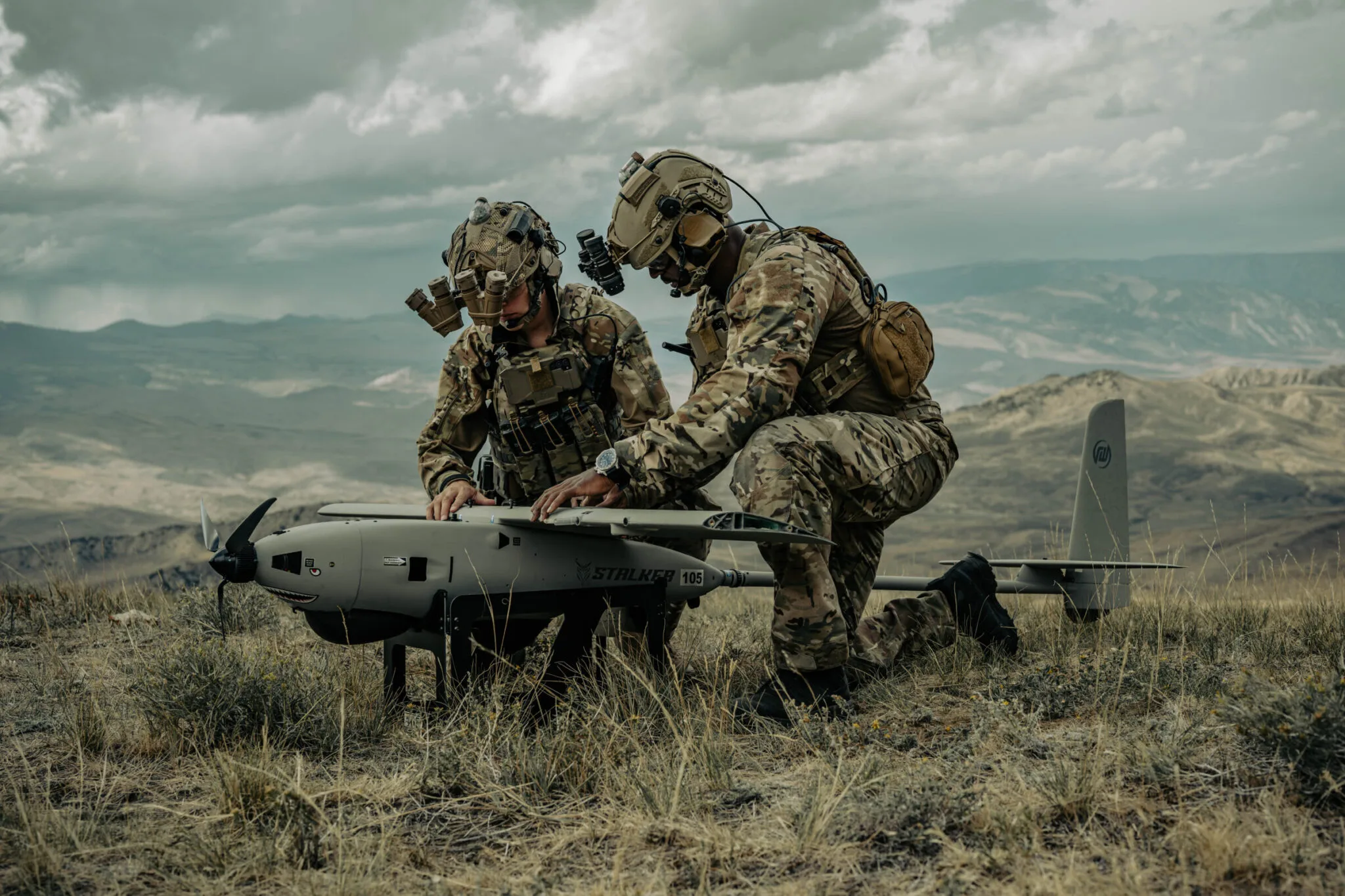
Redwire Corporation will deliver Stalker Group 2 Uncrewed Aircraft Systems (UAS) to the National Guard Bureau (NGB) under purchase orders worth approximately $13.8 million, the company announced on October 15, 2026. Guard instructors will use the aircraft to train soldiers for the Army’s new 15X Tactical UAS Specialist Military Occupational Specialty (MOS), with Camp Shelby, Mississippi, and Fort Indiantown Gap, Pennsylvania, named as key regional training sites.
The orders land as the Army consolidates drone operations and maintenance into a single career field. The 15X specialty combines the traditional UAS operator and maintainer roles, soldiers transferring from the legacy 15W operator and 15E repairer specialties were due to recertify under the new MOS by October, and the Army has cited plans for 2,000 to 3,000 15X soldiers. Redwire already supplies the active-duty schoolhouse: on May 20, 2026, the 1st Aviation Brigade at the U.S. Army Aviation Center of Excellence (AVCOE) placed a $15 million follow-on order, its third in eight months, for a recent total of $24.8 million supporting Advanced Individual Training (AIT) with the 2nd Battalion, 13th Aviation Regiment at Fort Huachuca, Arizona.
Stalker UAS Airframe, Endurance, and Payload Architecture
Redwire did not disclose which Stalker configuration the Guard will receive or how many air vehicles the orders cover. Publicly available specifications for the VXE30, or Block 30, baseline describe a fixed-wing Vertical Takeoff and Landing (VTOL) aircraft with a 4.9-meter (16-foot) wingspan and a 22-kilogram (49-pound) maximum takeoff weight. Power comes from a propane-fed solid oxide fuel cell or rechargeable batteries, yielding more than eight hours of endurance, a 15,000-foot ceiling, a communications range of up to 160 kilometers, and a top speed above 50 knots, according to manufacturer data.
The aircraft launches and recovers autonomously, and a two-person crew can assemble the complete system in about 20 minutes. A Modular Open Systems Approach (MOSA) supports multi-mission payloads, typically Electro-Optical/Infrared (EO/IR) sensors for day and night target tracking. A Havoc configuration introduced in 2024 doubles the endurance and payload capacity of the base aircraft, according to the manufacturer.
Those attributes translate directly into training value. VTOL operation removes the need for launchers or prepared strips at Guard ranges, long fuel cell sorties give instructors realistic mission timelines, and the open payload architecture lets students rehearse the integration and fault-isolation tasks central to the new specialty. Earlier Stalker variants, originally marketed by Lockheed Martin, were used by Army and Marine Corps special operations forces in Afghanistan to detect improvised explosive devices. The line now sits with Redwire following its $925 million acquisition of Edge Autonomy, completed on June 13, 2025.
How the 15X MOS Merges Drone Operators and Maintainers
The Guard buy targets the gap the new specialty creates. Soldiers in the 15X field are expected to embed within maneuver formations to operate, maintain, and troubleshoot Group 1 through Group 3 systems at the tactical edge. Fielding a common Stalker fleet across regional sites allows the NGB to standardize instruction and replicate the multi-domain conditions soldiers will meet in brigade and lower-echelon units.
Joshua Stinson, Co-President and Chief Growth Officer at Redwire Defense Tech, said the Guard needs operators “trained on combat proven aircraft that are ready to field.”
The airframe also ties training to operational procurement. In August 2025, the Army selected the Stalker Block 35X alongside AeroVironment’s P550 as initial Long Range Reconnaissance (LRR) systems, delivering organic Reconnaissance, Surveillance, and Target Acquisition (RSTA) to maneuver battalions under the Transformation in Contact 2.0 initiative. Separately, the Portfolio Acquisition Executive Robotic Autonomous Systems (PAE RAS) placed more than $41.5 million in Stalker orders for the Marine Corps across the first two quarters of 2026, including the service’s first acquisition of the Advanced Navigation version of the Stalker Block 30.
Analysis: The dollar value is modest, but the order means Reserve Component 15X soldiers will learn on the same Group 2 family the active Army has selected for battalion-level reconnaissance. That commonality shortens the conversion curve when Guard brigades mobilize alongside active units, and it gives Redwire an installed training base across both components. The limiting factor is breadth: a specialty spanning Group 1 through Group 3 aircraft cannot be built around one platform, so the Guard will still need access to smaller attritable systems and larger Group 3 aircraft to graduate fully qualified specialists.
Redwire has not released airframe quantities, the variant ordered, or a delivery schedule, and no Guard training sites beyond Camp Shelby and Fort Indiantown Gap have been named. Indicators to watch include whether additional Regional Training Institutes receive Stalker systems, the pace at which the first Guard 15X cohorts certify, and whether follow-on LRR production decisions widen the Stalker footprint across Army maneuver battalions.