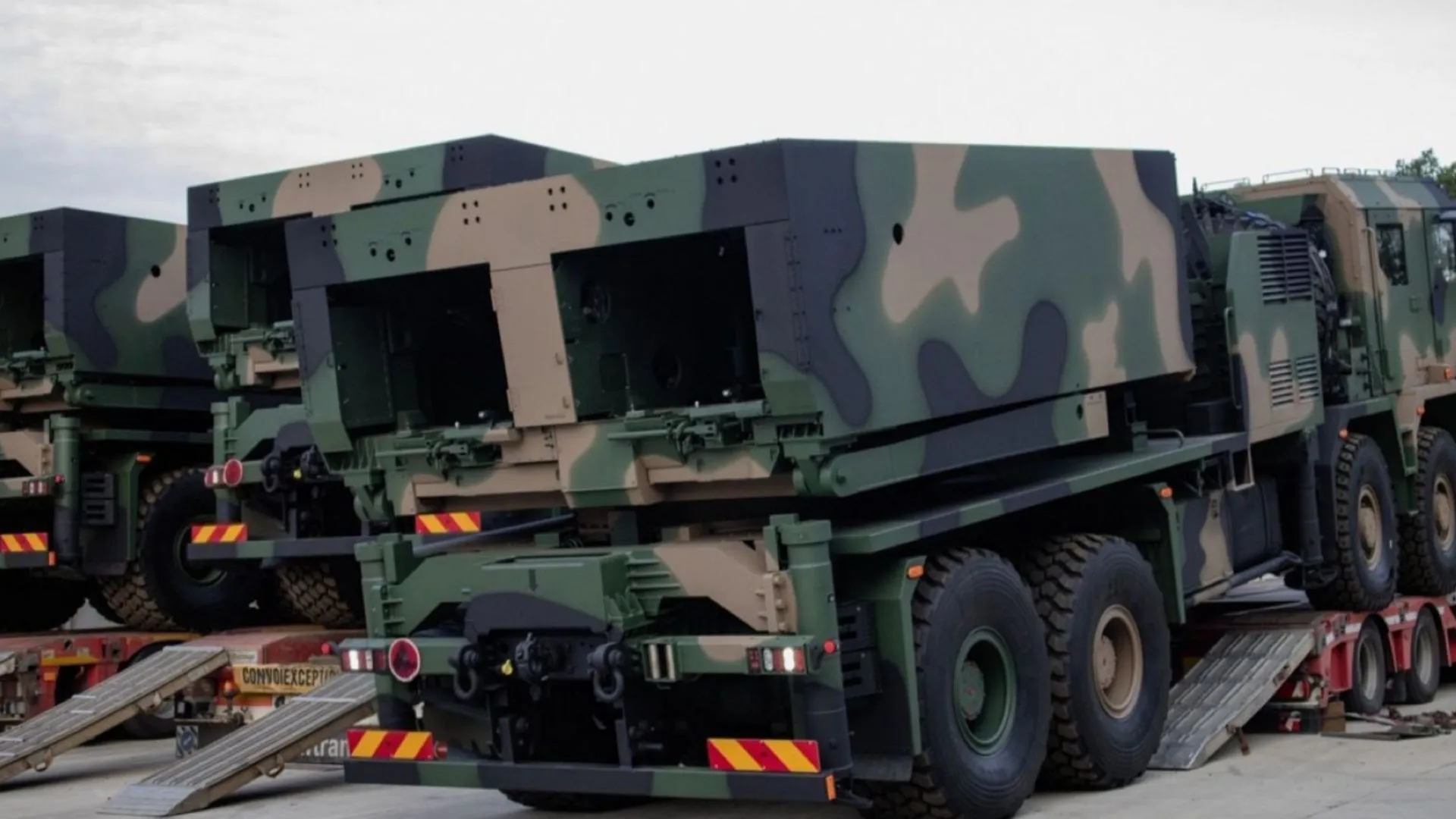
Poland’s Armament Agency said this week that deliveries of Homar-K multiple rocket launchers under its first executive contract, signed in 2022 for 218 launchers, are nearing completion after another batch of fully integrated systems reached the 11th Armored Cavalry Division. The agency said it will next begin executing the second executive contract, signed in April 2024, for 72 additional launchers.
Homar-K is the Polish adaptation of Hanwha Aerospace’s K239 Chunmoo, ordered under a framework agreement signed on October 19, 2022, and a first executive contract signed on November 4, 2022, worth $3.55 billion net. That contract covered 218 launcher modules, logistics and training packages, and a stockpile of CGR-080 guided rockets and CTM-290 tactical ballistic missiles. The agency had previously said the contract would run through the end of 2027, which puts deliveries ahead of schedule. The program replaces Cold War-era 122 mm rocket artillery and complements Poland’s 20 Homar-A launchers, the M142 High Mobility Artillery Rocket System (HIMARS).
Homar-K Launcher Deliveries Near Completion Under 2022 Contract
The agency did not disclose the size of the latest batch, the receiving regiment, or a cumulative total. The 11th Armored Cavalry Division fields two artillery regiments that took Homar-K into service in 2025: the 5th Lubusz Artillery Regiment in Sulechów and the 23rd Silesian Artillery Regiment in Bolesławiec, which assigned the system to its 3rd Rocket Artillery Battalion. Earlier recipients include the 18th Mechanized Division’s artillery at Nowa Dęba, which received the first Polish-integrated launcher in November 2023, and the 1st Masurian Artillery Brigade, equipped from August 2024. Figures the agency released in December 2025 counted 156 modules delivered from South Korea, 108 of them already assembled into complete launchers.
Each module ships from South Korea to Huta Stalowa Wola (HSW), which mounts it on a Jelcz P882.57 TS T45 8×8 chassis with an armored cab and integrates the WB Group Topaz automated fire control system, Fonet digital vehicle communications, and Radmor radios. The launcher carries two pods. Each holds six 239 mm CGR-080 guided rockets with an 80 km range and a manufacturer-stated circular error probable of 15 meters, or one 600 mm CTM-290 tactical ballistic missile with a 290 km range. A full load is 12 CGR-080s, two CTM-290s, or a mix of six and one. Polish crews fired a CGR-080 to 79.6 km during the Polish-Danish Baltic Shield exercise in May 2026, the longest Homar-K shot recorded in Poland.
Publicly available specifications indicate the M142 HIMARS carries a single pod with six 227 mm guided rockets or one Army Tactical Missile System round. Homar-K therefore doubles the precision salvo per vehicle, which compounds at battalion level: each battalion fire module fields 18 launchers, and the 290 launchers on order support 16 battalions plus two systems for the Missile Forces and Artillery Training Center in Toruń.
Second Executive Contract Moves Homar-K Production Into Poland
The second contract, worth about $1.6 billion net, covers 72 launcher modules, several thousand CGR-080 and CTM-290 rounds, logistics and training packages, and transfer of production and support technology, with deliveries scheduled from 2026 to 2029, bringing the fleet to 290 launchers. Polish officials have said the first 12 modules will be built in South Korea and the remaining 60 in Poland. Hanwha Aerospace’s chief executive had previously described the contract as conditional on financing; the agency’s statement indicates it is now moving into execution.
Localization has advanced on three further tracks. On December 29, 2025, the agency signed a third executive contract, worth about PLN 14 billion ($4 billion), for more than 10,000 CGR-080 rockets to be built in Gorzów Wielkopolski by Hanwha WB Advanced System, a joint venture 51 percent owned by Hanwha Aerospace and 49 percent by WB Electronics, with deliveries from 2030 to 2033. On May 30, 2026, a contract worth about PLN 19 billion, financed through the European Union’s Security Action for Europe (SAFE) loan instrument, ordered roughly 1,000 accompanying vehicles from the PGZ-WWR consortium, including artillery ammunition vehicles, battery and battalion command vehicles, mobile communications nodes, and command post modules. On September 8, 2026, Hanwha signed a sub-license at the MSPO exhibition in Kielce transferring rights to produce selected spare parts and assemble launcher modules in Poland for all 290 launchers. Both agreements also cover transport-launch pods that will let Homar-K fire Polish-made 122 mm unguided rockets with a range of up to 40 km.
Analysis: Poland is turning an off-the-shelf import into a domestically sustained rocket artillery enterprise, and the sequencing exposes the main risk. Launcher deliveries under the first contract will close years before Polish-built CGR-080 rockets arrive in 2030, leaving the force dependent on stocks bought from South Korea in the interim. The vehicle order matters as much as the launchers, because ammunition and command vehicles are what turn individual launchers into battalions able to sustain fire. Operationally, CTM-290 range from positions in northeastern Poland covers Kaliningrad Oblast in depth, giving NATO’s eastern flank a land-based deep-strike layer alongside HIMARS.
The agency has not set a date for the final handover under the first contract. The next milestones are delivery of the 12 South Korean-built modules under the second contract, the first Polish-assembled modules from HSW, construction of the Gorzów rocket plant, and qualification of the 122 mm pods. Whether the 60 domestic modules hold the 2029 schedule will be the clearest test of how far Homar-K localization has progressed.