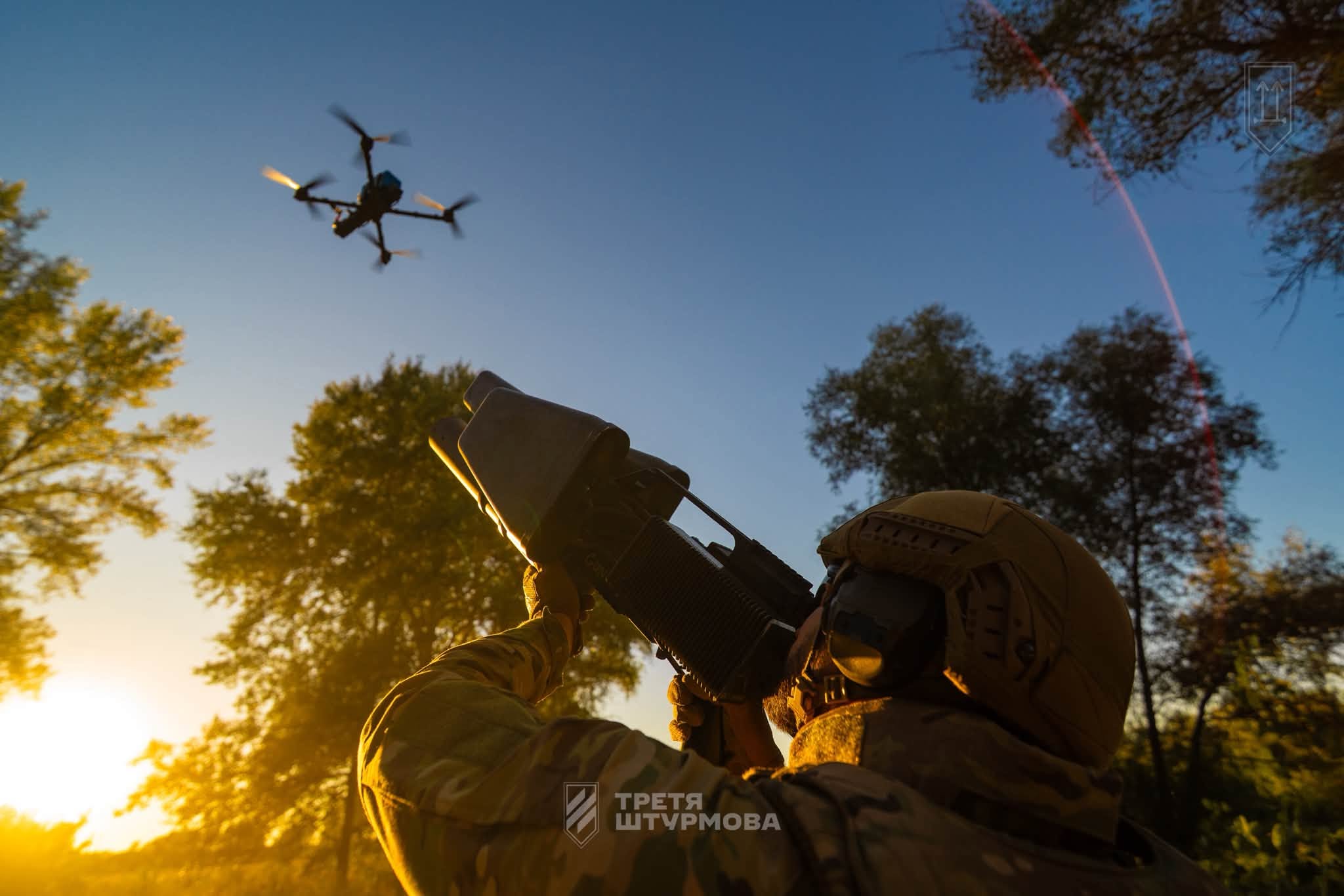
Ukraine’s Ministry of Defense said on September 26, 2026, that the electronic warfare (EW) platoon of the 2nd Assault Battalion, 3rd Assault Brigade, is training soldiers to operate handheld anti-drone rifles that jam Russian first-person-view (FPV) drones over Ukrainian infantry positions. In a post illustrated with photographs credited to the 3rd Assault Brigade, the ministry said clear skies above the battalion’s lines were “not the weather,” crediting the platoon’s electronic countermeasures.
The 2nd Assault Battalion sits within the 3rd Assault Brigade, now a core formation of Ukraine’s 3rd Army Corps, which grew toward a five-brigade structure starting in 2025. The battalion has seen recent combat: in August 2026 its troops took part in operations that recaptured the village of Novomykhailivka in Donetsk Oblast, working alongside the Artan reconnaissance unit of Ukraine’s Defense Intelligence directorate. The training push comes as Russian drone saturation of the front remains extreme; Ukraine’s General Staff reported more than 10,000 Russian kamikaze drone sorties in a single 24-hour period in early September 2026, underscoring why individual battalions are building organic counter-drone capacity rather than relying solely on higher-echelon air defense.
Inside Ukraine’s Anti-Drone Rifle Training Pipeline
The rifles the EW platoon is training with belong to a class of man-portable, battery-powered jammers that Ukrainian units have fielded since the early stages of the full-scale invasion. Publicly available specifications for the systems most widely documented in Ukrainian service, including Lithuania’s NT Service EDM4S, known as SkyWiper, indicate a weight of roughly 5.5 to 6.5 kilograms, a length near 1,050 millimeters, and an effective jamming range of 3 to 5 kilometers; the Ministry of Defense’s release did not specify which model the 2nd Assault Battalion’s platoon uses. Systems in this class typically flood the 433 MHz, 900 MHz, 1.2 GHz, 2.4 GHz, and 5.8 GHz bands used for FPV control links and video downlink, along with GPS and GLONASS navigation frequencies, forcing a targeted drone to lose control, abort its attack run, or trigger a fail-safe return-to-home routine.
The training reflects a broader institutional push. Ukraine’s Ministry of Defense confirmed in January 2026 that cadets at the National Army Academy named for Hetman Petro Sahaidachnyi now train on anti-drone rifles as part of officer instruction, covering electronic warfare operation, threat identification, and unit coordination under drone attack. Ukraine has also extended basic recruit training to 51 days and 402 hours, adding a dedicated block on countering FPV threats before soldiers earn their rifleman qualification. Ukraine is pushing this instruction down to platoon level, rather than concentrating it in specialized electronic warfare companies, to give infantry the ability to blind an attacking drone within the first seconds of detection, when reaction time determines survival.
Fiber-Optic Drones Test the Limits of Electronic Jamming
The rifle’s utility has a hard boundary. Fiber-optic FPV drones, introduced by Russia in spring 2024 and fielded by Ukraine within months, guide the aircraft through a spool of optical cable instead of a radio link, so no jamming rifle can affect them regardless of power output. By February 2026, Ukraine’s armed forces had cleared more than 80 domestically built fiber-optic drone systems for frontline use, with strike ranges typically spanning 5 to 20 kilometers. Where radio-controlled FPVs remain jammable, fiber-linked drones are not, and Ukrainian units have responded by falling back on physical countermeasures: shotguns, rotating barbed-wire lines strung to snag or cut trailing fiber, and nets over trench lines and vehicles.
Ukraine’s state-run defense innovation platform, Brave1, disclosed in June 2025 that it had developed a NATO-codified anti-drone rifle cartridge designed to let ordinary infantry rifles engage FPV drones at standoff range, reducing reliance on the 12-gauge shotguns that have become standard issue for close-in defense. The cartridge disperses fragments after a set flight distance, giving a rifleman a wider margin for error than a jamming rifle, which requires line of sight, engages one target at a time, and offers no answer to a fiber-guided attacker.
Analysis: The platoon-level rollout the Ministry of Defense described marks a deliberate shift in how Ukraine organizes counter-drone defense: away from centralizing jamming assets in dedicated electronic warfare units and toward distributing that capability to the infantry formations that face the threat first. That approach measurably improves survivability against radio-controlled FPVs, which still make up the bulk of daily Russian drone sorties. But it does not close the gap that fiber-optic drones have opened, since their immunity to jamming has already forced both armies toward kinetic countermeasures that predate the electronic warfare era entirely. For NATO militaries studying the Ukrainian front, the lesson is not that jamming rifles are obsolete, but that no single countermeasure layer is sufficient; credible force protection now requires infantry trained and equipped across the full spectrum, from RF jamming to shotguns to anti-drone ammunition, matched to the specific guidance method of the threat overhead.
Ukraine has not said whether it will standardize the 2nd Assault Battalion’s model across the 3rd Army Corps or leave it as a battalion-level initiative. Open questions include how quickly Brave1’s anti-drone cartridge reaches frontline stocks, whether additional units receive dedicated EW platoons rather than relying on centralized electronic warfare companies, and how Russian forces adapt their own drone employment, including further fiber-optic fielding, in response. NATO’s Security Assistance Group for Ukraine has flagged counter-drone electronic warfare as a standing focus area for 2026, suggesting Western observers will track the program closely regardless of how Kyiv scales it.