Ukraine is reconfiguring its fleet of US-supplied High Mobility Multipurpose Wheeled Vehicles (HMMWVs), fitting the 1980s-era light tactical vehicle with anti-drone screens, electronic warfare (EW) jammers, repurposed Soviet air-to-air missiles and satellite-linked remote-control kits. The vehicle’s rising frequency in Russian Ministry of Defense strike reports points to heavier frontline use, as Ukrainian drone teams and logistics units lean on the platform’s mobility, payload margin and tolerance for modification.
The United States committed more than 5,000 HMMWVs to Ukraine through military aid packages between 2022 and 2024, as the US Army shifted frontline roles to more heavily protected vehicles and retained a smaller HMMWV fleet for support missions. Open-source loss tracking based on visual confirmation has documented 760 Ukrainian HMMWVs destroyed, damaged, abandoned or captured since February 2022. That figure suggests a large share of the delivered fleet remains available, and Ukraine is now converting that inventory into roles the vehicle was never designed to fill.
Why the Ukraine HMMWV Remains Relevant for Forward Drone Teams
AM General developed the HMMWV in the early 1980s to replace the M151 jeep and several other light vehicles with a single multirole chassis, designed for the mixed terrain of Central and Eastern Europe. AM General specifications indicate that current M1151 and M1152 variants use a 6.5-liter turbocharged V8 diesel rated at roughly 190 hp, a four-speed automatic transmission, four-wheel drive and 17.2 inches of ground clearance, with a gross vehicle weight of 12,100 lb.
Up-armored variants defeat small-arms fire and artillery fragmentation but offer limited protection against mines and roadside bombs, the vulnerability that drove US forces toward Mine-Resistant Ambush Protected (MRAP) vehicles in Iraq and Afghanistan.
Those characteristics map directly onto Ukraine’s current tactical requirement. Forward drone teams, typically two to four soldiers, must move unmanned aircraft, batteries, ground control stations, antennas and supplies between firing positions, then relocate quickly before Russian counter-battery fire or reconnaissance drones find them. The HMMWV carries that load on roads and across mud, slopes and treelines, and its compact footprint is easier to conceal near operating positions than an MRAP or armored personnel carrier. The same mobility supports resupply runs to forward positions and casualty evacuation.
Cages, Jammers and Missiles: How Ukraine Rearms the Humvee
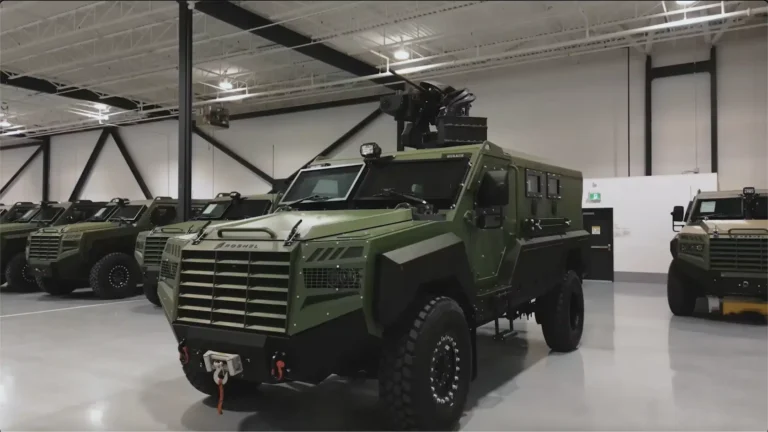
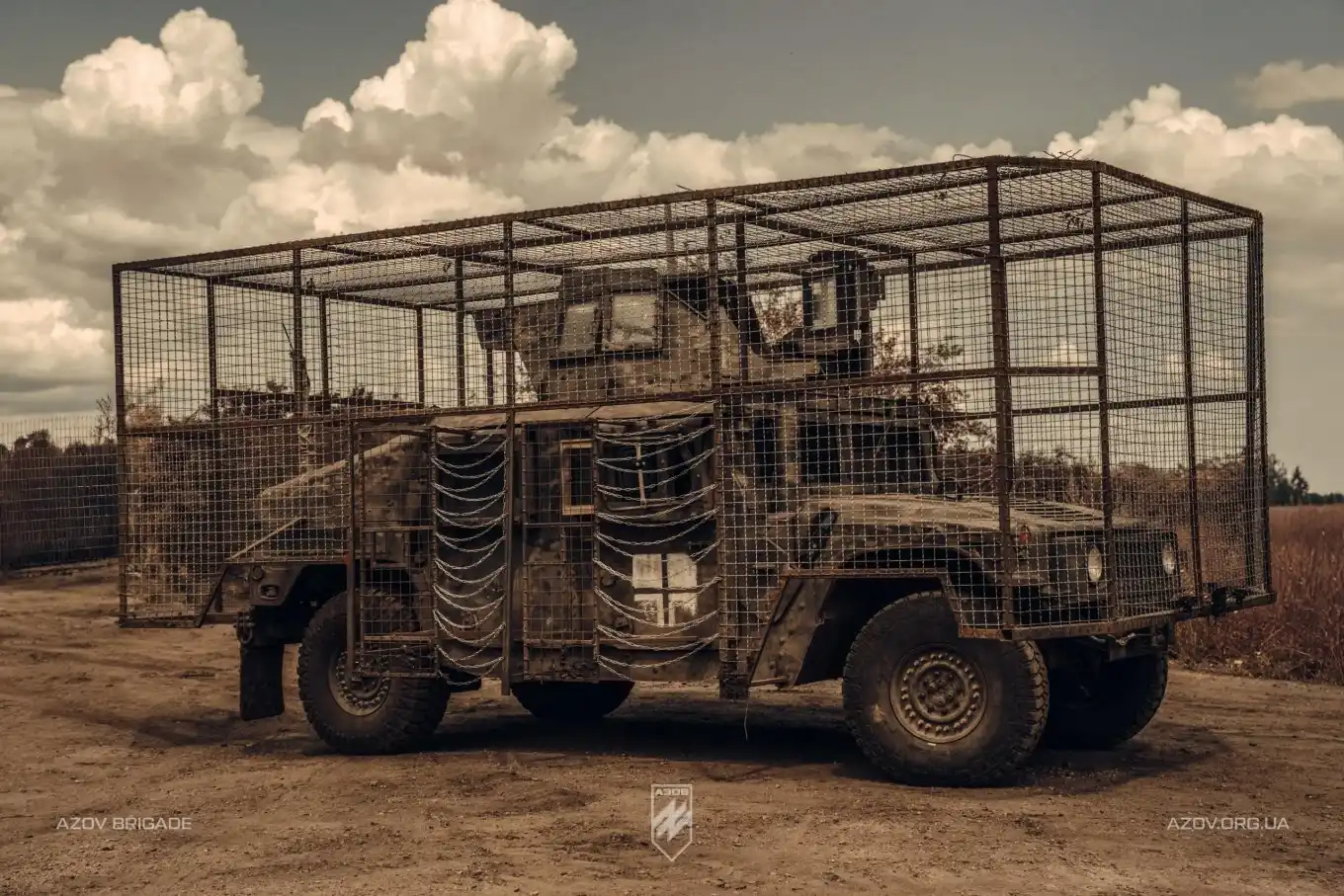
Ukrainian units have hardened the HMMWV against the drones that now account for much of the equipment damage on the front. Field modifications include added armor, welded metal cages and mesh screens designed to detonate or snag first-person-view (FPV) drones before they reach the cabin or engine bay. Some vehicles carry rooftop EW systems that detect incoming drones and jam their control and video links. These measures improve survivability against small FPV drones but provide little protection against larger strike drones and artillery. Many HMMWV strikes shown in Russian Ministry of Defense footage appear to involve artillery rather than FPV drones, which may reflect the effectiveness of the screens and jammers.
The modular cargo bed has also made the HMMWV a weapons carrier. In May 2025, Ukraine’s 3rd Separate Assault Brigade presented the Dragon H73, a short-range air defense vehicle with a rotating twin-rail launcher for Soviet-era R-73 (NATO: AA-11 Archer) infrared-guided missiles, paired with target detection equipment and roof-mounted EW. The fire-and-forget seeker lets the crew launch and displace without guiding the missile to impact. The ground-launched engagement range has not been disclosed and is likely shorter than the air-launched figure. Separately, Ukrainian formations, including a National Guard project, have fielded HMMWV-mounted launchers for 122 mm rockets. Neither configuration is yet in widespread service.
Kaban Kit Turns the HMMWV Into a Satellite-Linked UGV
The newest adaptation removes the driver. Ukrainian company Drone Fight Group developed Kaban, a bolt-on remote-control system that installs without structural changes and lets operators switch between remote and manual driving. According to the developer, the kit relies primarily on a Starlink satellite link and gives the operator control of steering, lights, infrared illumination and searchlights, along with two-way audio, a camera suite and data from the vehicle’s onboard computer. If the link drops, the vehicle stops automatically.
Drone Fight Group says it has delivered three converted HMMWVs, to the 3rd Army Corps, the 429th Separate Unmanned Systems Regiment Achilles and the 49th Brigade, with development supported by the Brave1 defense technology cluster. The intended missions are ammunition resupply, equipment transport and casualty evacuation on the most exposed route segments. Converting an existing fleet is faster and cheaper than procuring purpose-built unmanned ground vehicles (UGVs), although the kit’s resilience against Russian satellite-link jamming has not been demonstrated publicly.
Analysis: As Forbes contributor Vikram Mittal argued, Ukraine’s use of the HMMWV challenges the assumption that survivability scales with armor and weight. Heavier protected vehicles still fall to inexpensive drones, while costing more to buy, sustain and replace. In a high-attrition war, a large fleet of simple, repairable vehicles that can absorb new armor kits, EW, missiles and autonomy packages may deliver more combat value than a smaller fleet of specialized platforms. International buyers appear to agree: Israel signed a contract worth about $150 million with AM General on July 20, 2025, for hundreds of new HMMWVs and spare parts, for troop transport, casualty evacuation, logistics and fire support. For US Army and NATO planners, the lesson concerns fleet mass and adaptability as much as the vehicle itself.
The next indicators to watch are whether Kaban moves beyond its first three vehicles into brigade-level use, whether the Dragon H73 configuration spreads across Ukrainian air defense units, and whether Kyiv can sustain spare parts for a fleet of more than 5,000 vehicles without new US aid packages. Taiwan, which received US approval in December 2025 for 39 M1152A1 HMMWVs as part of a High Mobility Artillery Rocket System (HIMARS) sale and, according to Forbes, ordered 38 vehicles in July 2026, will offer another data point on how the platform is being configured for a drone-saturated battlefield.