Airbus Helicopters has set a 50% cut in maintenance burden and single-pilot, low-level night flight as baseline targets for Europe’s next military helicopter, the company said on October 19, 2026, as the European Union-backed European Next Generation Rotorcraft Technologies (ENGRT) project moves through its second phase. Airbus expects the aircraft to fly before the end of the 2030s.
ENGRT is the EU’s technology track toward replacing and complementing current military helicopter fleets after 2040. Its first phase, funded with €40 million under the European Defence Fund (EDF) 2021 call, ran from December 2022 to the end of 2025. ENGRT II, selected under the EDF 2024 call, carries a €160 million budget, including up to €100 million from the EU, and kicked off in Brussels on January 29, 2026. Airbus Helicopters coordinates the 53-member consortium, with Leonardo as co-lead, on a three-year schedule that shifts the effort from research and technology to research and development.
ENGRT Military Helicopter Requirements: Survivability and Halved Maintenance
Ralf Weber, campaign manager at Airbus Helicopters, ties the requirement set directly to combat experience. “This is what we see in Ukraine,” he said, describing partner nations’ demand for higher crew and airframe survivability in zones exposed to enemy fire. Airbus frames the answer as a dense mission system, combining avionics, sensors and self-protection, built to cut pilot workload rather than add to it.
The flight benchmark is specific: single-pilot tactical flight at 30 feet above ground level and 130 knots, at night. Holding that profile without a second pilot demands automation, sensor fusion and decision aids able to absorb tasks two-pilot crews share today.
Sustainment carries equal weight. Airbus aims to reduce the maintenance burden by 50% compared with existing machines, relying on standard tools and the smallest possible logistics footprint. The target lands against a difficult record for Europe’s current medium fleet: Norway terminated its NH90 contract in 2022, and Australia withdrew its MRH90 fleet in 2023, ahead of schedule, with availability shortfalls weighing on both decisions. For forces planning dispersed operations from austere sites, maintenance hours per flight hour translate directly into sortie generation.
Weber also cites open system architecture (OSA), which speeds reconfiguration of mission equipment and changes how spares are replenished. He said European nations, the United States and NATO are all moving in that direction, making OSA a condition of allied interoperability rather than a design preference.
Compound vs Tiltrotor: How Racer and Leonardo Frame ENGRT II
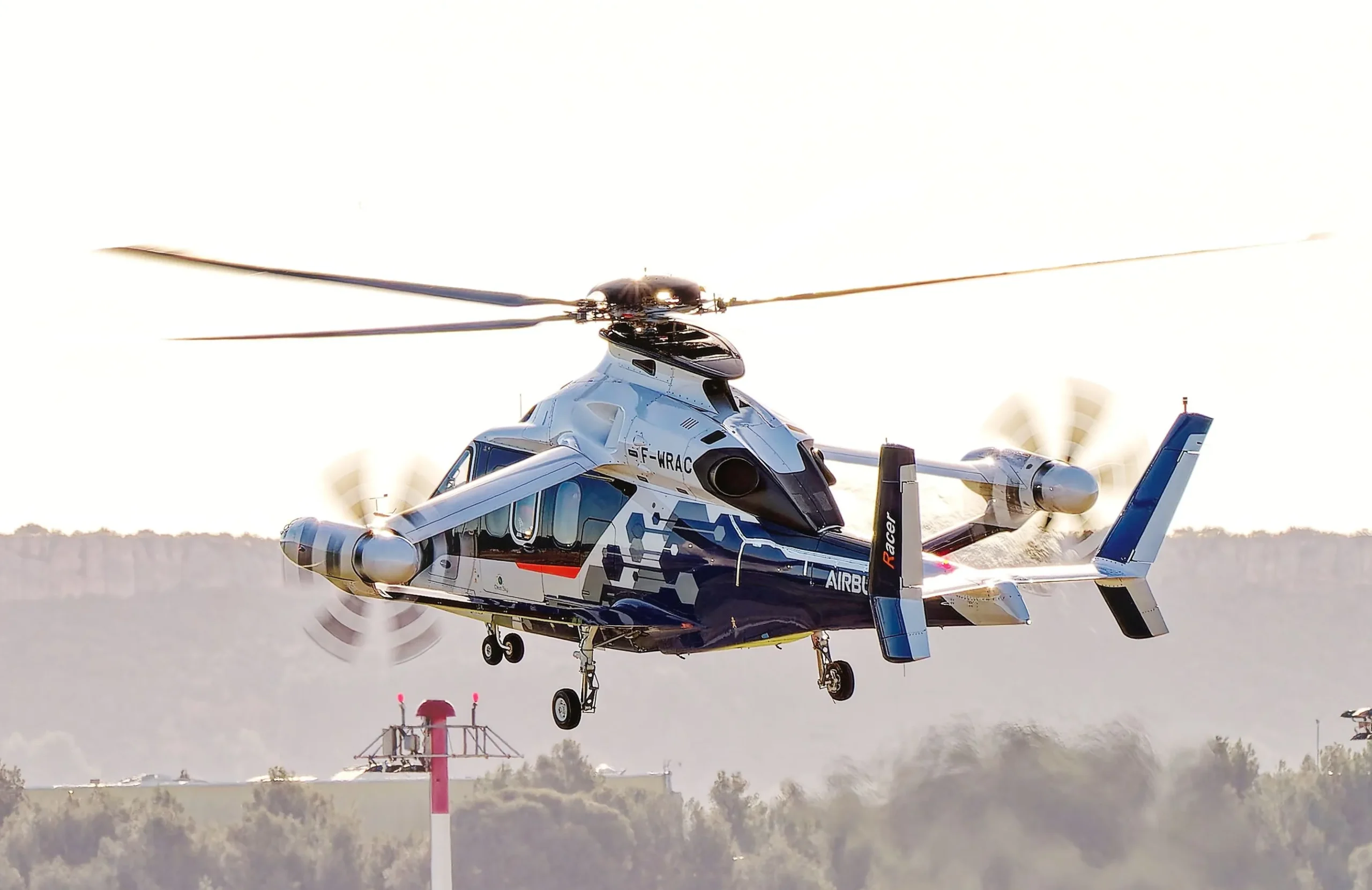
ENGRT II studies two airframe architectures to balance speed, range and payload. Airbus contributes a compound rotorcraft derived from its Racer demonstrator; Leonardo leads a tiltrotor configuration.
Racer, developed under the EU’s Clean Sky 2 research program, pairs a main rotor with a box wing carrying two lateral pusher rotors, powered by two Safran Aneto-1X turboshafts with an eco-mode that pauses one engine in cruise. Airbus reports a cruise speed of 440 km/h, roughly 238 knots, at 25% lower fuel burn than a conventional helicopter, plus 2g turns at 370 km/h and a 14-degree slope landing in its latest campaign. Leonardo brings tiltrotor experience from its AW609 civil program. Neither company has published performance targets for the ENGRT configurations themselves.
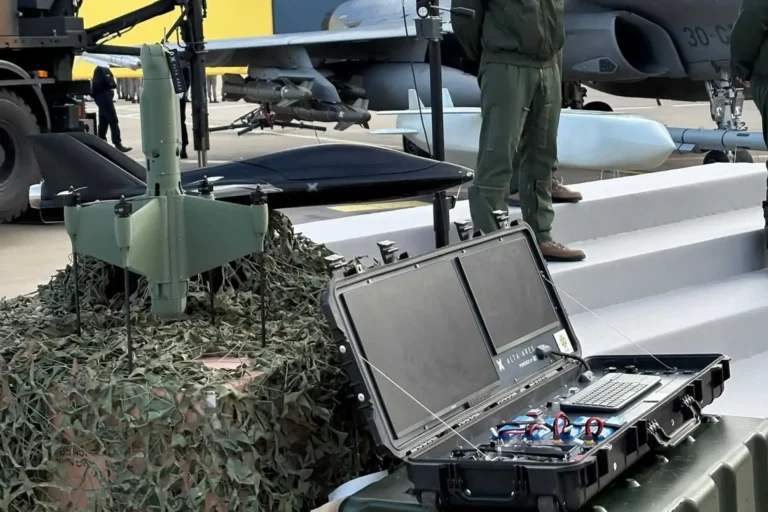
The digital work package reaches beyond the airframe: cognitive cockpits and artificial intelligence (AI)-driven interfaces, crewed-uncrewed teaming, secure communications for jammed environments, and integrated logistic support. Weber described the teaming goal as moving from one helicopter paired with one drone to one aircraft controlling multiple drones while staying connected to the battlefield network.
Phase one set a technology readiness level (TRL) baseline for OSA and drone teaming; phase two is meant to raise it. Weber said the consortium should have an OSA test bench by the end of ENGRT II, replacing paper studies with a physical integration environment. On the future of crewed vertical lift, he was categorical: as long as forces move troops, a pilot on board remains preferable.
ENGRT II and NATO’s NGRC: Two Tracks, One Multirole Requirement
Airbus presents ENGRT as Europe’s response to NATO’s Next Generation Rotorcraft Capability (NGRC), managed by the NATO Support and Procurement Agency (NSPA) to replace medium multirole helicopters reaching end of life from 2035. The two efforts share a purpose but not a membership. NSPA issued the NGRC concept design request for proposals on July 31, 2026, for Canada, France, Germany, Italy, the Netherlands and the United Kingdom. The request went to four pre-qualified bidders, each allowed to offer up to two concepts, with bids due in August 2027 and evaluation planned by the end of 2027. Boeing has since withdrawn from the competition, leaving three bidders.
ENGRT II draws on a different coalition. Airbus lists 12 supporting EU member states: Austria, Belgium, Denmark, Finland, France, Germany, Greece, Italy, Latvia, the Netherlands, Poland and Spain; the European Commission counts 13. The United Kingdom and Canada sit outside the EU framework, while eight of the 12 ENGRT backers Airbus lists hold no seat in the current NGRC phase.
NGRC parameters set the bar any European design must clear: a cruise speed of at least 220 knots, with targets above 250 knots, a unit flyaway cost target of €35 million, and a first delivery ideally by 2038.
Analysis: The calendar is the core problem. NSPA expects to identify qualified NGRC options by the end of 2027, while ENGRT II runs into early 2029, so Airbus and Leonardo will submit NATO concept designs before the EU-funded maturation work, including the OSA test bench, is complete. That positions ENGRT as a technology feeder, both for NGRC bids and, as Weber acknowledged, for upgrades to current Airbus rotorcraft. The compound-versus-tiltrotor split between Europe’s two helicopter primes adds a second fault line: without convergence, Europe risks funding two architectures while NGRC nations narrow their choice.
Next come NGRC bids in August 2027, NSPA’s evaluation at the end of 2027 and the ENGRT II test bench. Weber said the aircraft’s definition depends on talks between the European Commission and partner nations. Development funding, configuration choice and whether ENGRT and NGRC converge on one platform remain open ahead of a first flight targeted before 2040.