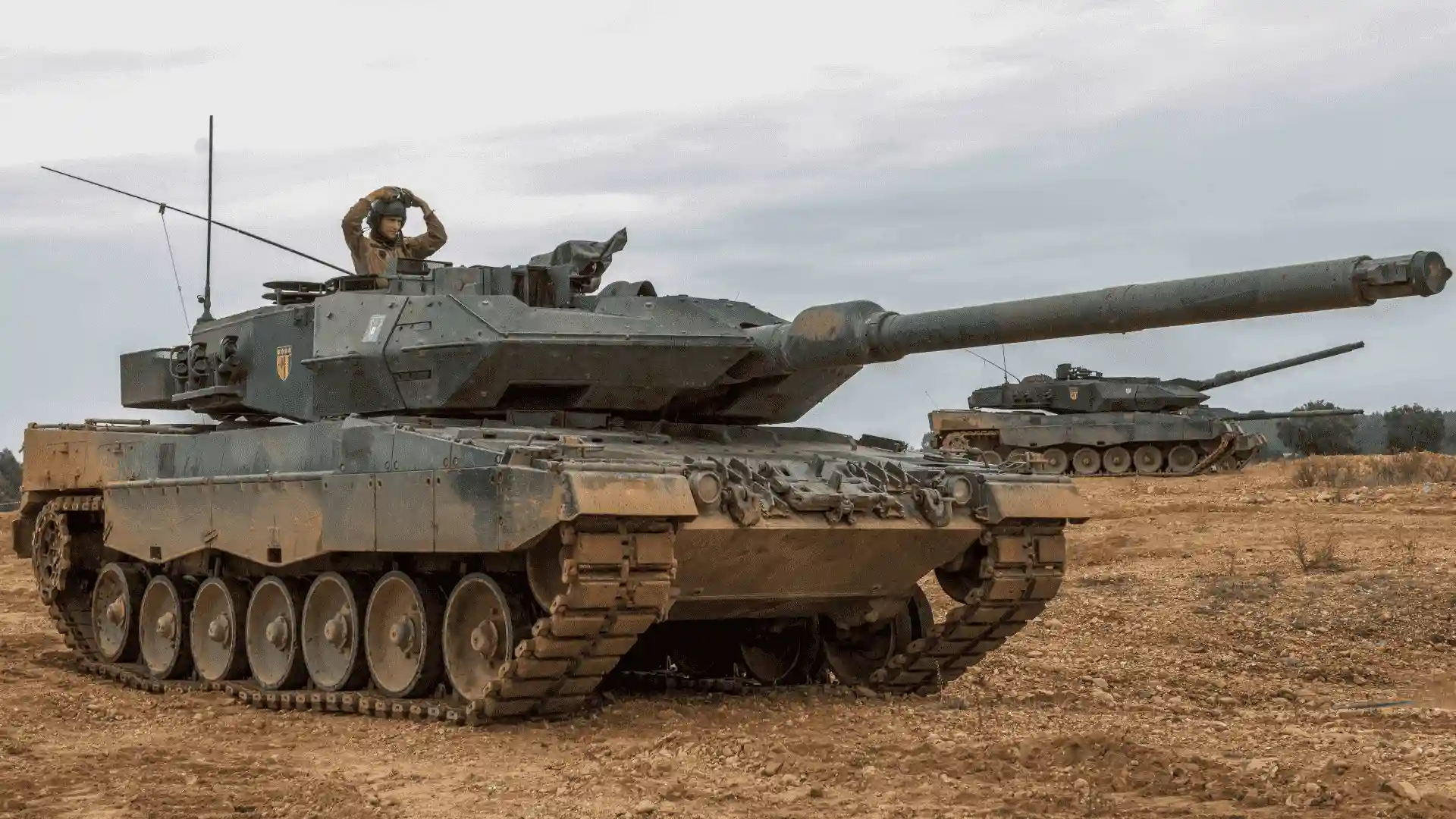
Portugal’s Council of Ministers has authorized the Portuguese Army to spend up to €82.35 million, excluding value-added tax (VAT), on a Leopard 2A6 midlife upgrade for its main battle tank fleet. Resolution No. 210/2026, approved October 22, 2026, and published November 2 in the official gazette, Diário da República, clears a multiyear commitment through 2031 covering general overhaul, modernization work, and a logistics package of diagnostic tools, special equipment, technical manuals, and training.
The decision answers a sustainment problem the government now states in official terms. According to the resolution, several components of the fleet, in Portuguese service since 2008, have become obsolete, and lead times for repairs, parts, and specialist maintenance have grown substantially since 2023 because of ongoing conflicts. Those shortages pushed the Army to join the Leopard Project of the NATO Support and Procurement Agency (NSPA) Land Combat Vehicles Support Partnership in January 2026, a framework the resolution also ties to the upgrade. Portugal acquired 37 former Dutch Leopard 2A6s in 2008 and transferred three to Ukraine in 2023, leaving 34 tanks on public counts.
How the Leopard 2A6 Midlife Upgrade Funding Is Structured Through 2031
The ceiling combines two sources. The Military Programming Law (LPM) provides €56.85 million for 2026 to 2031, and the Army adds €25.5 million from its 2026 state budget allocation to put more tanks at operational readiness. Annual spending, before VAT, is capped as follows:
- 2026: €26 million
- 2027 and 2028: no allocation
- 2029: €14,199,500
- 2030: €24,900,500
- 2031: €17.25 million
Unspent balances can roll into later years. The 2029 to 2031 tranche totals €56.35 million, about 68 percent of the program. The resolution bars any reinforcement from the provisional allocation or other centralized Finance Ministry funds and states that the commitment does not justify additional spending room for 2027 to 2031.
The initial scope appears partial. The contract may reference an extension to the entire fleet, but only with separate prior spending authorization. The resolution does not state how many tanks the first phase covers, name a contractor, or set a delivery schedule.
The program has slipped and grown for years. Originally planned for 2019 to 2024, it moved to 2026 to 2030 at approximately €46 million, and the LPM implementation report for 2020 linked the delay to lower fleet availability. The LPM adopted in 2023 then raised the line to €55.4 million, slightly below the €56.85 million the resolution now cites. Separately, Germany agreed in November 2023 to fund about €20 million of KNDS Deutschland refurbishment work on 14 Portuguese tanks as partial compensation for the Ukraine transfer.
Published Army Priorities Point to Turret, Sensor, and Power Upgrades
The resolution lists no technical configuration, saying only that the work will combine overhaul with upgrades driven by obsolescence management and operational requirements. Seven priorities selected for the upgrade were published before the authorization in Atoleiros, the journal of the Portuguese Army’s Mechanized Brigade, according to a 2024 open-source summary. The first replaces analog elements of the E-WNA electric gun and turret drive, the fire control system, and the commander’s control unit with digital equipment. The E-WNA has been the fleet’s leading source of faults, largely from overheating, which explains the second priority, a turret cooling system. Ultracapacitors would shield turret electronics from electrical faults, and an auxiliary power unit would run the turret and its electronics with the main engine off, a direct gain for silent watch and fuel consumption.
The remaining items are a new fire suppression system extended to the crew compartment, Hensoldt Spectus front and rear driver sights, and replacement of the EMES 15 A2 gunner’s sight and PERI R17 A2 commander’s sight with ATTICA thermal variants. Those plans included neither additional armor nor the L/55A1 gun. Whether they survive contract negotiation is unknown. Reporting in January 2026 cited a broader Leopard 2A7+ target, and the Army has studied an active protection system without any public decision.
Publicly available specifications indicate that the baseline tank carries a 120 mm Rheinmetall L/55 smoothbore gun with 42 rounds and a 1,500 hp MTU MB 873 Ka-501 diesel, at a combat weight of roughly 60 to 62 tonnes. The planned package would leave that firepower and mobility baseline essentially unchanged.
Analysis: The resolution reads as a readiness measure first and a capability upgrade second. Portugal is buying availability for a small fleet that already carries NATO tasks, including five Leopard 2A6s deployed with the Spanish-led multinational brigade in Slovakia. The NSPA partnership gives a 34-tank operator access to qualified maintenance providers and a route to the upgrade it would struggle to replicate alone. The funding curve is the main exposure: no new money is set for 2027 or 2028, so any spending in those years depends on unspent 2026 funds, and most of the budget arrives only from 2029. That leaves the program vulnerable to cost escalation and component lead times, and the resolution rules out centralized reinforcement.
The next milestones are the contract award, disclosure of the first-phase tank count, and the final technical baseline. Until the contract terms are public, neither the cost per tank nor the expected gain in availability can be assessed.