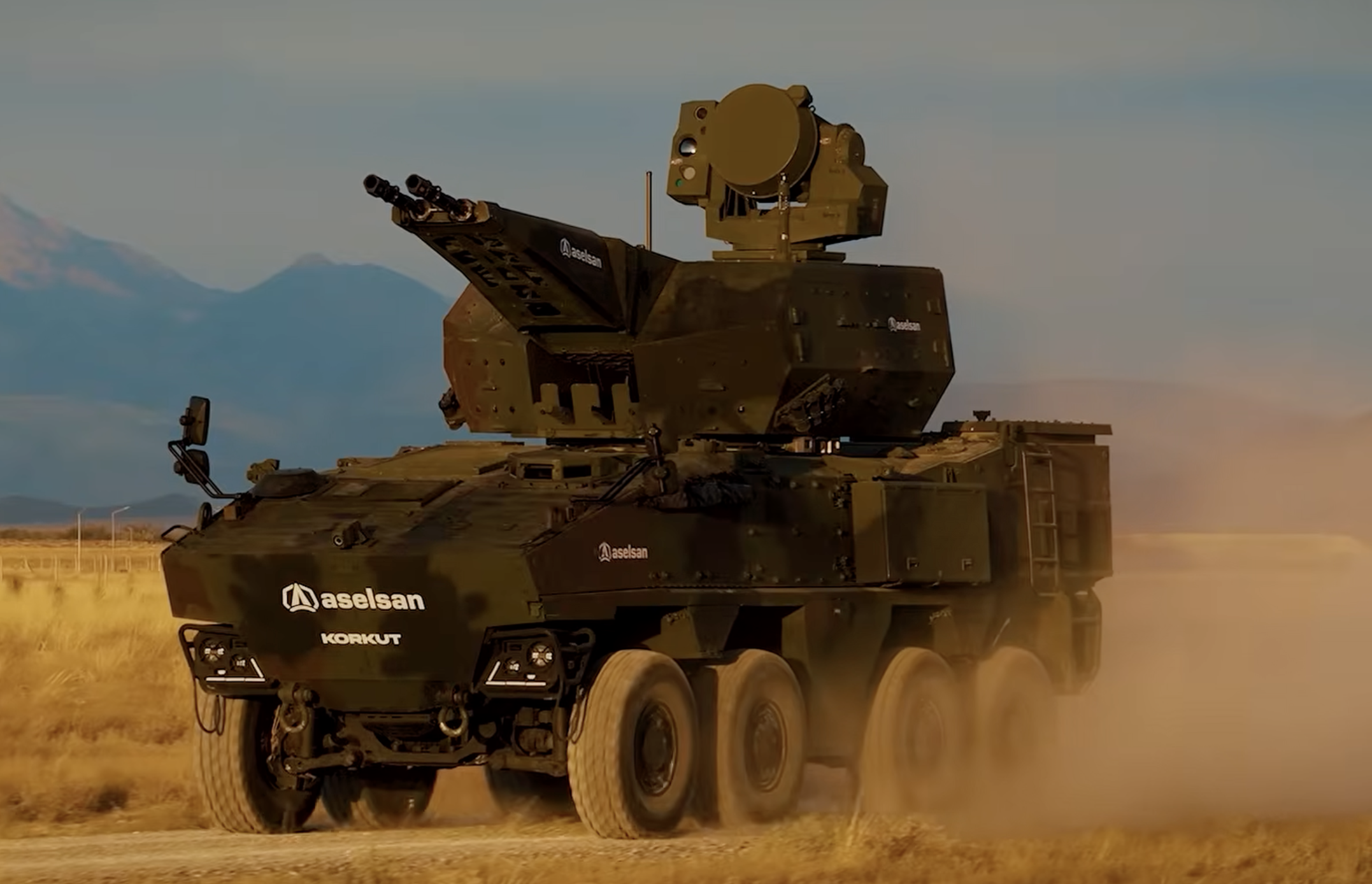
Turkish defense manufacturer ASELSAN said September 26, 2026, that its KORKUT 35 air defense gun system shot down multiple types of drones and struck a moving ground target while both the launcher and the target were in motion, in a live-fire demonstration at the Ministry of National Defense’s Karapınar Test and Evaluation Group Command in Konya watched by military delegations from 12 countries.
The trial extends a year-long export push for KORKUT, the gun-based layer of Turkey’s ÇELİKKUBBE, or Steel Dome, integrated air defense architecture. Demand for short-range, gun-based interceptors has grown globally as militaries confront swarms of low-cost kamikaze drones, a threat that has strained missile-based defenses built around interceptors costing far more than the targets they destroy. ASELSAN spent much of 2026 widening KORKUT’s international footprint, from a European production partnership to an unconfirmed appearance in Pakistan’s air defense inventory, making the Konya demonstration as much a sales pitch as a technology test.
Inside the KORKUT 35 Air Defense System’s Gun and Ammunition
The system fields twin 35 millimeter cannons, derived from the Oerlikon KDC-02 autocannon, that ASELSAN says fire a combined 1,100 rounds a minute, with an effective range of about 4 kilometers, or 2.5 miles. Each barrel feeds on ASELSAN’s ATOM programmable ammunition, a proximity-fused round that detonates near its target and scatters tungsten sub-projectiles rather than depending on a direct hit, a design meant to offset the difficulty of tracking small, erratically flying drones. The round sets its own fuze mechanically at the muzzle rather than relying on in-flight guidance, which ASELSAN says makes it resistant to electronic jamming, a property that matters as adversaries increasingly pair drones with electronic warfare support.
A KORKUT battery pairs one command-and-control vehicle, which searches for and tracks targets, with three gun vehicles that each engage an assigned target, according to the company. The command vehicle carries its own three-dimensional search radar, extending detection well beyond the guns’ four-kilometer engagement range and letting a single battery cue multiple gun vehicles onto separate targets. Fire control on each gun vehicle combines radar with electro-optical sensors, feeding a stabilized turret that ASELSAN says holds its aim while the vehicle itself is moving, the capability at the center of the Konya trial. Adding Stinger or Igla-S man-portable air defense missiles to the turret extends engagement range further. In the demonstration, KORKUT 35 engaged fixed-wing, delta-wing and mini and micro drones, with particular emphasis on kamikaze, or loitering, munitions built to dive into their targets, the threat category driving most recent interest in gun-based air defense.
From Tracked Original to Wheeled Export Configuration
KORKUT entered Turkish army service in 2016 in a tracked configuration built on the FNSS ACV-30 chassis, reaching a road speed of 65 kilometers an hour and retaining amphibious capability. ASELSAN introduced a wheeled version, integrated onto Otokar’s ARMA II 8×8 armored vehicle and commonly designated KORKUT 140/35, at the Eurosatory exhibition in Paris in 2024. The manufacturer lists the wheeled variant’s road speed at up to 105 kilometers an hour, trading some of the tracked model’s cross-country mobility for the ability to keep pace with faster wheeled formations. ASELSAN released footage of the wheeled KORKUT downing a first-person-view drone on the move in January 2026, a rehearsal for the capability demonstrated again at Konya. ASELSAN’s broader KORKUT family includes a towed 130/35 version and a naval GÖKDENİZ derivative, and since June 2025 a dedicated counter-drone variant, the KORKUT 100/25 SB, built around 25 millimeter guided airburst ammunition sized for micro-drone threats.
The wheeled configuration has become the centerpiece of ASELSAN’s export drive. In February 2026, the company agreed with the Czech Republic’s Excalibur International, part of Czechoslovak Group, to build a European joint venture integrating KORKUT onto a Tatra Force 6×6 truck for European and other international customers. In September 2026, a KORKUT variant appeared among the air defense systems Pakistan’s air force put on public display, though neither ASELSAN nor Pakistani officials have specified which configuration Pakistan received. ASELSAN has also paired the gun and ammunition with non-Turkish carriers before, including a demonstration on a United Arab Emirates-built 8×8 vehicle, underscoring a strategy of marketing KORKUT as adaptable to whatever chassis a customer already operates.
Analysis: The Konya demonstration is as much about positioning as capability. Layered air defenses built on expensive interceptor missiles have struggled with the economics exposed since 2022, as adversaries learned that cheap drones could force defenders to expend munitions costing many times more per shot. A jam-resistant gun system such as KORKUT gives importing air forces a cheaper close-in layer beneath missile-based defenses, which is why ASELSAN is courting Europe through the Czech joint venture, the Gulf through third-party chassis integrations, and South Asia through Pakistan at once rather than one region. That multi-front push puts KORKUT in direct competition with Western gun-based systems such as Germany’s Skyranger family, and the outcome will likely hinge on which supplier delivers ammunition and integration fastest to buyers facing an active drone threat.
ASELSAN has not named the 12 countries, and neither the company nor Turkey’s Ministry of National Defense has said whether the visit produced new orders. Confirmation of the KORKUT variant Pakistan received, progress on the Czech joint venture toward serial production, and any additional buyers moving to acquire a gun-based counter-drone layer are the next developments likely to surface as ASELSAN keeps marketing the system through the rest of 2026.