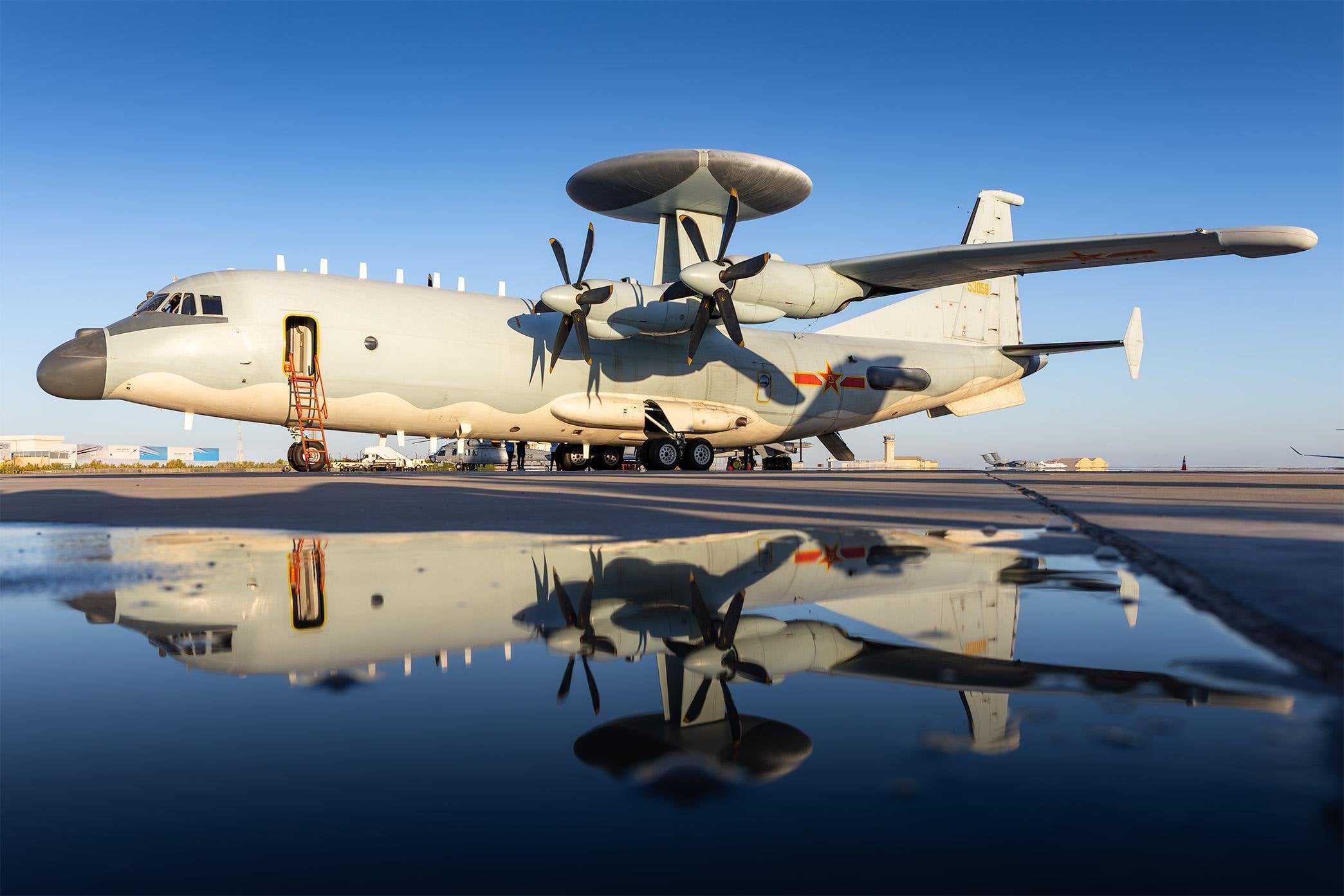
China’s People’s Liberation Army Air Force (PLAAF) put a Shaanxi KJ-500 airborne early warning and control aircraft on public display at Egypt’s El Alamein International Airshow on September 8, 2026, the radar plane’s first appearance at an airshow outside China. The KJ-500 stood alongside a Shenyang J-16 fighter, a Xi’an YY-20A aerial refueling tanker, and a Harbin Z-20 helicopter, four PLAAF platforms making simultaneous overseas debuts at the event’s second edition, which ran through September 10.
The display followed the Eagles of Civilization 2026 exercise, a bilateral air combat drill with the Egyptian Air Force that ran from late August to early September and swapped in the heavier, twin-engine J-16 for the single-engine Chengdu J-10C flown in the inaugural 2025 edition. China’s footprint at El Alamein has grown quickly since Egypt’s air force hosted a handful of J-10 fighters at the airshow’s 2024 debut; this year’s four-type contingent coincides with the 70th anniversary of Chinese-Egyptian diplomatic relations and follows Pakistan’s June 2025 decision to become the KJ-500’s first export customer.
KJ-500 El Alamein Debut Showcases Chinese AEW&C Design
The KJ-500 is a third-generation airborne early warning and control aircraft built by Shaanxi Aircraft Corporation on the Y-9 turboprop transport airframe. Unlike the rotating radome on the US Navy’s E-2D Hawkeye or the Soviet-era A-50, the KJ-500 carries a fixed dorsal radome housing three AESA antenna faces arranged in a triangular pattern, each covering roughly 120 degrees for uninterrupted 360-degree coverage. The layout mirrors China’s larger, Ilyushin-based KJ-2000 and is credited in open-source assessments with a detection range against fighter-sized targets of around 470 kilometers, though Beijing has released no authoritative figures. Four WoJiang WJ-6C turboprops, the same powerplant fitted to the Y-9, drive six-bladed composite propellers and give the airframe a ferry range on the order of 5,700 kilometers. The KJ-500 entered PLAAF service in late 2014 and naval aviation service about a year later; the International Institute for Strategic Studies counted roughly 40 airframes in air force service and more than 20 KJ-500H naval variants by 2025, with total production above 60 units, China’s most numerous AEW&C type. The improved KJ-500A, with a retractable refueling probe, entered service in 2020 and is now the standard production variant. Pakistan became the type’s first confirmed export customer in June 2025, with four aircraft on order, a deal that gives the El Alamein appearance an unmistakable sales-floor dimension.
What the Four-Aircraft Debut Means for Export Diplomacy
El Alamein’s second edition, held under the patronage of President Abdel Fattah el-Sisi, drew more than 250 exhibitors and over 100 aircraft, with displays from Russia’s Su-57, Saudi Arabia’s Saudi Hawks aerobatic team, and Egypt’s own Silver Stars, underscoring Egypt’s position as a marketplace where Western, Russian, and Chinese suppliers compete for the same buyers. China’s Ministry of National Defense described the participation as meant to increase friendship and mutual trust and strengthen diversified military cooperation between the two militaries, language nearly identical to its framing of the 2025 exercise. What changed is the composition: rather than a single fighter, Beijing brought a fighter, a tanker, an AEW&C aircraft, and a transport helicopter together, presenting a networked strike-and-surveillance chain instead of an isolated airframe for sale. That distinction matters commercially, since AEW&C aircraft sit atop most air forces’ wish lists and most export-control lists alike, with only a handful of suppliers, Sweden’s Saab GlobalEye, Boeing’s E-7 Wedgetail, Israeli-modified platforms, and Russia’s Beriev family, able to offer one at all. A KJ-500 already validated by a Pakistani order gives China a credentialed entrant into that narrow field. Egypt’s own air force, which flew Rafale and MiG-29 fighters alongside the PLAAF during Eagles of Civilization 2026, is itself comfortable operating a multi-supplier fleet, putting the KJ-500 in front of the same regional buyers that Gulf and African states have historically sourced from the United States, France, and Russia.
Analysis: The four-aircraft package reframes Chinese defense diplomacy in North Africa and the Middle East. Where Beijing has historically marketed individual items, drones like the Wing Loong series or a single fighter type, El Alamein pairs a fighter with the enabling architecture, an eye in the sky, a tanker, and a transport helicopter, transforming a platform sale into an integrated combat-air pitch. For Egypt, hosting the display alongside a fleet that already includes Rafale, MiG-29, and F-16 aircraft extends a hedging strategy built over more than a decade, not a pivot away from Washington or Paris; Cairo has diversified suppliers to avoid dependence on any single relationship. For the United States, the episode adds to a pattern tracked for years in the Pentagon’s annual China Military Power reports: the PLAAF using overseas exercises and airshows to normalize its presence far from the Indo-Pacific and build the export track record that fighter sales alone do not provide.
Neither Cairo nor Beijing has announced a follow-on order beyond Pakistan’s four KJ-500s, and no cost figures or export timeline have been made public. The next marker will be whether other El Alamein attendees, several of which already operate mixed Western-Russian-Chinese fleets, request briefings or open procurement talks, and whether a third Eagles of Civilization exercise expands the exchange further. For now, the KJ-500’s Egyptian debut functions as a demonstration flight for a wider regional audience rather than confirmation of a specific sale.