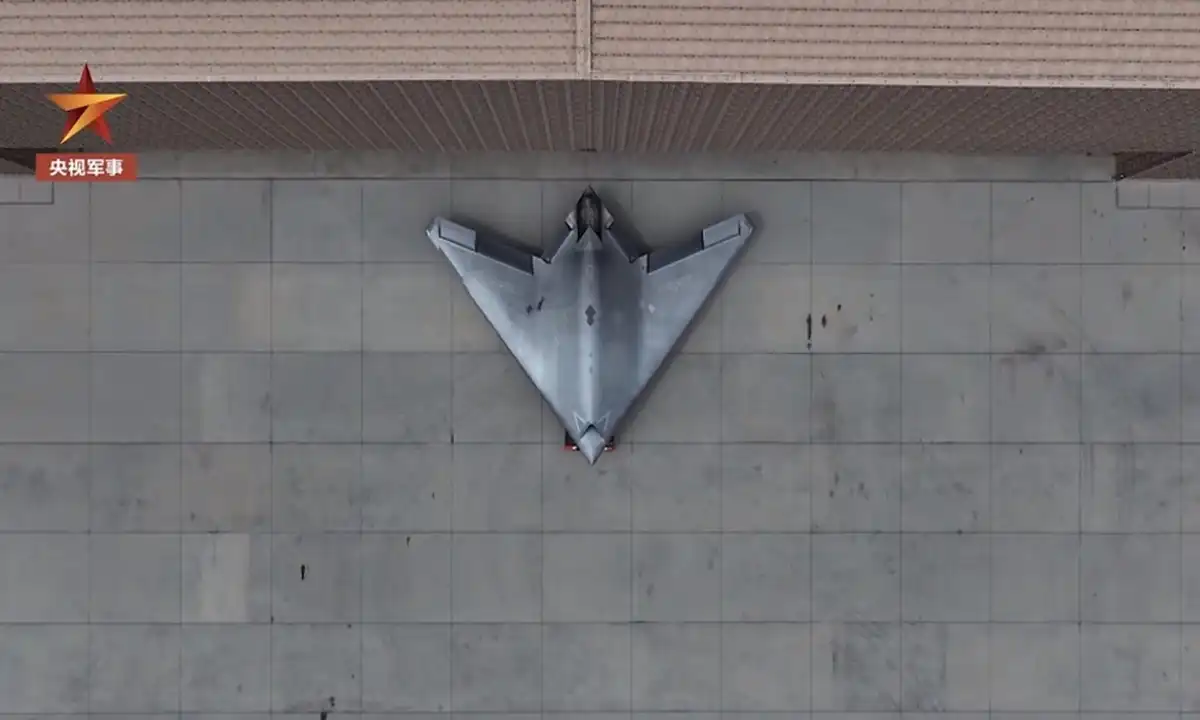
China Central Television (CCTV), the state broadcaster, aired close-in footage on November 9, 2026 of the Hongdu GJ-11 Xuanlong stealth drone, an unmanned combat aerial vehicle (UCAV), showing for the first time the aircraft’s internal weapons bays and describing a mission set that spans precision strike, forward reconnaissance and suppression of enemy air defenses (SEAD). The report also disclosed that a GJ-11 had completed its first live-fire strike, scoring a hit on a second pass after cloud cover initially masked the target.
The broadcast ran two days before the 77th anniversary of the People’s Liberation Army Air Force (PLAAF) on November 11, 2026. The tailless flying wing first appeared publicly at the October 1, 2019 National Day parade, and a PLAAF anniversary film in November 2025 showed it flying in formation with a Chengdu J-20 stealth fighter and a Shenyang J-16D electronic warfare aircraft, with the drone flying under the callsign Xuanlong 08. The aircraft entered operational service no later than 2025. Its naval derivative, the GJ-21, made its first catapult launch and arrested landing aboard the Type 076 amphibious assault ship Sichuan (Hull 51), the People’s Liberation Army Navy (PLAN) announced on October 30, 2026.
Inside the GJ-11 Stealth Drone Weapons Bays and Sensor Fit
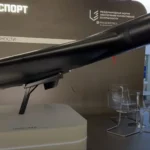
The new imagery shows the dorsal air intake, the blended-wing body, the landing gear and two internal weapons bays set into the blended wing sections on either side of the centerline. The bay doors carry serrated edges, a standard low-observable treatment that limits radar returns along panel seams. The layout matches the scale model the Aviation Industry Corporation of China (AVIC) displayed at Airshow China in Zhuhai in 2021, which showed each bay holding four small munitions comparable in size to glide bombs. CCTV said the bays can carry “a variety of air-to-surface munitions” but named no specific weapon. The bay volume visible in the footage appears large enough for sizable missiles, although no imagery has yet shown a store loaded.
The footage also shows a shrouded exhaust nozzle that masks the engine’s infrared signature from below and from the sides, a low-visibility surface coating, and a faceted optical window beneath the nose. That aperture resembles the electro-optical targeting system (EOTS) fitted to the J-20, which suggests the GJ-11 can search for and designate targets passively, without emitting radar energy. For a SEAD platform, passive targeting matters: it allows the aircraft to close on a hostile emitter without revealing its own position.
Publicly available specifications indicate a wingspan of roughly 14 meters and a length of about 12 meters. Power comes from a single turbofan whose type China has not disclosed, fed through the dorsal intake. China has released no official figures for weight, range, endurance or speed, and open-source estimates vary widely. The configuration is comparable to the Northrop Grumman X-47B, the US Navy carrier demonstrator of 2013 that never entered production.
Manned-Unmanned Teaming With J-20 and J-16 Fighters
The CCTV report showed operators planning sorties in which a GJ-11 flew alongside J-16 multirole fighters and, separately, alongside fifth-generation J-20s. According to the broadcaster, the drone can act as a forward sensor for crewed fighters by locating enemy air defense radars, as a decoy that draws fire and forces hostile batteries to reveal themselves, or as a weapons carrier releasing guided munitions on instruction from a crewed aircraft. The GJ-11 has also operated in coordination with another unmanned aircraft, pointing to a degree of onboard autonomy. The autonomy level and the datalink architecture remain undisclosed.
That spread of roles places the GJ-11 at the high end of what Western air forces call collaborative combat aircraft: a penetrating, low-observable strike asset rather than an attritable escort. Teaming it with the J-16 family, whose J-16D variant already performs electronic attack, indicates the PLAAF intends to build SEAD packages in which the drone absorbs risk at the front of a strike formation while crewed aircraft stay at standoff range.
CCTV also said the integrated ground control station can be airlifted by military transport aircraft, letting the PLAAF move control nodes to forward airfields.
First GJ-11 Live-Fire Strike and Desert Test Campaign
The PLAAF has trained an initial cohort of servicewomen to operate the aircraft, according to CCTV, and two of them conducted the GJ-11’s first live-fire strike. Operator Shi Xiaoran said dense cloud nearly prevented the crew from finding the target; after a second orbit they acquired it, released the weapon and recorded a hit. The broadcaster did not say when the test took place or which munition was used.
The report placed the test campaign at a desert facility in northwestern China. The PLAAF operates a base at Malan in the Xinjiang Uygur Autonomous Region, where Planet Labs satellite imagery analyzed by The War Zone showed two GJ-11 airframes in July 2024 and where several other uncrewed designs are believed to have been developed and tested. None of the live-fire details can be independently verified.
Analysis: The disclosure confirms that China is fielding a stealthy, internally armed UCAV with a defined SEAD mission, a class of aircraft the United States prototyped with the X-47B but has not fielded. In a Taiwan contingency or against US forces in the Western Pacific, a drone that can locate and draw fire from Patriot, Aegis or Taiwanese air defense batteries ahead of J-20 and J-16 strike packages would complicate the defender’s engagement calculus and drain interceptor inventories. With the GJ-21 now operating from the Sichuan, the same airframe family is extending that role to sea, giving the PLAN an organic stealth reconnaissance and strike asset aboard an amphibious ship.
Key unknowns remain the size of the operational fleet, the munitions cleared for internal carriage, combat radius, and how much of the targeting chain the drone executes without human input. The next indicators to watch are further PLAAF anniversary releases on November 11, imagery of the GJ-21 operating from the Sichuan at sea, and evidence of GJ-11 deployments to airfields facing the Taiwan Strait or the South China Sea.