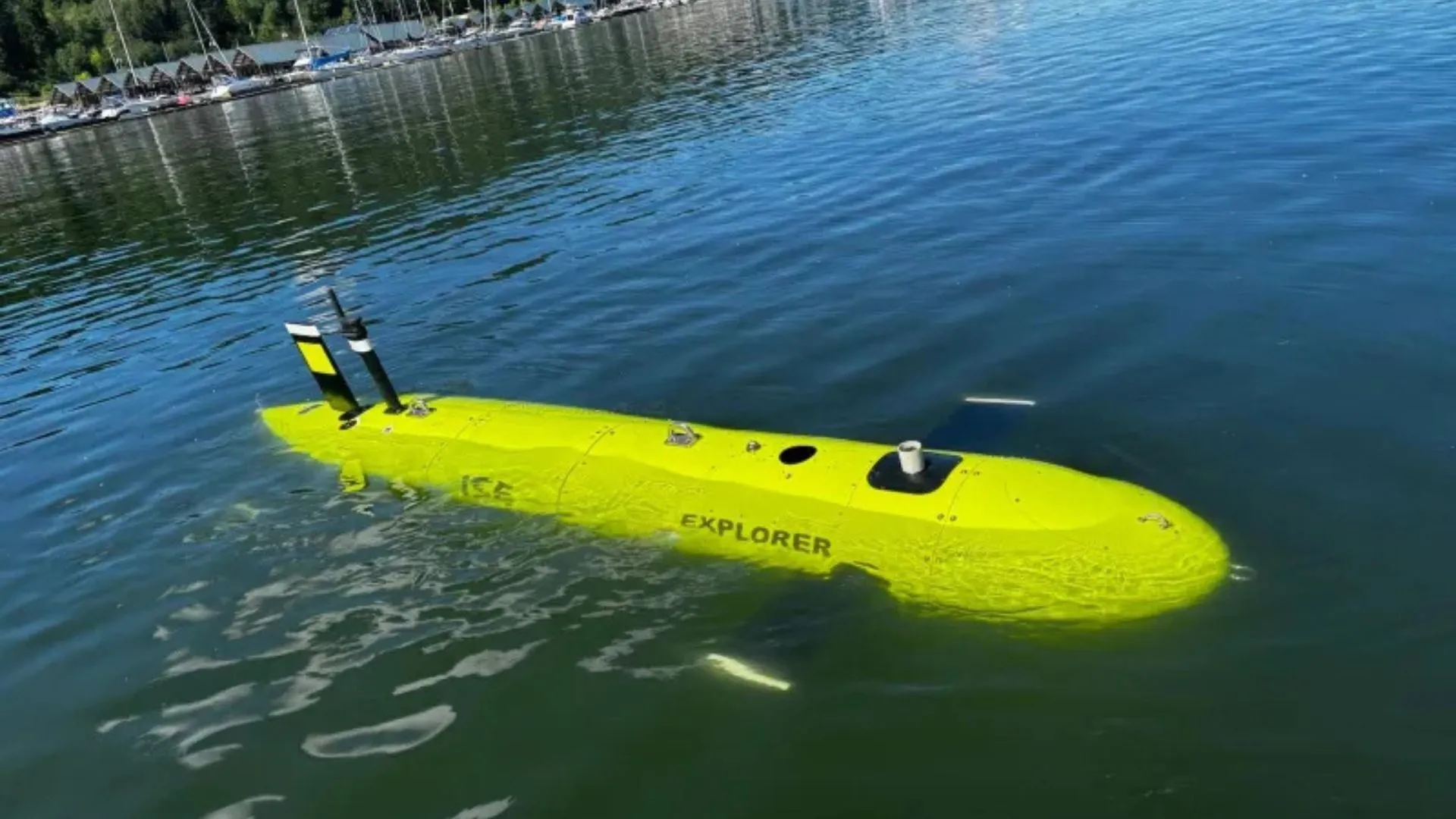
Elbit Systems has completed the acquisition of International Submarine Engineering Ltd. (ISE), a Canadian manufacturer of autonomous underwater vehicles (AUVs) and remotely operated vehicles (ROVs), the Israeli defense group announced on October 20, 2026. Elbit did not disclose the purchase price, stating only that it is not material to the company.
The deal adds ISE’s AUV and ROV lines to an Elbit naval portfolio that already spans unmanned surface vessels, underwater systems, sonar and electro-optical systems, electronic warfare and integrated command-and-control (C2) suites. Elbit says ISE’s technologies will expand its offering in underwater intelligence, surveillance and reconnaissance (ISR), mine countermeasures (MCM) and anti-submarine warfare (ASW). The purchase comes from a position of scale: Elbit reported $2,287.1 million in revenue for the quarter ended June 30, 2026, and an order backlog of $32.0 billion.
Elbit Systems ISE Acquisition Brings Explorer AUV and Navy ROV Pedigree
Founded in 1974 and headquartered in Port Coquitlam, in the Vancouver area, ISE has delivered more than 250 underwater vehicles to customers in over 20 countries. Its defense credentials run deep. ISE’s first AUV, ARCS, was developed from late 1981 for the Canadian Hydrographic Service to survey the high Arctic. Under contract with Canada’s Department of National Defence, as part of a joint US-Canadian effort, the company built Theseus, a large AUV that, after trials in 1995, laid fiber-optic cable under the Arctic ice pack in 1996 to link a seabed acoustic surveillance array. ISE says the vehicle laid several 220 km cables in 600 m of water beneath ice 2.5 m thick.
The current flagship is the modular Explorer AUV, developed from 2002. ISE’s 2024 data sheet lists 3,000 m and 6,000 m depth ratings, a 0.74 m hull diameter, a length of 4.5 m to 7.5 m and a weight of 620 kg to 1,700 kg, depending on battery banks and payloads. Lithium-ion batteries give 24 to 115 hours of endurance, with survey speeds of 0.75 m/s to 2.5 m/s. The swappable payload bay accepts multibeam echosounders, side-scan and synthetic aperture sonars and sub-bottom profilers. For MCM, the synthetic aperture sonar option is the most relevant. On the government side, ISE lists the Canadian and US navies among its vehicle customers, and the Japan Coast Guard operates an Explorer AUV.
Closing the Undersea Gap in Elbit’s Seagull MCM Architecture
Elbit’s main unmanned maritime product, the 12 m Seagull USV, was unveiled in February 2016 for MCM and ASW. It offers four days of endurance, operations up to Sea State 5 and multi-vessel control from a single mission station, with side-scan and forward-looking sonars and mine identification and disposal ROVs. In past demonstrations, part of that subsea layer came from third-party suppliers, such as the VideoRay ROV used for mine identification and disposal in Belgian MCM trials in 2017. ISE gives Elbit its own AUVs, ROVs and vehicle control software, allowing a USV-launched, end-to-end detect-to-neutralize chain built largely in-house.
Chief Executive Bezhalel Machlis said ISE’s underwater technologies “will further strengthen our position as a global provider of comprehensive, integrated maritime solutions.” Elbit has not released an integration roadmap, ISE headcount, or plans for the ISE brand and product names.
Analysis: The acquisition is less about a single vehicle than about owning the full MCM kill chain as navies retire manned minehunters in favor of mothership-and-drone toolboxes, a shift already under way in Belgian and Dutch programs. Primes able to deliver surface vessel, subsea vehicles, sonar and command software as one package hold an edge in those competitions. A Canadian-based subsidiary also gives Elbit a manufacturing foothold inside NATO and the Five Eyes industrial ecosystem, along with Arctic and under-ice experience that few competitors can claim as seabed infrastructure protection rises on allied agendas.
Key unknowns remain: how quickly Explorer is integrated with Seagull, whether ISE retains its Canadian product identity, and which export customers Elbit targets first. The first combined USV and AUV offering at a major naval exhibition, or an MCM contract award featuring ISE hardware, will signal how fast the integration is moving.