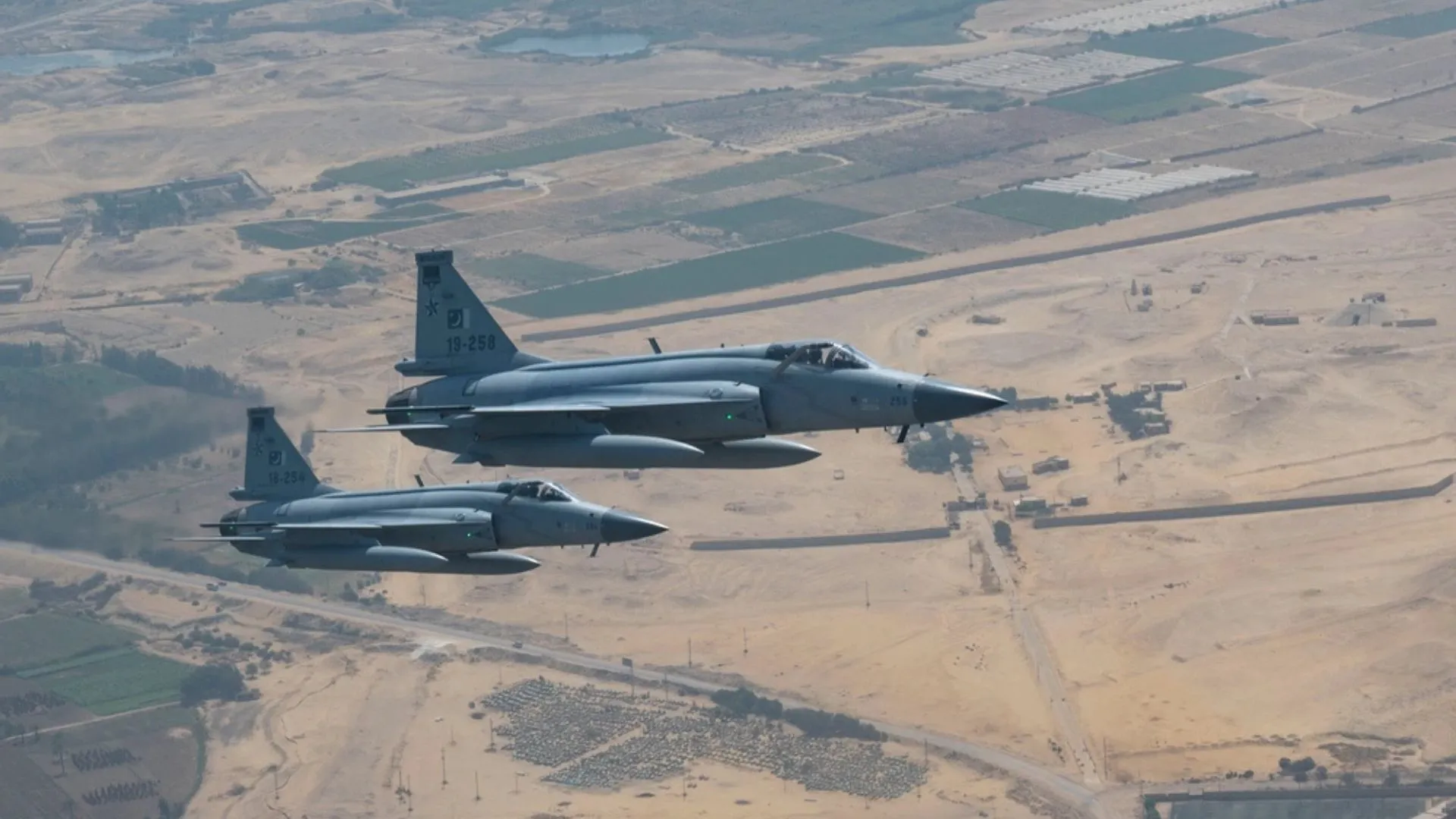
The Royal Air Force of Oman (RAFO) has been in discussions with Beijing and Islamabad on a deal for JF-17 Thunder multirole fighters as it nears a decision on its next batch of fighter jets, Intelligence Online reported on October 21, 2026. No order has been confirmed, and no aircraft quantity, variant, price or delivery schedule has been disclosed.
The report follows the October 13-14 visit to Islamabad by Omani Foreign Minister Sayyid Badr Albusaidi, who co-chaired the eighth Pakistan-Oman Joint Ministerial Commission with Pakistani Deputy Prime Minister and Foreign Minister Mohammad Ishaq Dar. Pakistan’s Foreign Office listed security and defense among the commission’s focus areas, although the five agreements signed were civilian in scope. The timing also follows drone strikes on fuel infrastructure at the ports of Duqm and Salalah in March 2026, during the regional conflict involving Iran, a reminder of the airspace the RAFO must cover, from the Musandam Peninsula near the Strait of Hormuz to Dhofar.
Oman JF-17 Options: Block III Radar, Missiles and Range
Jointly developed by Pakistan Aeronautical Complex (PAC) and China’s Chengdu Aircraft Corporation (CAC), the JF-17 is a single-engine lightweight fighter now in its third production standard. Block III first flew on December 15, 2019, and entered Pakistan Air Force (PAF) service in 2023. Publicly available specifications indicate a length of 14.33 m, a wingspan of 9.44 m and an empty weight of 7,965 kg. A single Klimov RD-93 afterburning turbofan, derived from the MiG-29’s RD-33, delivers a top speed of Mach 1.6, with China’s WS-13 associated with the program as an alternative engine. Internal fuel of 2,330 kg can be supplemented by three external tanks, and the refueling probe added on Block II matters for an operator patrolling the Strait of Hormuz approaches and Arabian Sea.
The central upgrade is the KLJ-7A active electronically scanned array (AESA) radar, which raises track-while-scan capacity from 10 to 15 targets and simultaneous engagements from two to four compared with the mechanically scanned KLJ-7. Its developer has claimed a maximum detection range of 170 km, without specifying the target’s radar cross-section. Block III adds a helmet-mounted display and sight, an integrated electronic countermeasures suite, missile approach warning and a chin-mounted weapons station.
The PL-15E beyond-visual-range missile carries a published export range of 145 km, while the PL-10E provides helmet-cued high off-boresight shots. Strike options include laser- and satellite-guided bombs, anti-ship and anti-radiation missiles, and the CM-400AKG air-to-surface missile. Tracking capacity, however, does not establish detection range against low-observable targets or missile performance under electronic interference.
How the JF-17 Would Sit Beside RAFO F-16 and Typhoon Squadrons
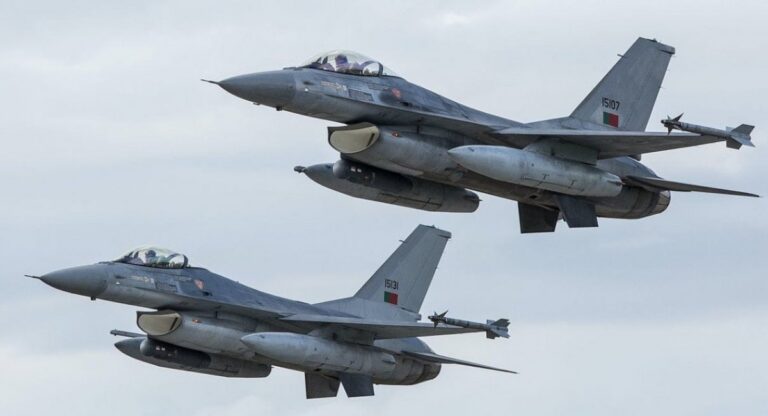
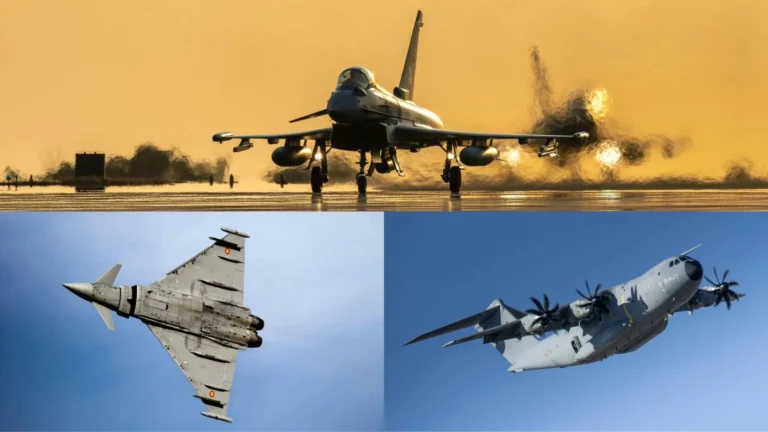
Open-source order-of-battle data credits the RAFO with 12 Eurofighter Typhoons flown by No. 8 Squadron at RAFO Adam, 23 F-16C/D Block 50s split between Nos. 18 and 20 Squadrons at Thumrait, and about 10 single-seat Hawk Mk 203 light fighters at Masirah. The Typhoons came under a £2.5 billion December 2012 contract with BAE Systems that also covered eight Hawk trainers, with deliveries completed in 2018. The F-16s arrived in two batches of 12, the first delivered in 2005 and 2006 and the second ordered in December 2011.
The search for additional combat aircraft predates the JF-17 reports. Intelligence Online reported in September 2025 that Muscat was looking to buy new fighter jets, and in February 2024 that Oman was on the lookout for second-hand combat aircraft, raising the possibility of buying Saudi Arabia’s used Typhoons. A JF-17 order could serve two purposes: adding airframes to a front line of roughly 45 combat jets, or beginning the replacement of Hawk Mk 203s delivered in 1993 and 1994. Either path creates a third support chain. The JF-17 depends on Russian engines, Chinese avionics and weapons, and British Martin-Baker ejection seats, with PAC producing 58% of the airframe and final assembly at Kamra. None of its Chinese munitions match the US and European stocks held for the F-16s and Typhoons, and sharing a tactical picture with those fleets would require separate data link integration. One industrial link already exists: the RAFO flies PAC’s Super Mushshak basic trainer.
Pakistan’s JF-17 Export Push Meets Production and Support Limits
Oman would join a crowded queue. Azerbaijan expanded a February 2024 order for 16 aircraft into a 40-aircraft Block III contract worth $4.6 billion in June 2025. Pakistani officials said in December 2025 that a weapons deal worth more than $4 billion with Libya’s eastern-based Libyan National Army includes JF-17s, and in January 2026 Pakistani sources said Islamabad and Riyadh were discussing converting about $2 billion in Saudi loans into a JF-17 purchase. Bangladesh, Indonesia, Iraq and Somalia have also been reported as prospective buyers. Islamabad markets the jet as combat-tested after the May 2025 clashes with India, though several Pakistani claims from that conflict remain disputed by New Delhi.
Cost and sustainment complicate the low-price image. Package-level averages range from about $35 million per aircraft for Myanmar’s 16 Block II jets to roughly $115 million for Azerbaijan once weapons, training and support are included. Myanmar’s reported structural cracking, radar faults and low availability, which required Pakistani technical assistance in 2022 and 2023, show the support burden a new operator assumes. PAC’s output of 20 to 25 aircraft per year is also shared between PAF requirements and Azerbaijan’s remaining deliveries.
Analysis: The JF-17 evaluation extends Muscat’s habit of balancing suppliers into new territory. Oman has sourced its frontline combat aircraft only from the United States and Europe, and a third fighter family would spread training, maintenance and munitions spending across three incompatible ecosystems. The stronger driver may be political: deepening security ties with Pakistan, which Albusaidi credited with creating space for US-Iran dialogue, and with China, while reminding Western suppliers that Gulf customers have options. Washington has previously linked advanced-fighter access in the Gulf to limits on Chinese technology, pressing the United Arab Emirates over Huawei before Abu Dhabi suspended F-35 talks in December 2021, and an Omani order would test whether that pressure extends to F-16 operators.
Key unknowns remain the number of aircraft, the variant, financing terms and the training and weapons package. The report coincides with Sultan Haitham bin Tarik’s state visit to the United Kingdom, which began on October 19, 2026; Britain’s BAE Systems supplied Oman’s Typhoons and Hawks. Dar has pledged to travel to Oman in 2027 for the next session of the joint commission, the next scheduled ministerial checkpoint.