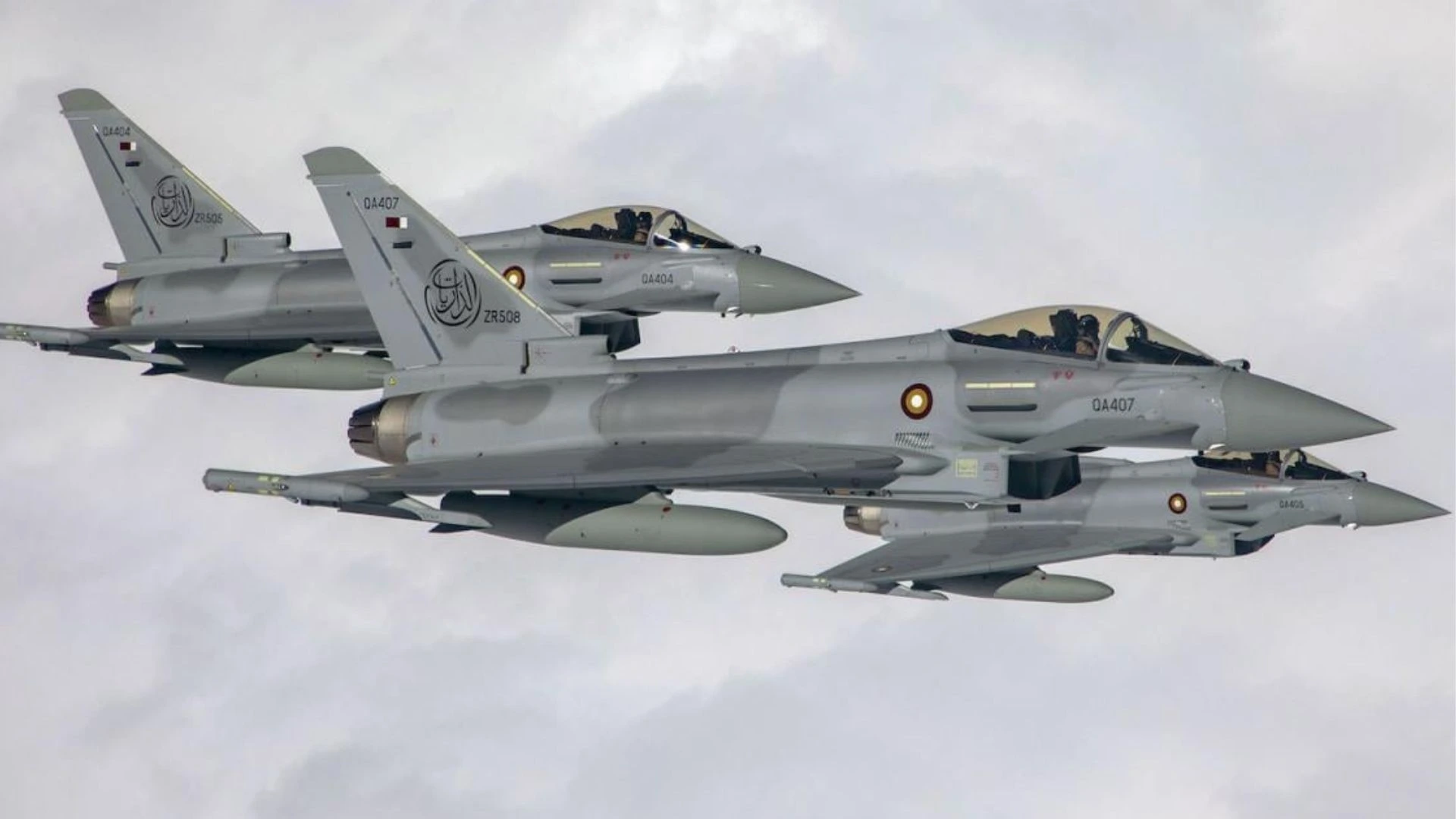
Türkiye is waiting for Qatar to deliver a draft sales contract and a draft training program covering Qatari Eurofighter Typhoon fighters, the Turkish Ministry of National Defense said on October 22, 2026. At the ministry’s weekly briefing in Ankara, spokesperson Rear Adm. Zeki Aktürk said negotiations continue after Turkish and Qatari delegations worked through technical and logistical issues in August and September.
The secondhand aircraft are Ankara’s fastest path to an operational Typhoon force. On October 27, 2025, Türkiye and the United Kingdom signed a contract for 20 new-build Typhoons, which the Turkish ministry valued at £5.4 billion including mission equipment and munitions, against London’s figure of up to £8 billion. The first of those jets is not due until 2030. The agreement allows Qatar and Oman to transfer part of their fleets to Türkiye through separate sales contracts. Ankara said in late 2025 it planned to take 12 aircraft from each as an interim measure, but it has yet to announce a signed contract with either country.
What the Qatari Eurofighter Typhoon Talks Cover: Jets, Munitions, Training
According to the ministry, the August and September sessions addressed the number of aircraft to be transferred, the ammunition to accompany them, and training for pilots and maintenance teams. Ankara has not disclosed how many Qatari airframes are on the table, the unit price, or which weapons the package would include. Turkish officials have put the combined Gulf requirement at 24 aircraft from Qatar and Oman, though progress on that procurement has been limited.
Qatar is the logical first donor. The Qatar Emiri Air Force ordered 24 Typhoons in December 2017 and received its first aircraft in August 2022, giving it one of the youngest Typhoon fleets in service. Because deliveries ran from 2022 into 2025, Türkiye would inherit airframes with most of their structural service life remaining. Doha committed in December 2024 to 12 additional Typhoons, which would partially backfill any transfer alongside its Dassault Rafale and Boeing F-15QA fleets.
The training track is already moving. Under a support agreement signed with London on March 25, 2026, BAE Systems is supplying spare parts, support equipment, electronic warfare capabilities, simulators, and instruction for engineers and pilots, plus technical support for an initial three-year period after entry into service. Turkish pilots began training in the United Kingdom in August, with flight training under way in September, and a Turkish technical team inspected maintenance facilities at Royal Air Force (RAF) Coningsby from September 15 to 17. The ministry has not detailed the content of the separate Qatari training program. Earlier Turkish projections that the first Qatari aircraft would arrive by the end of February 2026 did not materialize.
Tranche 3A Capabilities and Türkiye’s Three-Configuration Typhoon Fleet
Qatar’s aircraft are Tranche 3A airframes fitted with the European Common Radar System (ECRS) Mk0 active electronically scanned array (AESA) radar, the first AESA fielded on the Typhoon. The ECRS Mk0 mounts its array on a mechanical repositioner that widens its field of regard beyond that of a fixed AESA face, allowing the pilot to keep guiding a long-range missile while maneuvering away from the target. The jets also carry the Passive Infrared Airborne Track Equipment (PIRATE) infrared search and track sensor and the Praetorian defensive aids subsystem.
Publicly available specifications indicate two Eurojet EJ200 turbofans, each rated at about 60 kN dry and 90 kN with afterburner, a top speed near Mach 2, 13 external hardpoints, and a maximum takeoff weight of 23,500 kg. MBDA is the primary weapons supplier on the UK contract, and the package is reported to include the ramjet-powered Meteor beyond-visual-range air-to-air missile. Which munitions transfer with the Qatari aircraft remains under negotiation.
The Omani track is more complex. The Royal Air Force of Oman received 12 Typhoons from 2017, reportedly equipped with the mechanically scanned Captor-M radar, and Ankara has said those aircraft would undergo modernization before delivery, with Turkish reporting pointing to 2028. The 20 new-build jets, to be assembled at BAE Systems’ Warton site in Lancashire to a reported Tranche 4+ standard, are scheduled to arrive in three batches: six in 2030, eight in 2031, and six in 2032. If all three tracks close, the Turkish Air Force would operate Typhoons in up to three avionics baselines, each with its own software, spares, and training requirements.
Analysis: The Qatari jets’ value is a function of time, which is running short. The secondhand tranche was meant to put Typhoons on Turkish flight lines years before 2030; every quarter without a contract narrows the window in which ex-Qatari aircraft add capability rather than duplicate the new-builds. The UK training pipeline offsets part of that risk, since Turkish crews will qualify before airframes arrive. Strategically, the Typhoon gives Ankara a high-end fighter outside the US supply chain after its 2019 removal from the F-35 program over the Russian S-400 air defense system, and aligns the Turkish Air Force with the United Kingdom, Germany, Italy, and Spain on NATO’s southern and Black Sea flanks.
The next marker is Qatar’s submission of the draft contract and training program. On October 21, 2026, Ankara signed a defense cooperation accord in Doha with Qatar, Pakistan, and Indonesia covering joint development and production. Its 2027 budget proposal raises weapons and equipment procurement allocations by 229%, with the ministry citing air defense, the KAAN fighter, drones, and shipbuilding. Unit price, munitions, and a delivery date for the Qatari jets remain undisclosed.