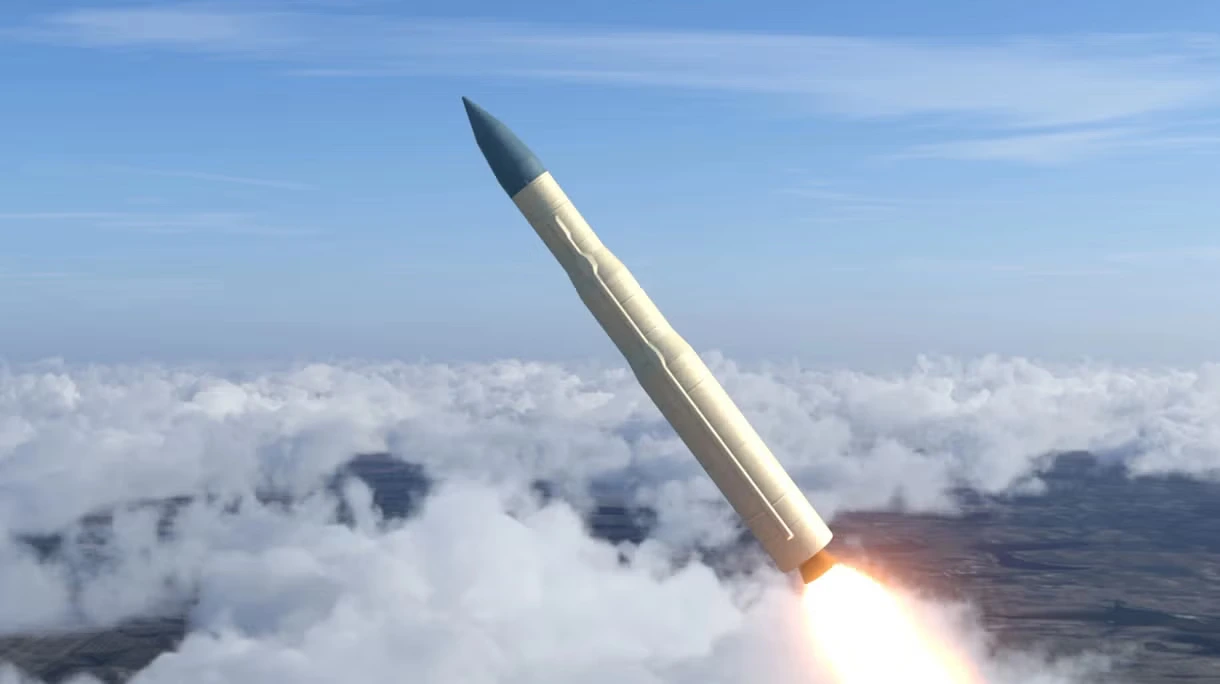
L3Harris Technologies is building a 110-acre solid rocket motor campus in Camden, Arkansas, that it expects to raise its large solid rocket motor (SRM) manufacturing capacity sixfold, with the U.S. Air Force’s LGM-35A Sentinel intercontinental ballistic missile (ICBM) as an anchor program. On October 22, 2026, the company said the Arkansas Advanced Propulsion Facilities (AAPF) will comprise more than 20 buildings and should be operational by the end of 2027, supporting Sentinel’s Stage 3 motor alongside several other SRM programs.
The timing matters for Sentinel. Led by prime contractor Northrop Grumman, the program will replace the LGM-30G Minuteman III, in service since 1970, with 400 deployed missiles. A critical Nunn-McCurdy cost breach disclosed in January 2024 ended in July 2024 with the Pentagon certifying the program at roughly $141 billion, an 81% increase, while rescinding its Milestone B approval. The Air Force has since opted to dig new silos rather than convert Minuteman III launch facilities and aims to regain Milestone B by the end of 2026. On September 14, 2026, the service and Northrop Grumman vertically stacked a fully integrated inert Sentinel at Vandenberg Space Force Base, California, ahead of a first flight test targeted for 2027.
How L3Harris Is Scaling Sentinel ICBM Propulsion in Camden
L3Harris broke ground on AAPF in November 2025 at its Camden site, where rocket motors have been produced since 1979. The campus relies on automation, including robotic precision manufacturing and automated quality inspections. For Sentinel motor production, the company also cites statistical process controls and automated propellant mixing, practices intended to reduce lot-to-lot variability in energetics production, where rework and scrap translate directly into schedule loss.
AAPF is distinct from the Arsenal of Freedom facility L3Harris opened in Camden on October 20, 2026. That 60,000-square-foot plant, tied to a $216 million Defense Production Act Title III cooperative agreement signed in 2023, centralizes production of motors for the U.S. Army’s Guided Multiple Launch Rocket System (GMLRS) and is designed to double current capacity. AAPF is the large-motor counterpart.
The Camden site already produces more than 115,000 solid rocket motors a year, according to the company. L3Harris says it is building approximately 60 new facilities across Arkansas, California, Virginia, and Alabama, and is growing its Sentinel workforce in Camden; Huntsville, Alabama; and Los Angeles, California. The company has not disclosed the capital cost of AAPF itself or a target Stage 3 production rate.
For the Air Force, the value lies in supplier depth. Large SRM production has long been concentrated in two producers, Northrop Grumman and L3Harris, which acquired Aerojet Rocketdyne in July 2023. A sixfold jump in large-motor capacity at one of those two suppliers widens the margin for Sentinel’s production ramp, provided that capacity is not absorbed by competing programs.
Stage 3 Motor and Post-Boost Propulsion Milestones Ahead of First Flight
Sentinel uses a three-stage solid-propellant booster. Northrop Grumman builds the first and second stages; L3Harris builds the third, the smallest of the three, plus the post-boost propulsion system (PBPS). The Stage 3 motor completed a closed-chamber static fire on March 16, 2024, at the Arnold Engineering Development Complex in Tennessee, following first-stage and second-stage static fires in March 2023 and January 2024. L3Harris says the motor uses new materials and manufacturing processes to cut cost without sacrificing reliability, and that it underwent structural load tests earlier in 2026 as engineers fed test data back into the design.
The PBPS operates during exo-atmospheric flight, maneuvering the front end before release of the Lockheed Martin Mk21A reentry vehicle carrying the W87-1 warhead. After passing its critical design review, the PBPS moved into a dedicated 10,000-square-foot final assembly room in Huntsville in December 2023 and completed a hot-fire test in 2025.
The heritage runs deep. Aerojet Rocketdyne was the original manufacturer of the Minuteman III second and third stages and its post-boost system. Publicly available specifications indicate the Minuteman III post-boost engine burns hypergolic nitrogen tetroxide and monomethylhydrazine through a gimbaled axial engine and 10 attitude-control engines. The Sentinel PBPS propellant combination and thrust levels have not been disclosed. During the four-month Pathfinder campaign, all three stages, propulsion elements, and the shroud were mated at Vandenberg, validating transport, crane handling, and interface connections.
Analysis: Propulsion has not been Sentinel’s critical path. The cost breach traced chiefly to the command-and-launch segment, from silos to cabling and land easements, while a February 2026 Government Accountability Office (GAO) report pointed to design tools and performance requirements as issues to resolve. Every booster stage has now been static-fired and stacked. AAPF’s late-2027 activation lines up with the shift from flight testing toward production, making the campus a hedge against the next bottleneck rather than a fix for the current one. The open question is allocation: AAPF will serve several large-motor programs while interceptor and strike demand climbs, pitting a strategic program that cannot slip against munitions the Pentagon wants faster.
The next decision point is Milestone B, which the Air Force targets by the end of 2026 alongside a firmer cost estimate; officials have treated $141 billion as a cap. A first flight from a test pad at Vandenberg is planned for 2027, although the GAO report placed it in March 2028. For L3Harris, the markers to watch are AAPF activation by the end of 2027 and any disclosed Stage 3 production award, ahead of Sentinel’s initial capability in the early 2030s.