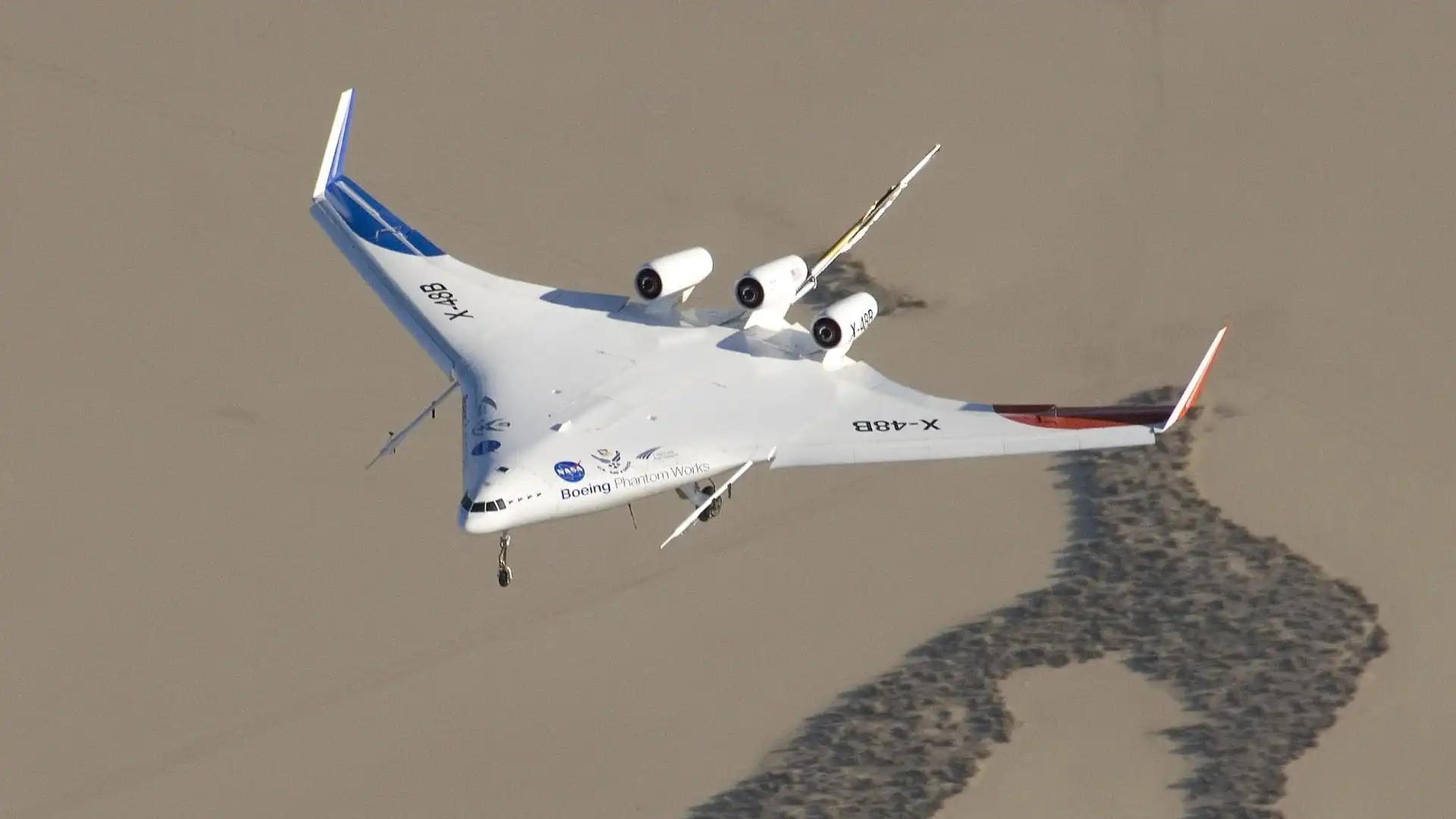
The US Air Force should develop and buy 250 medium-sized, long-range, high-offload tankers such as a Medium Blended Wing Body (BWB) design and cap its Boeing KC-46A Pegasus fleet at about 260 aircraft, according to a Hudson Institute report released October 27, 2026. Authors Timothy A. Walton and Shane Dennin estimate that the resulting mixed fleet would cost $15.5 billion less over 30 years than an all-KC-46A force of 510 tankers while delivering 58 percent more fuel offload capacity at a 2,500-nautical-mile (nmi) radius.
The study, “Resilient Reach: Redesigning Aerial Refueling for Contested Global Operations,” lands with the tanker roadmap in flux. Congress has set a minimum inventory of 478 tankers in fiscal year (FY) 2027, rising to 502 in FY2029, yet the fleet still relies on roughly 365 KC-135R/T Stratotankers against 113 KC-46As, per the report’s 2026 count. The FY2027 budget request funds 15 KC-46s for $3.9 billion, closing out the 188-aircraft program of record, and shifts money from the Next Generation Air Refueling System (NGAS) to an Advanced Tanker Systems effort focused on connectivity, electronic warfare, and self-protection rather than a new airframe.
Why Hudson Favors a Blended Wing Body Tanker Over More KC-46As
The report’s case starts on the ground. Drawing on the mean result of 100,000 simulated People’s Liberation Army (PLA) strike campaigns, the authors conclude that by 2035 the PLA could potentially suppress large-scale, sustained tanker operations from forward airfields in the Western Pacific, and that widespread suppression of many intermediate bases in Diego Garcia, northern Australia, the Central Pacific, and Alaska would hobble US operations. Iranian strikes on Prince Sultan Air Base in Saudi Arabia during Operation Epic Fury, which absorbed more than 200 US tankers in 2026, already showed that tankers can be hit on the ramp.
Basing options are thin. Of nearly 1,500 Indo-Pacific airfields outside adversary territory, the authors count only about 90 on US and allied soil within 5,000 nmi of China with the fuel stores, runway length, pavement strength, and ramp space to sustain a KC-46A squadron for one week. Fewer than half of those could do so for two weeks, and only 13 suitable airfields sit between 1,000 and 3,000 nmi from Chinese territory.
Falling back to distant bases forces medium-range KC-135s and KC-46As into force extension, in which tankers refuel other tankers and burn capacity before any fuel reaches a receiver. Standing off in the air carries its own penalty: the number of airborne F-35As needed to sustain one continuous four-ship combat air patrol (CAP) climbs from single digits to 58 as the distance between the CAP and the air refueling control point (ARCP) grows. In an earlier Hudson simulation of a 2035 Taiwan conflict, 40 percent of desired aerial refuelings could go unmet.
Reduced-signature shuttle tankers, modeled as a Medium Reduced Signature design and an unmanned Collaborative Tanker Aircraft (CTA), fared worse at scale: effective for a few force packages, but costlier at theater level and tied to parent KC-46As flying from the same vulnerable airfields.
Medium BWB vs KC-46A: Fuel Fraction, Offload, and Survivability
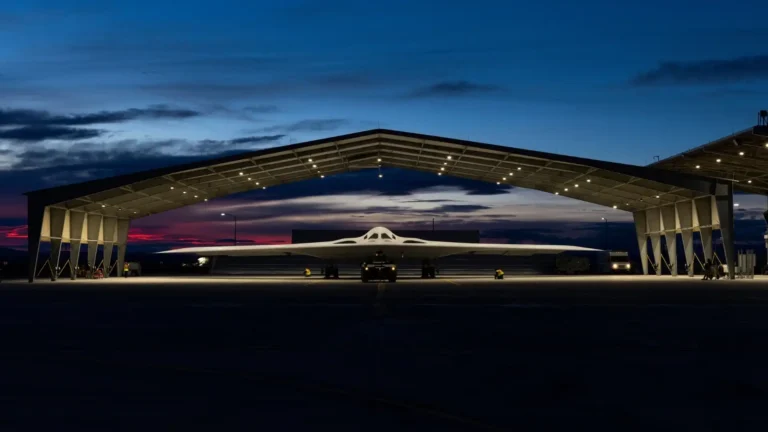
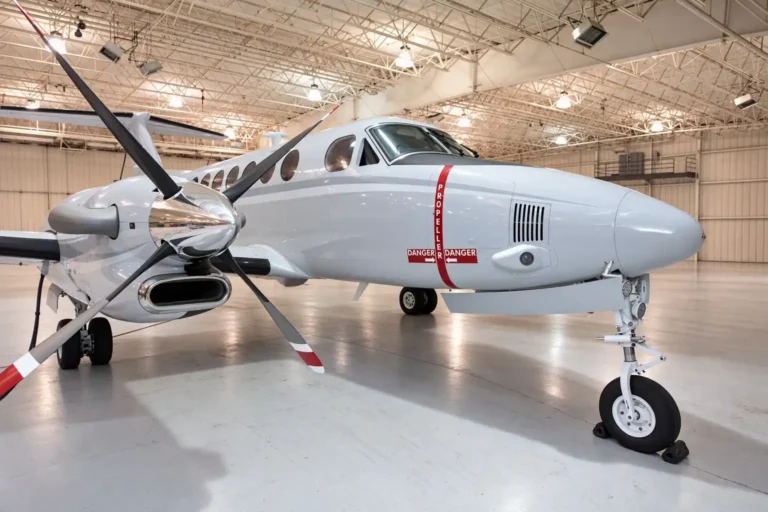
The Medium BWB is an analytical archetype, its image based on Boeing’s ERA-009H1 concept, rather than a specific contractor proposal. The configuration merges fuselage and wing into one lifting body to cut drag. The report credits the modeled aircraft with a 155,000-pound empty weight and 300,000 pounds of fuel, a 66 percent fuel fraction. The 767-derived KC-46A weighs 206,000 pounds empty and carries 212,000 pounds of fuel, a 51 percent fraction, while the A330neo-based A330 Multi Role Tanker Transport (MRTT)+ carries 245,000 pounds on a 285,500-pound empty weight. The Medium BWB also occupies 0.57 C-17 parking spots, against 0.84 for the KC-46A and 1.37 for the A330 MRTT+, a direct gain on scarce ramp space.
Those margins translate into reach. The KC-46A can offload 100,000 pounds to a C-17A at about 1,500 nmi, or 50,000 pounds to one F-35A four-ship at roughly 2,500 nmi. The Medium BWB supports force packages up to approximately 3,000 nmi farther, refuels more than twice as many packages or the same packages more than twice as far, and delivers up to five times as many operationally relevant fuel increments at long range and high offload. In a Philippine Sea vignette, it could sustain five continuous ARCPs at 100,000 pounds per hour from 69 airfields, against 19 for the KC-46A, and deploy an equivalent joint force in 13 days instead of 30.
Survivability rests on mission systems rather than stealth. With new size, weight, power, and cooling margins, the modeled aircraft carries a self-defense suite that lets it operate 300 nmi closer to threats than today’s KC-46A, against 200 nmi for the upgraded KC-46A and A330 MRTT+ options. Its externally mounted engines limit passive signature reduction. The authors flag two open questions: how receivers will handle a BWB wake, where published analyses suggest lower-intensity trailing vortices, and whether moderate-bypass engines lose efficiency at the 20,000 to 30,000 feet typical of refueling tracks.
KC-46 Production Extension, Fleet Plans, and the $15.5 Billion Gap
Hudson compared five 30-year plans in FY2027 dollars covering research, development, test, and evaluation (RDTE), procurement, and operations and support (O&S). Plan 1 continues KC-46A Tanker Production Extension buys at 18 per year to a 510-aircraft fleet for $413.2 billion. Plan 2 adds 250 A330 MRTT+ to 260 KC-46As for $426.8 billion. Plan 3, the recommended path, pairs 260 KC-46As with 250 Medium BWBs for $397.6 billion. It spends $7 billion on RDTE from FY2027, awards a development contract in FY2028 if the Air Force BWB demonstrator performs in 2027 and 2028, and ramps procurement from FY2032 to 21 aircraft per year at an average unit cost of $250 million. The last KC-135s would retire by 2046, two years earlier than under Plan 1.
The savings come mainly from O&S, which accounts for 79 percent of life-cycle cost across the plans. The authors estimate Medium BWB unit O&S at 11 percent below the KC-46A over 30 years, driven by lower fuel burn and a refueling-only role. They describe the result as robust: Medium BWB RDTE could more than triple, unit procurement cost could rise about 25 percent to roughly $312 million, or O&S could run 21 percent higher before an all-KC-46A fleet became cheaper. Matching Plan 3’s offload capacity with KC-46As alone would take 805 aircraft, 303 above the 502-tanker requirement.
A budget-constrained variant trims the extension from 75 to 49 aircraft, leaving 234 KC-46As and freeing about $7.8 billion. The airframe also sits inside a broader package: about $35.5 billion over a decade to harden 20 regular and 20 dispersal tanker airfields with shelters, fuel storage, and repair kits, and to field 15 short-to-medium-range air and missile defense batteries at the 12 most valuable regular airfields, plus $13 billion in mission systems, including $8 billion for onboard self-defense on 260 KC-46As.
Analysis: The report’s sharpest contribution is a change of metric. Congress legislates tanker numbers, and the 502-aircraft floor treats a KC-135, a KC-46A, and any future design as equal tails. Hudson’s modeling argues that the binding variables are offload at radius and the number of airfields from which a tanker can generate it, on which a KC-46A-only path scales poorly. It also explains why the authors prefer a refueling-only BWB to a stealthy shuttle tanker: operating from 69 airfields instead of 19 complicates PLA targeting more than signature reduction protects a handful of orbits. The weaknesses are equally concrete. The Medium BWB is a paper aircraft costed by the study’s own authors, the JetZero and Northrop Grumman demonstrator is not a refueler, and the FY2027 request carries just $13 million for Advanced Tanker Systems. With the B-21 Raider and F-47 drawing on the same topline, the plan depends on a decade of stable funding, a prospect Douglas Birkey, executive director of the Mitchell Institute for Aerospace Studies, questioned in comments to Air & Space Forces Magazine.
The next decision points are close. The Air Force has tied signature of the 75-aircraft KC-46A extension to deficiency fixes, with Remote Vision System 2.0 now due to begin fielding in early 2028. An Air Force spokesperson told Air & Space Forces Magazine that the BWB demonstrator is on schedule to fly in late 2027, and JetZero has proposed a KC-Z4 tanker derivative. The FY2028 budget request will show whether Advanced Tanker Systems gains an airframe line, and US Transportation Command’s next Mobility Capabilities and Requirements Study could push the requirement above 502 tankers.