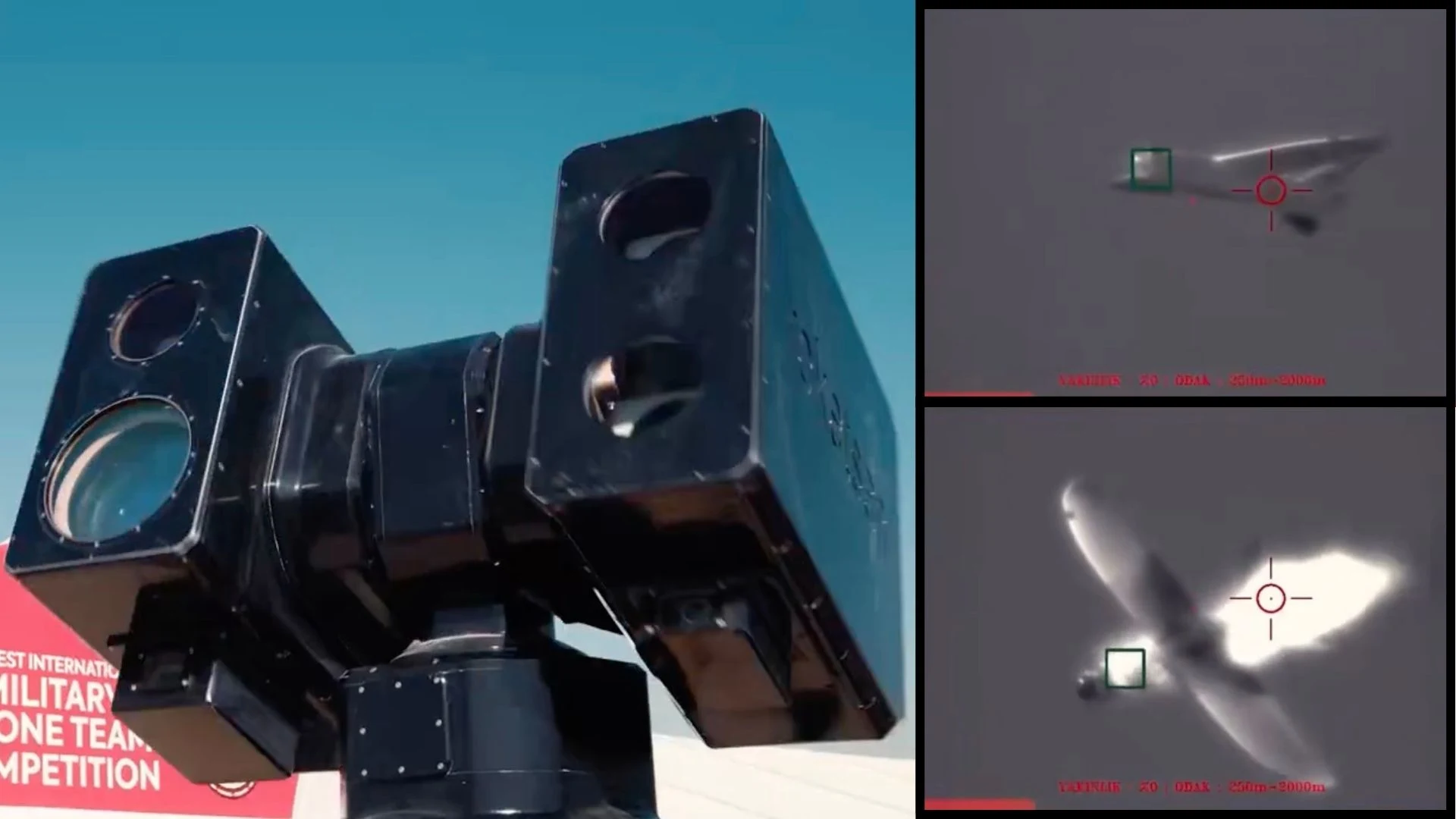
Turkish missile maker Roketsan said on October 23, 2026, that its ALKA Directed Energy Weapon System (DEWS) engaged rotary-wing and fixed-wing drone targets, as well as a fixed ground target, during live-fire exercises held within the scope of the Flying Eye Drone Competition. The company released a 53-second video of the firings, citing the system’s combined laser and electromagnetic jamming capability against asymmetric threats.
The trials come as Ankara builds out Steel Dome (Çelik Kubbe), the integrated, multi-layered air defense architecture linking Turkish sensors and effectors from very short range to long range. Roketsan positions ALKA as the laser element of Steel Dome and its final layer, a hard-kill point defense against small drones that leak through gun and missile coverage. The company did not disclose the test site, the number of targets engaged, engagement ranges, or the laser power class used during the trials.
How the ALKA Directed Energy Weapon Layers Soft and Hard Kill
ALKA pairs two effectors in a two-layered architecture. An Electromagnetic Jamming System (EJS) disrupts the command, control, and navigation links of mini and micro unmanned aerial vehicles (UAVs), while a Laser Destruction System (LDS) physically defeats targets that keep coming. Earlier configurations also included an electromagnetic destruction mode; earlier company figures placed swarm jamming effects out to 4,000 m and electromagnetic destruction at 1,000 m.
Roketsan’s 2024 product catalog lists two laser classes: a 2.5 kW output with an effective destruction range of 750 m, and a 5 kW output reaching 1,500 m. In June 2026, the company said a version above 10 kW was already in operational use, without publishing its range. A drone detection radar cues the system, which the manufacturer says can track up to 100 targets simultaneously, while electro-optical tracking guides the beam onto a marked aimpoint, day or night. Roketsan says artificial intelligence and deep learning support autonomous target detection, tracking, and classification.
The operational logic is cost exchange. A laser shot consumes only electrical power, easing the magazine depth problem units face when expending interceptors against commercial quadcopters. The constraint is dwell time: Roketsan says the beam needs one to five seconds to neutralize a drone, depending on the target’s plating, the aimpoint, and laser output, which limits throughput against dense salvos and makes radar cueing and fire control software as decisive as the laser itself.
From IDEF 2019 Prototype to the ALKA-KAPLAN Mobile Platform
Roketsan began ALKA development with internal funds in July 2016 and unveiled the system at the International Defense Industry Fair (IDEF) on May 8, 2019. The company signed a contract with the Presidency of Defense Industries (SSB) on April 20, 2021, and series production began that year. Turkish officials state the system is in the inventory of the Turkish Armed Forces, initially for critical infrastructure and base protection.
The program has since moved toward mobility and networking. ALKA NEW, the network-enabled variant, lets several units share a common command and control picture, apply threat evaluation and weapon assignment (TEWA) logic, and concentrate multiple beams on the same aimpoint, effectively summing laser power on a single target. Roketsan and armored vehicle maker FNSS integrated ALKA on the KAPLAN HYBRID vehicle, shown at IDEF 2025 and displayed as an optionally manned variant at SAHA 2026 in Istanbul in May 2026. Publicly available specifications for that configuration indicate a 5 kW laser with a 1.5 to 2.5 km range depending on beam intensity, fed by a 60 kW generator that allows three minutes of continuous firing before a one-minute cooling period.
Analysis: The engagement against a fixed ground target alongside aerial drones is the detail worth watching. It indicates Roketsan is marketing ALKA as a multi-role point defense effector rather than a pure counter-drone laser, consistent with earlier demonstrations against improvised explosive devices and explosive reactive armor. For NATO, Türkiye is one of only a few allies with a directed energy weapon in series production and in service, giving Ankara both an operational data advantage and an export product as European armies search for affordable answers to drone saturation attacks.
Key unknowns remain the power class and engagement ranges used in the Flying Eye trials, and how quickly Roketsan delivers the further power increases it has announced. The next indicators will be Steel Dome delivery announcements specifying ALKA unit numbers, progress on autonomous operation of the KAPLAN-mounted configuration, and any first export contract.