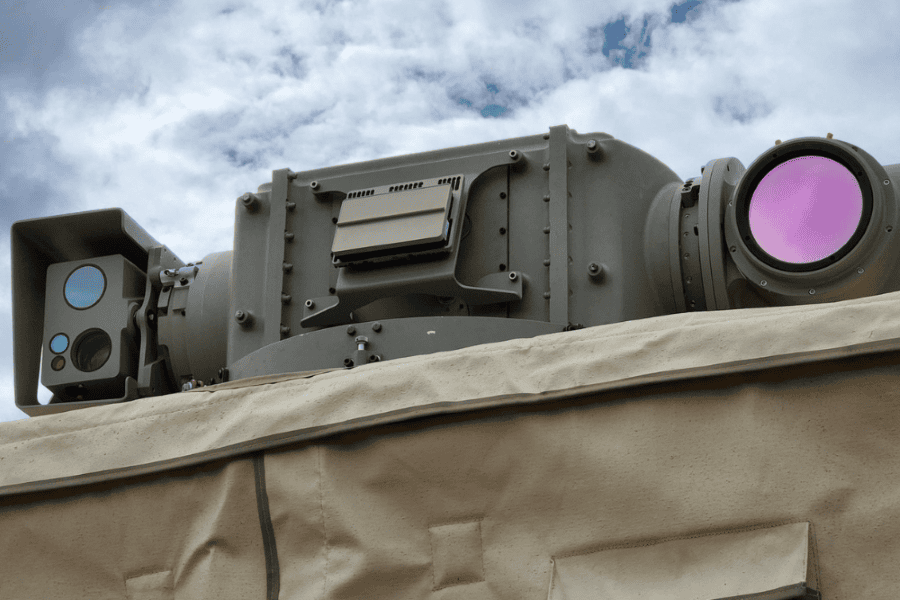
The Netherlands has signed a letter of intent with Australia’s Electro Optic Systems (EOS) to mature the company’s Apollo High Energy Laser Weapon into a fully operational counter-drone system and to examine building it on Dutch soil. State Secretary for Defence Derk Boswijk signed the document during the week of September 21, 2026, and the Netherlands Ministry of Defence announced it on September 24. If further development succeeds, the ministry intends to buy an unspecified number of systems.
The letter builds on an existing commitment. In August 2025, EOS announced a €71.4 million (approximately A$125 million) order from an unnamed European NATO member for a truck-mounted, 100 kilowatt (kW) class laser, with delivery through 2028 and manufacturing at the company’s Singapore plant. EOS later identified the customer as the Netherlands and describes the deal as the first export order for a laser weapon in that power class. The Dutch requirement is operational: on November 21, 2025, air force personnel fired on unidentified drones over Volkel Air Base, and days later the ministry outlined plans to spend between €1.25 billion and €3 billion on counter-drone capabilities.
Apollo Laser Weapon Design: Power, Range, and Magazine Depth
EOS lists a scalable output of 50 to 150 kW for Apollo, with the Dutch configuration in the 100 kW class. Company specifications give a hard-kill envelope of 50 meters to 3 kilometers against Group 1 through 3 unmanned aircraft systems (UAS), and an optical sensor denial range out to 15 kilometers. That second figure carries operational weight. Swarm attacks typically depend on a loitering spotter drone holding line of sight to the target area, often beyond 10 kilometers, and blinding its electro-optical payload can break the targeting chain without a hard kill.
EOS claims a kill rate above 20 Group 1 drones per minute and a slew-to-cue-and-engage time under 1.5 seconds across a 60-degree arc. Other EOS releases cite up to 30 per minute, so the product-sheet figure is the conservative planning baseline.
Magazine depth is the defining parameter. Connected to external power and cooling, Apollo fires without a magazine limit; operating in isolation, EOS rates its stored energy at more than 200 engagements. The system fits in a 20-foot ISO container that EOS says experienced crews can bring into action in under two hours, and the company states it integrates with NATO air defense command and control (C2) and theater integrated air defense systems (IADS).
EOS puts the cost per shot at under 10 cents. The ministry stresses logistics over price, arguing that removing ammunition supply as a constraint makes a laser more effective and cost-efficient than missile-based air defense. None of these figures has been independently verified in service, and the ministry did not detail the trials behind its effectiveness claim.
From Singapore Assembly to a Dutch-Led European Supply Chain
The industrial clause carries the most weight. Both parties will study a production site in the Netherlands supported by a Dutch-led European supply chain, and EOS intends, in principle, to perform development and production there, which would make the country its European base. The first Dutch unit, by contrast, is being built in Singapore, where EOS opened a laser manufacturing, integration and test facility on February 6, 2026. At that ceremony, Royal Netherlands Army Brigadier General Marc van Ockenburg cited a relationship spanning almost two decades, built on EOS remote weapon stations in Dutch service.
A Dutch site would follow an established EOS pattern. The company holds a binding conditional agreement with a Republic of Korea customer that includes a local partnership, and in June 2026 it signed a conditional joint venture agreement with the UAE’s Generation 5 Holding to manufacture its existing 100 to 150 kW laser and develop a 200 to 300 kW successor. Chief Executive Andreas Schwer has tied future expansion to localized production driven by customer sovereignty demands. In March 2026, EOS pitched localized Apollo production to German Defense Minister Boris Pistorius.
Lasers need no interceptor stockpile, but they depend on laser sources, beam directors, power electronics and cooling systems from narrow supplier bases. A Dutch-led chain would bring sustainment and upgrade work under European control.
Analysis: The Netherlands is treating high-energy lasers as a sustained capability line, not a one-off experiment. Its counter-drone layer still rests on guns, missiles and fighters: 22 Skyranger 30 systems are planned, and Dutch F-35s downed Russian drones over Poland on September 10, 2025, a cost exchange that breaks down against mass attacks. A 100 kW laser with a deep magazine targets that imbalance. The larger stake is industrial. If EOS anchors European production in the Netherlands, The Hague gains leverage over a supply base that Germany and other allies could draw on, placing an Australian design inside Europe’s rearmament spending. The constraint is physical: laser performance degrades in rain, fog and obscurants, common in the North Sea climate, which keeps Apollo a complementary layer beside guns, interceptors and electronic warfare.
The letter is not a contract. The ministry has disclosed no quantity, budget, schedule or host vehicle for follow-on procurement. Near-term milestones include acceptance testing of the first 100 kW system, a feasibility verdict on the Dutch production site, and funding within the counter-drone envelope. How Dutch trials measure up against EOS’s published kill rates will decide whether the Netherlands buys more systems and whether other European customers follow.