Anduril Industries said on November 13, 2026, that its Voyager compute and networking hardware will form the backbone of every system in the US Marine Corps’ initial order of Operational Command Post-Light (OCP-L), a modular command-and-control (C2) infrastructure built to let units establish and displace tactical operations centers quickly. The company did not disclose the order’s value, the number of systems, or the contracting vehicle.
The order lands as the Marine Corps reshapes itself into a more mobile, distributed force designed to operate from austere positions, a model that demands C2 nodes small enough to move with the units they serve. In September 2026, the Portfolio Acquisition Executive Marine Corps at Quantico, Virginia, awarded Affigent LLC of Herndon, Virginia, a $65 million firm-fixed-price contract for OCP-L hardware and software licenses, with work expected to finish by March 29, 2027. Anduril’s announcement does not state whether its hardware is delivered through that award.
How Anduril Voyager Shrinks the Marine Corps Command Post
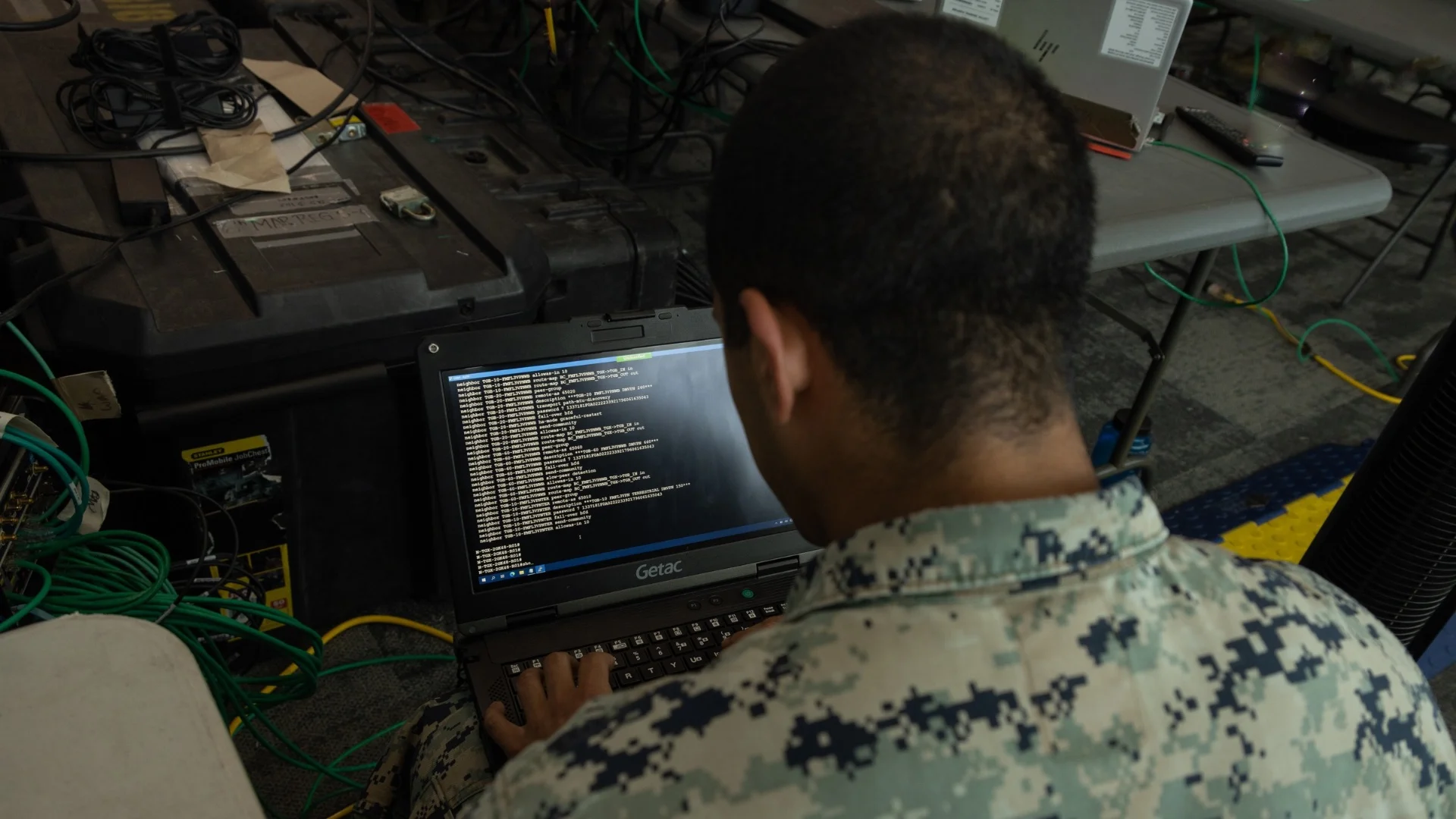
OCP-L provides modular compute and networking infrastructure to host secure services, including in environments where communications are limited or disrupted. The Marine Corps describes it as enterprise-grade capability pushed to tactical formations that may lose their links to higher networks.
Anduril’s involvement started with Fleet Marine Force units preparing expeditionary forces for upcoming deployments. Marines operating in maritime environments needed compute and networking that could support operations both at sea and ashore without slowing a unit on the move. Working directly with those Marines, Anduril tailored the configuration around two priorities: weight reduction and durability.
The result packages compute, networking, and GPU processing into three suitcase-sized chassis that can travel aboard commercial aircraft. During testing, Marines received a rapid-deployment notice, flew on commercial airliners, and used OCP-L to stand up a functional tactical operations center without waiting for dedicated military airlift. Removable storage lets Marines transport the system in a declassified state.
VoyagerVM 4.0 and VoyagerGPU 4.0: Specifications and Lineage
Voyager originated with Klas, the Dublin-based rugged edge computing firm Anduril agreed to acquire in May 2025 and absorbed in July 2025. The product line already underpins Anduril’s Menace family of expeditionary C2 systems and integrates with its Lattice software.
The OCP-L configuration relies on two modules. Publicly available specifications indicate that VoyagerVM 4.0 is a headless server built on an Intel Xeon D processor, measuring 188 x 160 x 52 mm and weighing 1.5 kg without solid-state drives, drawing up to 110 W from a 9 to 36 VDC input. VoyagerGPU 4.0 pairs a 10-core Xeon D CPU with an Nvidia Ampere A4500 GPU carrying 16 GB of GDDR6 memory inside a 220 W power envelope, with four 25 Gigabit Ethernet ports and four DisplayPort outputs at up to 4K resolution. Klas markets that GPU capacity for AI and machine-learning workloads and graphics-intensive applications at the edge, the kind of demanding software Anduril says Marines need to run from a mobile command post.
Manufacturer literature lists design compliance with MIL-STD-810 environmental and MIL-STD-461 electromagnetic interference standards. Anduril says it engineers, builds, and tests each Voyager system to withstand shock, vibration, and extreme conditions. The company has not specified which Voyager chassis OCP-L uses or how many modules each kit carries.
Analysis: The commercial-airline test addresses a concrete constraint for a distributed force: a C2 node that travels aboard airliners lets a unit establish a tactical operations center without waiting for dedicated military airlift. For Anduril, the order carries Voyager, the hardware line it gained with Klas, beyond its own Menace systems into the compute and networking backbone of a Marine Corps C2 program.
Anduril describes the order as one part of a broader effort to field OCP-L across the force. The Navy’s fiscal 2026 Marine Corps procurement justification cites continued OCP-L purchasing, fielding, kitting, and training as one driver of a $100.7 million request for its communications switching and control systems line, up from $39.4 million in fiscal 2025, although that line also funds other work. Key unknowns remain the order’s value, kit quantities, delivery schedule, and which units receive OCP-L first.