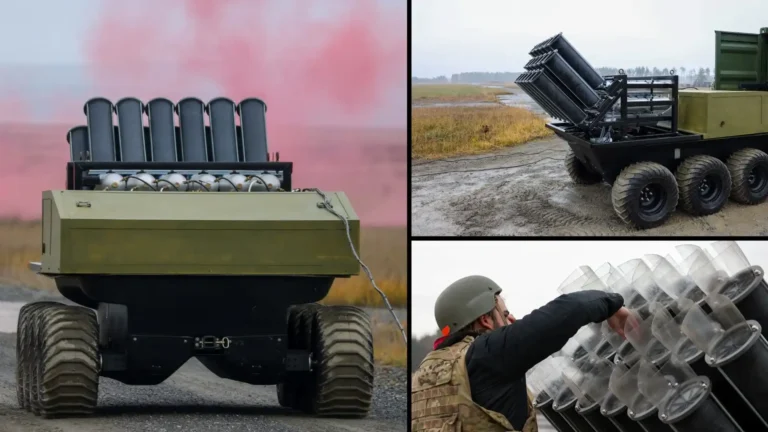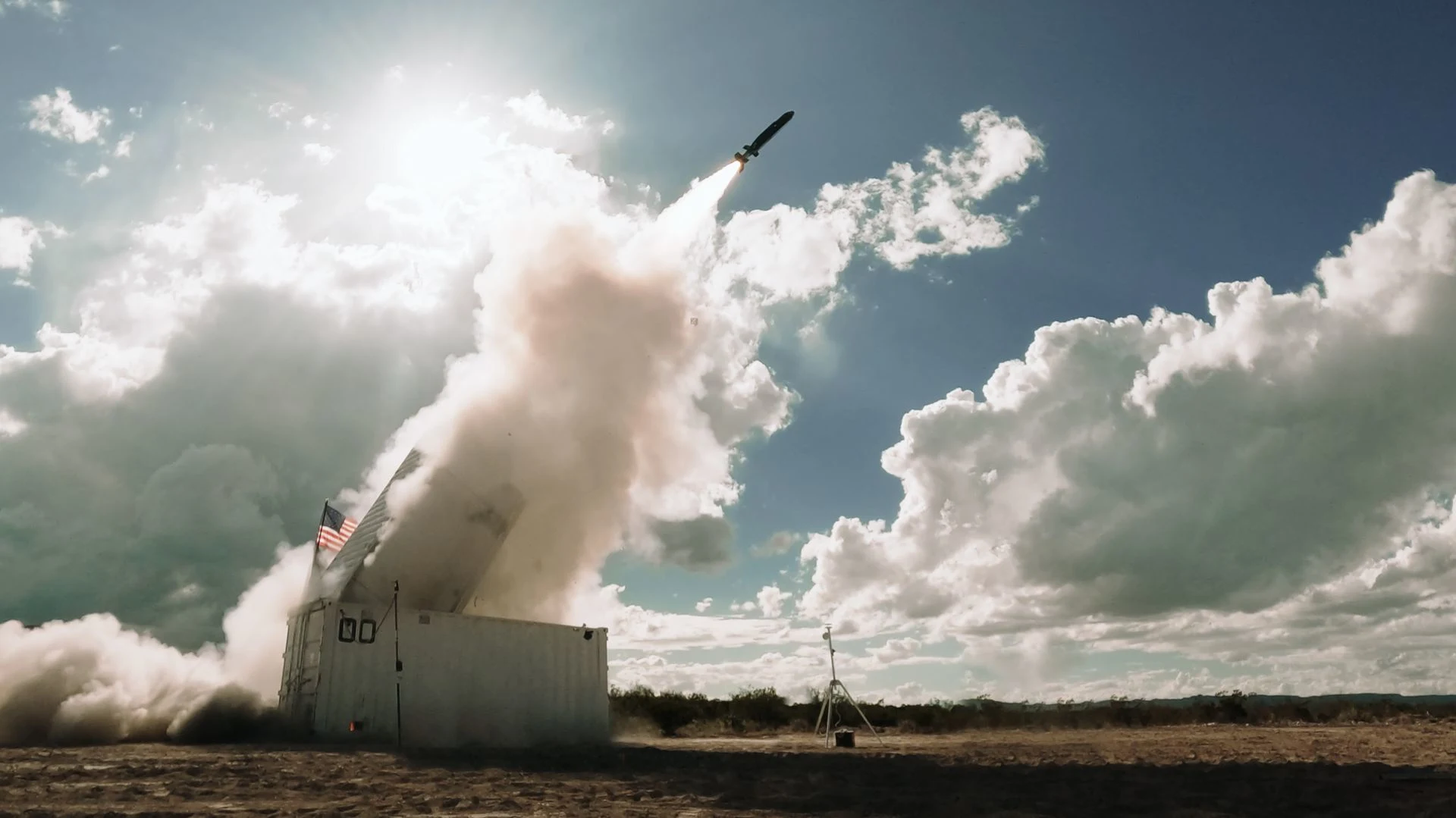
The U.S. Air Force has awarded Anduril Industries a prototype contract to develop a containerized launcher for its Counter-Air Missile Program (CAMP), the company announced on November 12, 2026. The launcher is designed to host missiles from multiple vendors developed under CAMP’s Ground Launched Counter Air (GLCA) effort and to operate from dispersed locations for extended periods with minimal personnel support. Neither the Air Force nor Anduril has disclosed the value of the award.
CAMP is the service’s attempt to break the cost curve in counter-air munitions. The Air Force Life Cycle Management Center (AFLCMC) Armament Directorate opened the effort with a request for white papers in November 2025, targeting a missile priced at $500,000 or less per round, with a full-rate production goal of 1,000 to 3,500 missiles per year. The formal solicitation for the GLCA Enterprise Test Vehicle (ETV), released July 1, 2026, sought both missile primes and launcher builders, and paired a new supersonic missile with a Common Containerized Launcher.
Inside the Anduril CAMP Launcher and Its Menace-I Heritage
Anduril describes the launcher as an infrastructure layer rather than a missile-specific rail. It supplies the power, computing, thermal management, communications, and software services each round requires, so missile developers integrate against a common interface instead of building bespoke launch equipment for every weapon. That approach tracks the open, modular architecture the Air Force wrote into CAMP from the outset, including standardized fire-control and datalink interfaces intended to connect the missile to existing Army and Air Force command systems without unique software for each launcher.
The design draws directly on Menace-I, Anduril’s containerized command, control, communications, and computing shelter. Menace-I integrates power, cooling, compute, and communications in a rugged shelter that moves by truck, rail, airlift, or helicopter sling load; publicly available specifications indicate it fits a C-130 across three pallet positions. U.S. Marines sling-loaded a Menace-I beneath a CH-53K King Stallion in August 2025, and the Menace family was designed from its 2022 launch to support Air Force Agile Combat Employment (ACE) operations. Anduril says it will apply that fielding experience to reduce the logistics burden of deploying and sustaining CAMP launch systems.
Key parameters remain undisclosed: missile capacity per container, the prime mover or trailer that will carry it, reload procedures, and emplacement time. Solicitation reference documents reportedly include interfaces associated with the Guided Multiple Launch Rocket System (GMLRS), which would suggest compatibility with established pod standards, but neither the Air Force nor Anduril has confirmed that link. The source of fire-control cueing, whether an organic radar or offboard tracks, is also unconfirmed.
10-Month Prototype Phase and the Path to FAMM-GLCA Production
The award was made under the Prototype Other Transaction authority of 10 U.S.C. 4022, which bypasses much of the traditional acquisition timeline. Over the initial 10 months, Anduril will work with the Air Force program office to mature the preliminary design and prepare the launcher for testing with missiles built by other companies. The company says it is folding manufacturing requirements into the design from the start, covering component selection, assembly, supply chain, testing, and tooling, so that a production decision would not trigger a redesign. The Air Force has not publicly named the missile vendors selected for the ETV phase, and Anduril has not said whether it is also competing a GLCA round.
CAMP’s first phase was planned as a 24-month effort ending with a prototype launcher, a flight-tested missile, and a full technical data package to support high-rate production. Phase 2 would convert the ground-launched system into a program of record, while later phases would evolve the design into an air-to-air variant. The July solicitation also identifies a possible follow-on, FAMM-GLCA, which would place the effort inside the Family of Affordable Mass Missiles (FAMM). Anduril already holds a position in that family on the strike side: in July 2026 it joined CoAspire and Zone 5 Technologies under FAMM framework agreements covering offensive air-launched missiles. The Air Force has also stressed government ownership of technical data rights and exportability, both of which govern how open the launcher interface must remain to second-source missile suppliers.
Analysis: The award shows the Air Force treating the launcher, not only the missile, as a separate and competitive node. Decoupling launch infrastructure from the round lets the service bring in several missile suppliers, swap motors or seekers as costs fall, and avoid tying weapon and launcher to one prime, a model that has long limited competition in air defense programs. Containerized launchers able to operate for long periods with small crews also fit ACE dispersal across austere airfields in the Indo-Pacific and Europe. Anduril’s own description of GLCA as a long-range offensive counter-air weapon built to engage enemy aircraft from the ground points to ambitions beyond point defense of air bases. Whether a $500,000 supersonic round can support that mission is the open question; range, engagement ceiling, and seeker architecture remain undisclosed, and those figures, not the launcher, will decide whether CAMP adds meaningful magazine depth.
The next milestones are the completion of the preliminary design, integration testing with third-party GLCA missiles, ETV flight tests, and a production decision on both missile and launcher. The contract value, the identities of the missile vendors, launcher capacity, and the date of the first live-fire event have yet to be announced.