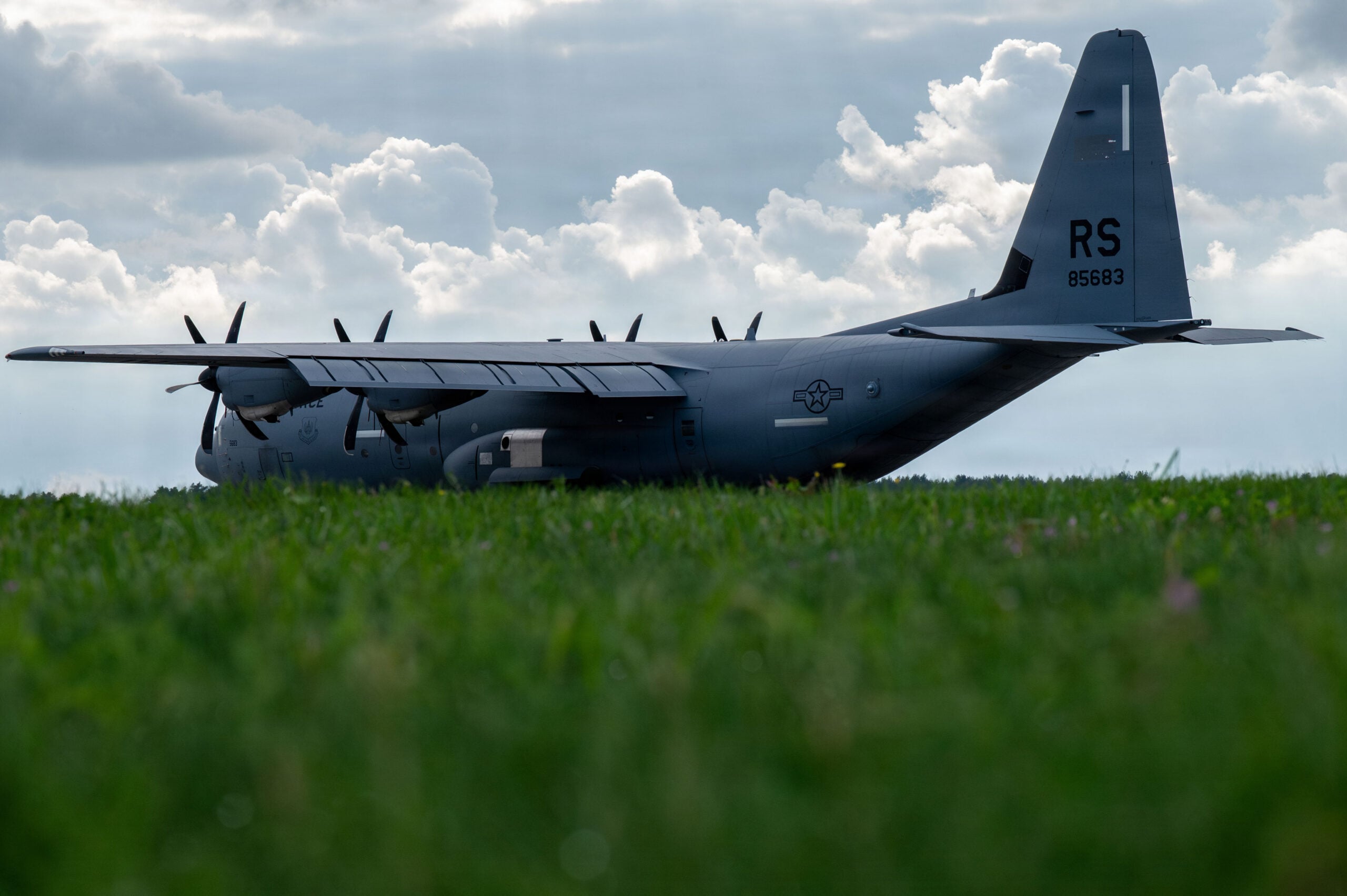
US and Polish Air Force units launched Hussar Saber 26-4 on September 14, 2026, a two-week bilateral exercise centered on Poland’s 33rd Transport Aviation Base at Powidz. The training covers tactical airlift and airdrop, low-level flights, night operations and landings in austere conditions, with scenarios built to replicate Agile Combat Employment (ACE) operations. Participants include personnel and aircraft from the 86th Airlift Wing and 435th Air Ground Operations Wing (AGOW) at Ramstein Air Base, Germany, and the 52nd Fighter Wing at Spangdahlem Air Base, Germany.
Hussar Saber runs on a quarterly rotation model that traces back to a June 13, 2011, memorandum of understanding establishing a permanent US Air Force aviation detachment in Poland. That unit, Detachment 1 of the 52nd Operations Group, began receiving personnel in October 2012 and has hosted rotational fighter and airlift deployments since 2013. Its commander, Lt. Col. Brian K. Jarrell, said US-Polish integration “sets the baseline for contingency operations and successful European deterrence on NATO’s Eastern flank.” The 26-4 iteration follows Hussar Saber 26-1, held April 13 to 24, 2026, with Air National Guard C-130H crews from the 139th Airlift Wing.
How Hussar Saber 26-4 Rehearses Airdrop and Austere Landing Operations
The flying component rests on the 37th Airlift Squadron (AS) at Ramstein, which brought C-130J Super Hercules aircraft to Powidz. Imagery released by the 86th Airlift Wing shows loadmasters rigging and releasing cargo parachutes on September 14 and 15, while an aerial delivery technician from the 86th Logistics Readiness Squadron loaded pallets, a sign that rigging capacity deployed with the aircraft. Capt. Connor Ullom, the 37th AS pilot serving as mission commander, said the exercise simulates “a deployed environment where a joint mission planning cell prepares our crews to execute complex missions to test our capabilities, tactics, techniques, and procedures.”
Ramstein’s squadron flies the stretched C-130J-30 variant, according to publicly available fleet information. US Air Force specifications credit it with four Rolls-Royce AE 2100D3 turboprops rated at 4,700 shp each, driving six-blade composite propellers. The aircraft carries up to 44,000 lb of payload, eight pallets or 24 Container Delivery System (CDS) bundles, against 16 bundles for the standard-length C-130H. Range with a 35,000 lb load reaches 2,100 nautical miles, compared with 1,300 nautical miles for the C-130H, and the crew shrinks to two pilots and a loadmaster. In an ACE resupply cycle, eight extra bundles per sortie mean fewer flights to sustain each dispersed location.
The 435th AGOW supplies the ground half of the equation. The wing includes the 435th Contingency Response Group, the command’s sole expeditionary open-the-base unit, tasked with assessing airfields, standing up initial airfield operations and providing expeditionary aerial port capability. The release does not specify which 435th units deployed to Poland.
Why Powidz Anchors Tactical Airlift and Prepositioning on the Eastern Flank
Powidz is the main operating base of Polish transport aviation. On May 8, 2026, the 33rd Transport Aviation Base received the fifth and final ex-US Air Force C-130H supplied under an April 12, 2021, Excess Defense Articles grant; Warsaw paid $14.3 million for regeneration and retrofit on aircraft Washington valued at about $60 million. The H models replace C-130Es delivered between 2009 and 2012 on a one-for-one basis, with one E model still in service as of May. Each C-130H runs four Allison T56-A-15 turboprops at 4,591 shp and requires a five-person crew, so combined sorties with C-130J crews also rehearse two different cockpit and crew concepts under a single plan. The Polish H models also carry the AN/APN-241 low-power color radar, which supports navigation and weather avoidance on low-level and night profiles.
The base also hosts the US Army’s Powidz Army Prepositioned Stocks-2 (APS-2) worksite, opened April 5, 2023, and funded through the NATO Security Investment Program. The complex includes 650,000 square feet of humidity-controlled warehouse space and stores an armored brigade combat team’s worth of equipment, in an investment exceeding $360 million that officials described as NATO’s largest single infrastructure project in more than 30 years. That concentration of airlift, heavy equipment and the permanent US Air Force detachment on one airfield sits about 250 km from the Kaliningrad border, inside the publicly reported 500 km range of Russia’s Iskander-M. Airdrop and austere landing drills rehearse the fallback: sustainment that does not depend on Powidz’s runway or ramp staying open.
Analysis: Hussar Saber 26-4 is a small exercise with a structural purpose. ACE doctrine assumes fighters and support elements disperse across spoke locations, but dispersal only holds if theater airlift can feed those spokes without the main operating base. The exercise rehearses that chain end to end: Ramstein riggers, C-130J crews, air-ground operations Airmen and Polish hosts planning under one mission cell. The limiting factor is capacity rather than proficiency. Poland’s tactical transport fleet at Powidz stands at five C-130Hs, and US Air Forces in Europe’s permanently assigned tactical airlift rests largely with a single squadron at Ramstein. Interoperability multiplies a small pool of airframes; it does not replace them.
The exercise is scheduled to run two weeks from September 14. The command has not disclosed aircraft numbers, total personnel, the Polish platforms involved, or the drop zones and landing sites used, and the 52nd Fighter Wing’s contribution beyond hosting Detachment 1 remains unstated. The next markers are post-exercise releases, the next iteration in the series, and how Warsaw plans airlift capacity beyond the five-aircraft C-130H fleet it completed in May 2026.