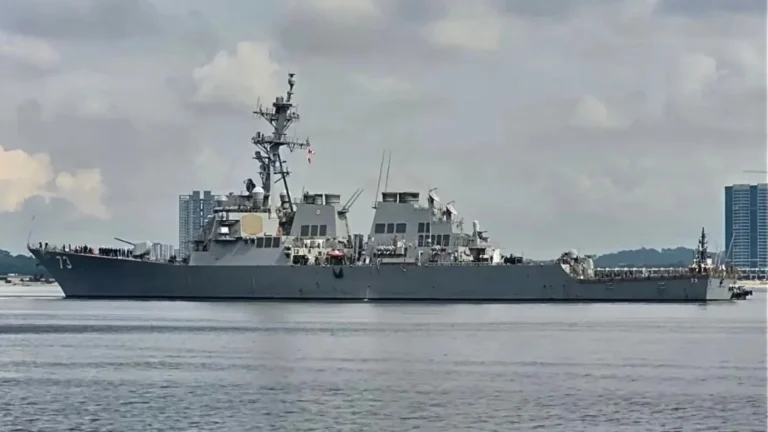
CACI International Inc has won a five-year task order valued at up to $281 million from the U.S. Navy’s Naval Surface Warfare Center (NSWC) Crane to advance next-generation electromagnetic warfare (EW) capabilities across the Department of War (DoW), the Reston, Virginia-based contractor announced on October 26, 2026. The work spans research, prototyping, and test and evaluation for electromagnetic spectrum operations (EMSO) at multiple sites.
The award reinforces CACI’s position at one of the Pentagon’s principal EW engineering centers. NSWC Crane, a Naval Sea Systems Command (NAVSEA) field activity in southern Indiana, describes itself as holding the largest concentration of EW expertise in the department, spanning all military branches. The center treats EMSO as a strategic priority because U.S. forces expect to fight in congested, contested, and constrained spectrum, where adversary jamming, spoofing, and passive detection can degrade sensors, datalinks, and precision fires.
Navy Electromagnetic Warfare Task Order Covers Research to Prototypes
According to CACI, the task order covers research, analysis, assessment, and prototype development to enhance EMSO across multiple operational environments. The scope also includes designing and maturing advanced technologies, performing test and evaluation (T&E), and developing infrastructure and capability enhancements at multiple sites based on unique customer requirements.
That language points to a science and technology and rapid-prototyping effort rather than sustainment of a single program of record. In joint doctrine, EMSO covers the coordinated military actions used to exploit, attack, protect, and manage the electromagnetic operational environment, combining electronic attack, electronic protection, electronic support, and spectrum management. A multi-site, multi-environment mandate suggests the work could touch maritime, airborne, and expeditionary applications, although CACI did not tie the award to any named platform.
CACI President and Chief Executive Officer John Mengucci framed the effort around speed. “By accelerating next-generation spectrum technologies and AI-enabled decision tools, we are helping operators stay ahead of increasingly complex global threats,” he said. The reference to artificial intelligence aligns with the broader push toward cognitive EW, in which systems characterize unfamiliar emitters and adapt countermeasures in the field instead of waiting for threat library updates. CACI did not specify which AI applications the task order will fund.
Several details remain undisclosed. CACI did not name the contract vehicle, the contract type, whether the award was competed, the funding obligated at award, or the locations of the sites involved. The $281 million figure is a ceiling; actual value will depend on tasking and funding over the five-year period.
NSWC Crane Spectrum Warfare Contracting and CACI’s EMSO Portfolio
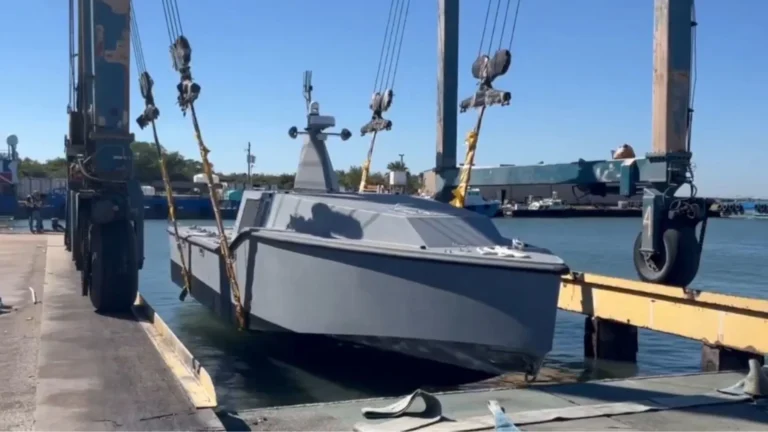
The award caps an active year for Crane’s EW enterprise. In March 2026, Precise Systems received a contract valued at about $102 million to support Crane’s Expeditionary Electromagnetic Warfare Division, followed in June by a five-year, $116.8 million award for airborne electronic attack depot operations. In July, Crane led Silent Swarm 26 at the National All-Domain Warfighting Center in Alpena, Michigan, an experimentation event focused on early-stage EMSO payloads for small uncrewed systems in the air and on the water.
CACI is no stranger to the center. In December 2021, the company won a five-year, $80.5 million Crane task order under the Department of Defense Information Analysis Center multiple-award contract to develop counter-unmanned aircraft systems mission technology for platforms including the EP-3E, P-8A, MQ-8, and MQ-25. In July 2022, it secured a $557.8 million task order supporting digital engineering for the Navy’s Digital Integration Support Cell and NSWC Crane. On the Army side, CACI won a task order valued at up to $382 million in January 2024 for signals intelligence and EW systems integration under the Trojan program, and a five-year task order valued at up to $250 million in January 2026 from the Army’s Capability Program Executive Intelligence, Electronic Warfare and Sensors (CPE IEW&S) for integration and sustainment work supporting multi-domain EW and spectrum dominance.
The company, which reports roughly 27,000 employees, has built its EW franchise around signals intelligence, spectrum sensing, and counter-drone systems sold across the services. The new Navy award pushes that portfolio further into early-stage development, where design choices are set before programs of record lock in requirements.
Analysis: The structure of the award matters more than its ceiling. Crane is buying an engineering pipeline, not a fixed system, reflecting a recognition across the department that EW advantage now depends on refresh speed: how quickly new techniques move from the lab to operators as adversary emitters change. For the defense industrial base, it confirms that EW work is flowing to integrators that pair radio-frequency hardware expertise with software and data skills, and that ceiling-heavy task orders reward sustained execution rather than a single delivery.
The next indicators will be individual task awards and obligated funding over fiscal year 2027, along with any disclosure of the sites and customers involved. Still unknown is whether prototypes developed under the effort will transition into fielded Navy or joint EW programs or remain within experimentation venues such as Silent Swarm. CACI’s upcoming quarterly results may clarify how the award contributes to backlog.