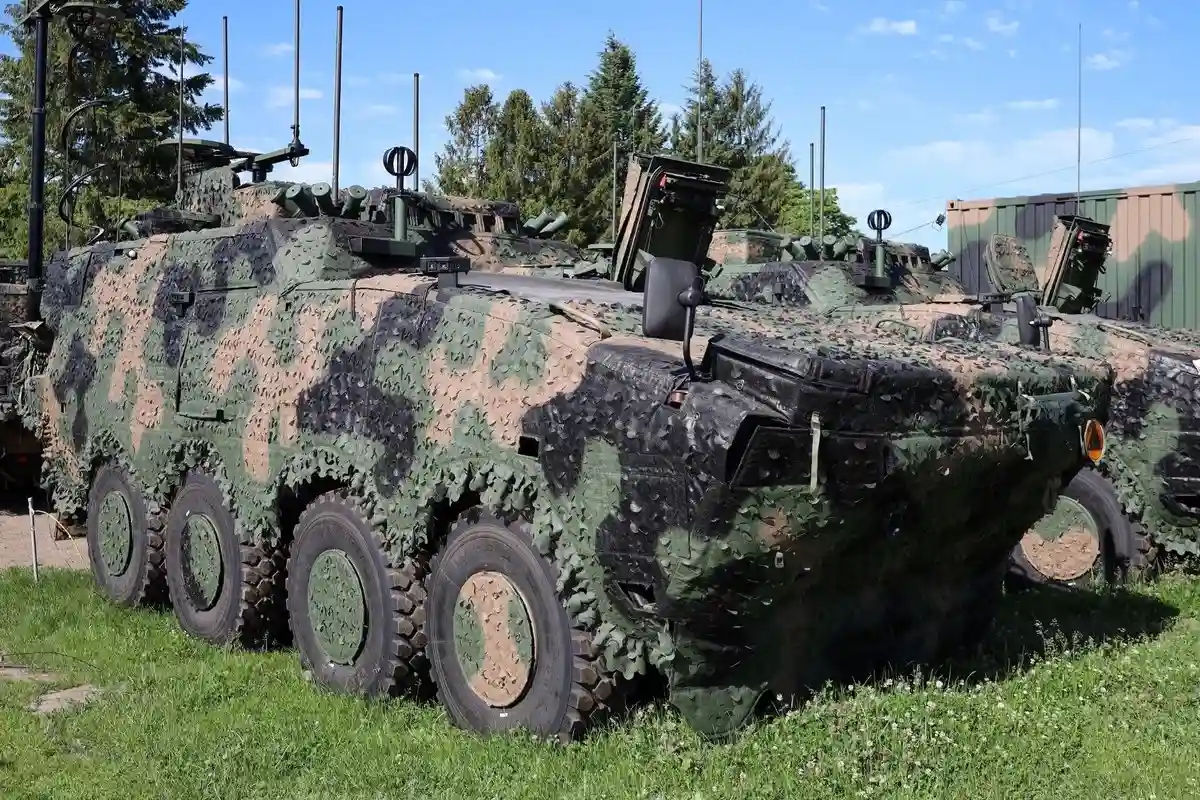
Poland’s Armament Agency confirmed on October 27, 2026, that the first Kroton-bis command vehicles built on the KTO Rosomak 8×8 platform have entered service with the Polish Armed Forces. The vehicles are delivered under a contract with Rosomak S.A. dated December 22, 2023, covering 12 battalion-level command vehicles for units equipped with the M1A2 SEPv3 Abrams main battle tank.
The order, valued at approximately PLN 268 million gross, or about $68 million at signing, closes a specific gap in Poland’s Abrams fielding. Warsaw ordered 250 M1A2 SEPv3 tanks from the United States in April 2022 for the 18th Mechanized Division, and its Abrams battalions are designed to operate with a high degree of autonomy. Until now, Poland’s Rosomak-based command vehicles served mainly at division headquarters level. The Armament Agency has not disclosed how many vehicles were handed over in this first batch or which units received them.
How the Kroton-bis Rosomak Command Vehicle Differs From Kroton
Kroton-bis is a development of the Kroton command vehicle, also known as Rosomak WD. Poland received 17 Kroton vehicles between 2018 and 2022 under three contracts signed in 2018, 2019, and 2020. Those vehicles were built in a coalition configuration able to process classified information up to NATO SECRET, with HF and VHF radio links and a semi-automatic mast that raises VHF antennas to 15 meters.
The bis variant keeps the command layout but changes the communications fit. Program disclosures indicate a modified set of Harris radios and an HF antenna mast of a different design. Each vehicle supports four equivalent workstations for the battalion’s operational staff. Its mission equipment provides classified information exchange over both radio and wired links, plus an internal communications subsystem. Rosomak S.A. and WB Electronics integrate the command and communications suite.
The PLN 268 million figure does not cover the full communications package. Part of the radio equipment is procured through separate agreements, including US Foreign Military Sales cases, a sourcing choice consistent with aligning the vehicles to the Abrams ecosystem.
Rosomak Platform and Abrams Battalion Integration Explained
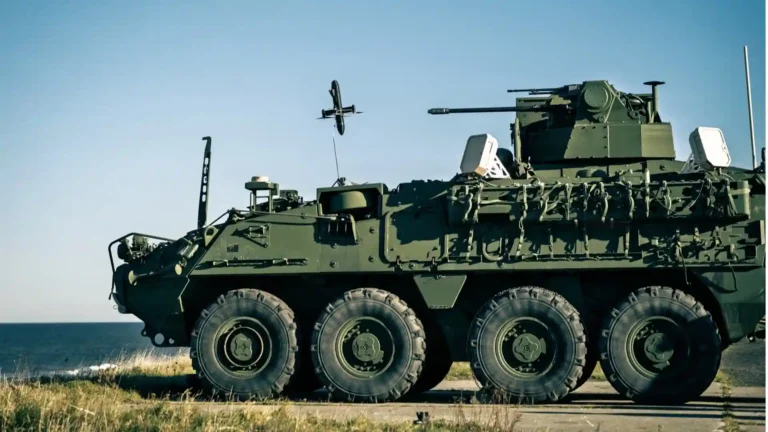
The KTO Rosomak is a license-built derivative of the Finnish Patria AMV in Polish service since 2004 and produced by Rosomak S.A., part of the Polska Grupa Zbrojeniowa (PGZ) group. Publicly available specifications indicate a Scania diesel engine in the 360 kW class and road speeds of around 100 km/h. Command variants use a raised hull to give working space to a vehicle commander, an operator, and four staff officers, according to program disclosures, while retaining the same mobility as the rest of the Rosomak fleet.
That mobility parity matters for an armored formation. A battalion command post that moves with the maneuver force while staying connected to brigade and division networks is the practical bridge between the Abrams units’ battle management tools, including the SitaWare Frontline system procured for the Abrams battalions, and Polish national command systems.
The Kroton-bis also sits alongside the Zawilec, a national-configuration command vehicle on the same chassis fitted with domestically produced WB Group communications and data processing equipment. Six Zawilec vehicles were ordered in October 2023 and delivered to the 5th Command Regiment in 2025.
Analysis: Poland is now fielding three distinct command vehicle configurations on one chassis: Kroton for coalition operations, Zawilec for national networks, and Kroton-bis for the Abrams force. That approach preserves a common logistics, maintenance, and driver training base, but it also splits the radio and software baseline across the fleet. Interoperability between the Abrams battalions and the rest of the 18th Mechanized Division will depend less on the hull than on how cleanly the US-sourced and Polish command layers exchange data under field conditions.
Under the contract schedule, all 12 Kroton-bis vehicles are due by the end of 2026. Warsaw has since moved to order further Rosomak-based command vehicles for its K2GF and K2PL tank battalions, financed through the European Union’s Security Action for Europe (SAFE) loan instrument. Open questions include the delivery pace of the remaining vehicles, the identity of the receiving units, and when the Abrams battalions will validate the full command chain in a division-level exercise.