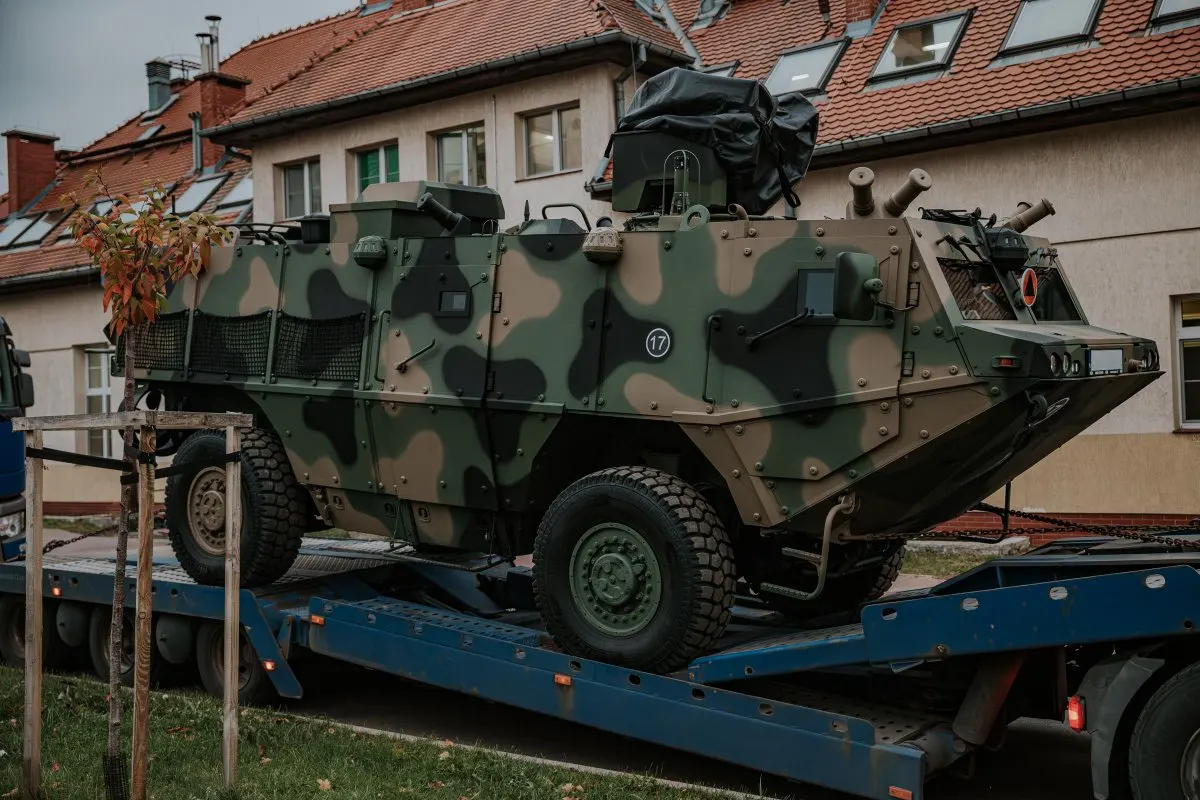
Poland’s Armament Agency began handing over the first serial-production LOTR Kleszcz (Tick) light armored reconnaissance vehicles to Land Forces reconnaissance subunits on October 21, 2026, starting the replacement of the Soviet-designed BRDM-2 scout cars still in Polish service. The first vehicles went to the 15th Giżycko Mechanized Brigade, part of the 16th Pomeranian Mechanized Division, and the agency said a second batch will reach the army before the end of 2026.
The deliveries flow from the first executive contract signed with AMZ-Kutno S.A. on August 14, 2024, covering 28 vehicles plus logistics and training packages for roughly PLN 800 million (about €187 million at signing), with deliveries running through 2028. That order sits under a February 28, 2024 framework agreement for 286 vehicles through 2035. A second executive contract for 24 more vehicles followed on May 29, 2026, financed through the EU’s Security Action for Europe (SAFE) loan instrument. The Armament Agency has not disclosed how many vehicles changed hands in the initial transfer.
LOTR Kleszcz Design: Bóbr-3 Chassis, Protection, and Mobility
The Kleszcz is built on AMZ-Kutno’s Bóbr-3 amphibious 4×4 chassis, developed under a National Centre for Research and Development (NCBR) contract signed in December 2013, with a consortium that also included the Military Communications Institute, the Military Institute of Armament Technology, and the Military Institute of Chemistry and Radiometry. The project’s end date was amended twice, and the prototype was sent for testing to the 17th Greater Poland Mechanized Brigade in August 2021.
Publicly available specifications indicate a vehicle 6.9 m long, 2.5 m wide, and 2.38 m high excluding sensor heads, with 400 mm of ground clearance. The Bóbr-3 platform has a gross vehicle weight of 15.6 tonnes, while reported weights for the Kleszcz range from 14 to 16 tonnes depending on armor level. Power comes from a 240 kW (326 hp) diesel mated to an Allison automatic transmission. Road speed reaches 90 km/h with a 600 km range on paved roads, and the vehicle makes 7 km/h afloat.
The self-supporting steel hull delivers STANAG 4569 Level 2 ballistic and Level 2a mine protection in base configuration, and add-on armor raises this to Level 3 and 3a. Against the BRDM-2, the Kleszcz adds mine protection.
ARSUS 100 Sensor Mast and Kongsberg Protector Armament Suite
The vehicle’s reconnaissance value rests on its mast. Turkish firm Aselsan supplies the ARSUS 100, a stabilized system combining a long-range ground surveillance radar, a day and night EO/IR head, and dead-reckoning navigation for target detection, identification, automatic tracking, and real-time video and data streaming. Aselsan signed a €16.6 million contract with AMZ-Kutno for radar and electro-optical payloads in November 2024, then an order for 24 additional ARSUS sets on September 8, 2026, for delivery in 2028 and 2029, a quantity matching the second executive contract. A communications and data-processing subsystem transmits encrypted reconnaissance data up to battalion level.
Armament consists of a Kongsberg Protector Dual remote weapon station carrying a 12.7 mm WKM-B heavy machine gun and a 7.62 mm UKM-2000 machine gun, intended for lightly armored vehicles, low-flying aerial targets, and infantry. A laser warning system and smoke grenade launchers are available, and the vehicle carries a five-soldier reconnaissance team, with a rating for up to five days of autonomous operation.
Analysis: The Kleszcz is less a combat vehicle than a mobile sensor node, and its worth will depend on how quickly its radar and EO/IR picture reaches brigade and division fires. Fielding it first with a brigade garrisoned in Warmia-Masuria, near Russia’s Kaliningrad exclave and the Suwałki Gap, puts that capability where NATO’s northeastern flank is most exposed. Survivability is the open question: a 4×4 with Level 2 base protection working near the line of contact faces a drone-saturated battlefield.
The next milestone is the second batch before year-end, with the first 28 vehicles complete by 2028 and the 24 SAFE-funded vehicles to follow. A contamination-reconnaissance variant on the Kleszcz chassis remains under study. Still unknown are Kutno’s annual production rate and the timing of further executive contracts toward the 286-vehicle total.