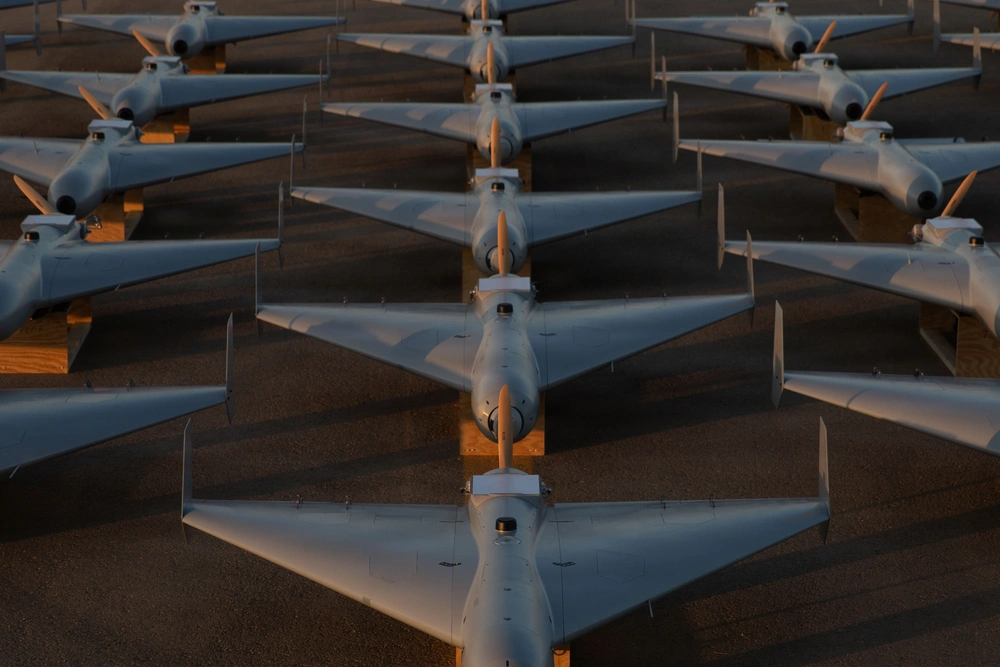
The Pentagon selected Shield AI on May 19, 2026, to integrate Hivemind autonomy software onto the Low-Cost Uncrewed Combat Attack System (LUCAS), a one-way attack drone, with a demonstration of one operator commanding a swarm due this fall, according to Shield AI. Russia is scaling jet-powered Geran drones, and Ukraine’s Main Intelligence Directorate (HUR) reports commercial artificial intelligence (AI) modules in Russian strike systems.
LUCAS, which U.S. Central Command (CENTCOM) says is modeled on Iran’s Shahed drones, entered combat on February 28, 2026, in Operation Epic Fury against Iran. CENTCOM priced it near $35,000 per unit; the Pentagon puts the family at $55,000 or less and said in March that inventory stood in the dozens. The fiscal 2027 request seeks $53.6 billion for unmanned efforts under the Defense Autonomous Warfare Group, up from $225.9 million in fiscal 2026.
How One-Way Attack Drones Move From Waypoints to Collaborative Autonomy
Publicly available specifications for the SpektreWorks FLM 136 target drone, from which LUCAS derives, indicate a 9.8-foot length, an 8.2-foot wingspan, a 215-cubic-centimeter carbureted engine, about six hours of endurance and a 40-pound (18.1-kilogram) payload. Manufacturer data lists a range of 444 nautical miles, while the Pentagon cites about 500 miles. Launch options include catapult, rocket-assisted takeoff and mobile ground systems. It is unclear whether every figure applies to the deployed configuration.
Hivemind changes the flight model. A conventional one-way attack drone follows preplanned waypoints and fails when conditions shift. Shield AI says Hivemind reroutes missions, avoids obstacles and coordinates groups in communications-constrained environments, with strike decisions remaining under human control. The same release says the software can sense, decide and act without human intervention, so the boundary rests on policy rather than airframe design. Hivemind has also flown on the Anduril YFQ-44A collaborative combat aircraft, so LUCAS extends an autonomy stack already flown on a larger, costlier platform.
Volume comes from the Drone Dominance Program, which planned orders of about 30,000 small one-way attack drones at $5,000 each after its first Gauntlet evaluation. The second Gauntlet at Fort Carson, Colorado, flew 1,858 sorties across 23 platforms from 19 companies; each of 11 long-range platforms reached 15 kilometers, against 24 percent of first-round drones reaching 10 kilometers. The department now plans purchases totaling about 60,000 drones from that vendor pool. On August 13, 2026, CENTCOM also announced Task Force Falcon Strike, a multinational one-way attack unit whose partners it has not named.
Jet-Powered Geran Output and Commercial AI Modules in Russian Strike Systems
HUR assessed on August 12, 2026, that Russia builds about 3,000 Geran-4 and Geran-5 jet-powered drones a month, against some 2,800 piston-engine Geran-2 units. The Ukrainian Air Force counted 350 jet-powered launches in June, 1,500 in July and 2,850 in August. Ukrainian intelligence data indicate the Geran-5 carries a warhead of about 90 kilograms, cruises at 450 to 600 kilometers per hour and reaches 950 to 1,000 kilometers. Examined airframes contained a Kometa-M12 jam-resistant satellite navigation receiver, an inertial unit, a mesh modem and a Chinese turbojet. Unconfirmed Ukrainian reporting from September 27 describes a Geran-5 K5 variant with an optical scene-matching module that navigates from ground imagery without satellite signals.
The same August 12 release identified an Nvidia Jetson Orin module in the S-71 Monochrome cruise missile, which HUR said may indicate onboard AI, along with passive radar seeker components that Russia has begun installing on Geran-2 drones to engage surface-to-air missile systems and radars. Ukrainian intelligence earlier reported Jetson modules in the V2U strike drone. Publicly available specifications indicate the Orin NX delivers up to 157 trillion 8-bit integer operations per second. Nvidia says it does not sell the Jetson line in Russia and cannot track secondary sales.
Ukrainian Air Force data show Russia launching about 4,450 long-range drones in January, a record 8,150 in May and nearly 5,000 in July.
Interceptor Economics and Electronic Warfare Limits Against Autonomous Strike Drones
Publicly reported unit costs frame the exchange. A Shahed-class drone is commonly estimated at $20,000 to $50,000, a Patriot interceptor near $4 million and a Coyote interceptor near $125,000, while Ukrainian interceptor drones are reported at roughly $2,000 to $15,000. At those figures a Coyote round costs about 3.6 times a LUCAS and a Patriot about 114 times.
Gulf states reported interception rates of 80 to 90 percent in March, figures the United States did not independently verify, and interceptor inventories in the Gulf were reportedly running low. Those states relied on helicopters, fixed-wing aircraft and short-range ground defenses, and the United States also has Coyote, Roadrunner and Advanced Precision Kill Weapon System (APKWS) rounds designed for the mission. Iran has launched thousands of drones during the war, and multiple strikes evaded defenses.
Autonomy erodes the cheapest defense. Gen. Dan Caine, chairman of the Joint Chiefs of Staff, told the Air, Space and Cyber Conference on September 16 that some Ukrainian first-person-view drones now use AI-enabled computer vision to keep flying at targets after satellite navigation or datalinks fail, and that U.S. planners should assume formations will be hunted by autonomous systems. Reported optical navigation on Russian jets points the same way, so jamming and spoofing lose value and defenders lean on kinetic, directed-energy and machine-vision countermeasures. Speed adds pressure: Gerans cruise at 450 to 600 kilometers per hour against roughly 185 for the piston Geran-2, although Ukrainian units reported that a new interceptor drone downed a Geran-5 flying at 425 kilometers per hour in late September.
Analysis: Autonomy shifts the contest from airframes to software and components. Onboard vision and optical navigation blunt jamming, mass production sustains saturation, and commodity AI modules move through resale channels that export controls have not closed. For U.S. systems, strike authority rests on policy rather than architecture, since the software that lets one operator command a swarm can also act without a link. Defenders gain only if interceptors cost less than their targets and sensors scale with the threat.
Shield AI’s swarm demonstration remains undated. Gauntlet 2.5, focused on bomber drones, is planned for October, and Gauntlet 3 is due about six months after Gauntlet 2. The Convention on Certain Conventional Weapons review conference opens November 16 in Geneva, where states decide whether to negotiate on autonomous weapons. National Security Presidential Memorandum 11 gave the Pentagon 90 days from June 5 to update Department of Defense Directive 3000.09; no revised text was public as of September 29. Unknown: current LUCAS production rates.