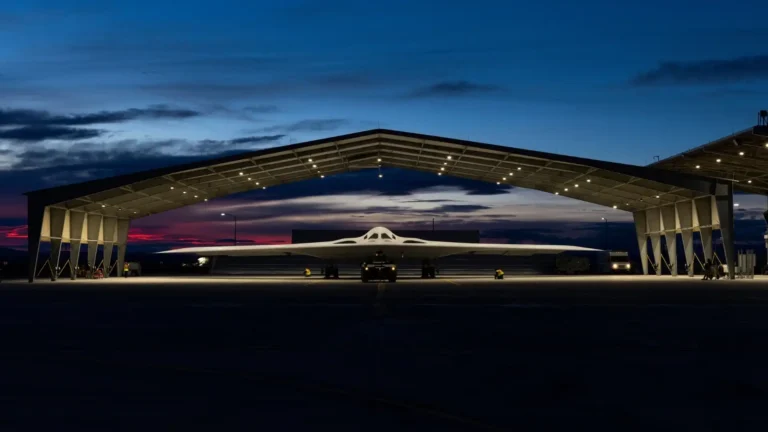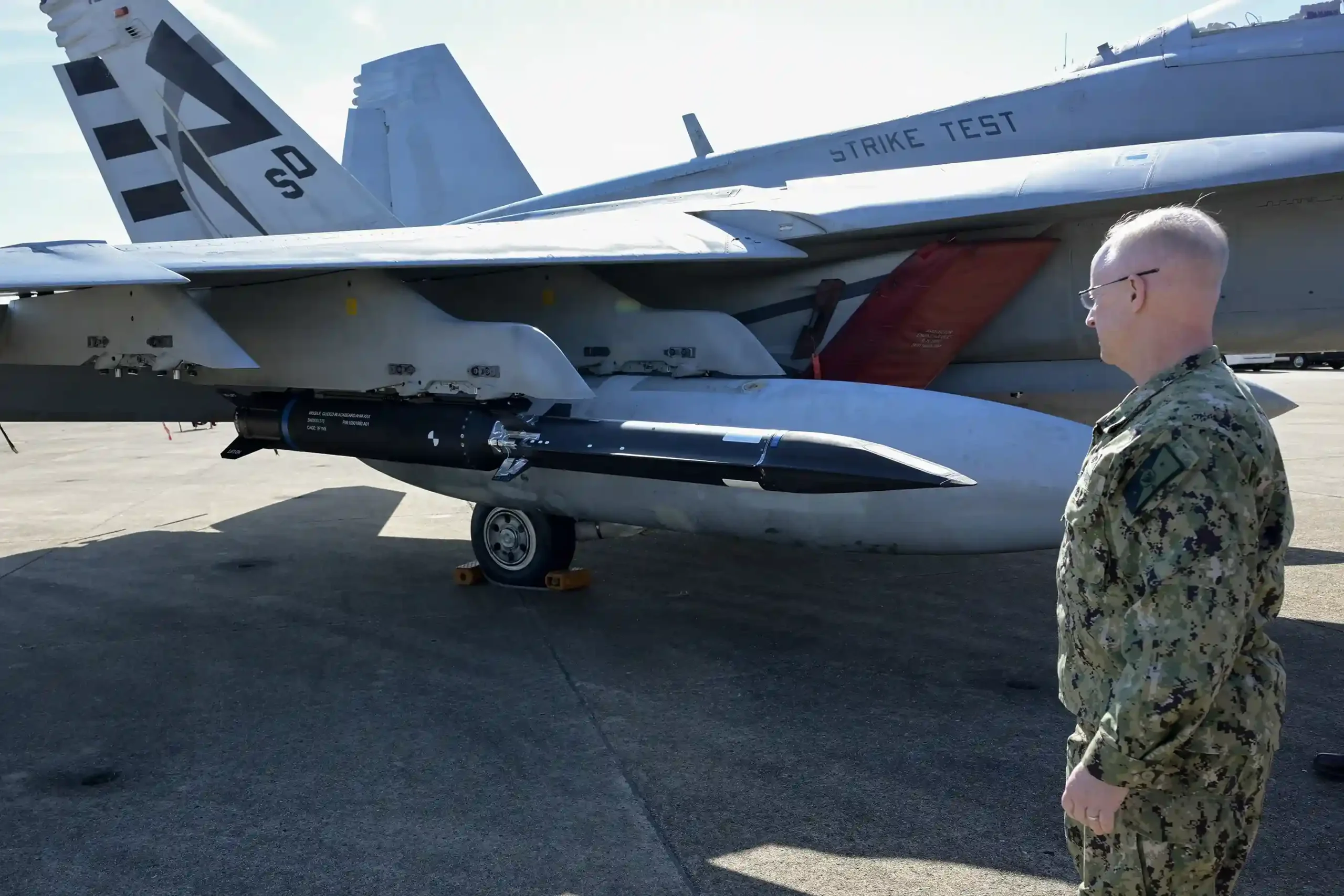
Chief of Naval Operations (CNO) Adm. Daryl Caudle visited Naval Air Station (NAS) Patuxent River, Maryland, on October 28, 2026, using the stop to tie the base’s aviation test enterprise directly to fleet lethality while pressing for endurance, upgradable airframes and autonomous systems. Caudle addressed personnel inside the newly built MQ-25A Stingray test hangar, then toured Air Test and Evaluation Squadron (VX) 23 for a briefing on the Navy’s Blackbeard air-launched hypersonic strike missile.
The visit followed Caudle’s October 26 address at the Navy Memorial’s Fantail Breakfast in Washington, D.C., in which he named adaptation and endurance as the two attributes the Navy needs in the decades ahead. Pax River, headquarters of Naval Air Systems Command (NAVAIR), is where several programs carrying that agenda now converge: the station hosts the newly built test hangar of the MQ-25A, the Navy’s first carrier-based uncrewed aircraft, and Blackbeard entered developmental flight testing on the F/A-18E/F Super Hornet at the station this year.
CNO Caudle Links Pax River Test Work to Fleet Readiness
Caudle framed the station’s research, development, test and evaluation (RDT&E) mission as a direct input to deployed combat power. “There are a lot of things going on in this space and anything that flies, you know there is a certain standard that has to be maintained,” he said. “The sustainment model has to be really pristine and the work that goes on here at Pax River is so inextricably tied to that readiness model.”
On administrative bottlenecks in incentive programs such as the Military Cash Award Program (MILCAP) and in leave structures, Caudle acknowledged the need to streamline internal processes and committed to engaging leadership to improve efficiency.
He closed the all-hands by restating the “Total Sailor: Fit to Fight” initiative, launched in September 2025. The program rests on physical, mental and spiritual pillars. At Pax River, Caudle singled out proactive nutritional health, sleep discipline, mental fitness and predictable career paths as readiness investments, arguing that the Navy’s combat edge begins and ends with its sailors.
MQ-25 Stingray and RASWDC Anchor the Air Wing of the Future
Asked where future naval aviation research should focus, Caudle called adaptability and endurance “the Holy Grail of modern warfare.” “Endurance is such a crucial part of modern warfare, and then we see in spades the need to adapt quickly; the upgradability of airframes is so important,” he said. Pointing to the MQ-25 Stingray, he noted that autonomous systems are foundational to extending the reach and survivability of the carrier air wing.
The Boeing-built MQ-25A flew its first production-representative sortie on April 25, 2026, received Milestone C approval in May and entered low-rate initial production with a $562 million contract on September 14 for three aircraft plus long-lead parts for three more. Powered by a single Rolls-Royce AE 3007N turbofan, the aircraft is designed to deliver about 15,000 pounds of fuel at 500 nautical miles from the carrier, returning Super Hornets now flying organic tanker missions to strike duties. The program of record stands at 76 aircraft, but initial operational capability, once planned for 2024, has slipped to 2029.
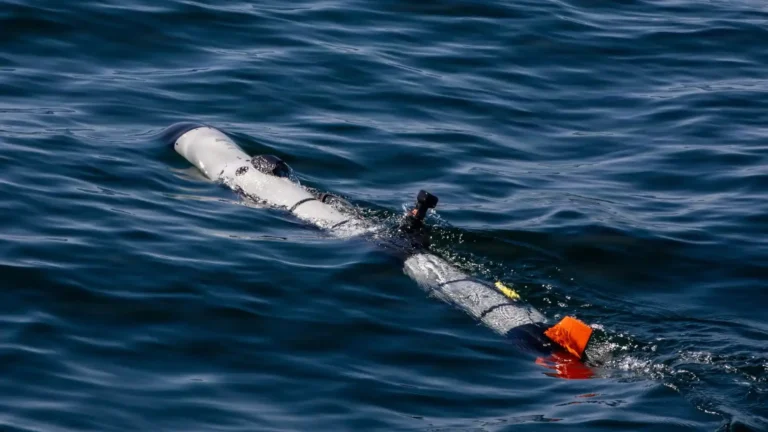
Caudle also urged developers toward open architecture “plug and play” systems and away from “Frankensteined” software, favoring integrated code that any branch of the service can upgrade. He pointed to the Robotic and Autonomous Systems Warfighting Development Center (RASWDC), established September 24 at Joint Expeditionary Base Little Creek-Fort Story, Virginia, as an Echelon 3 command under U.S. Fleet Forces Command. The center develops tactics, techniques and procedures for uncrewed systems. “I have to have [an unmanned system] in the middle of the Pacific Ocean and be able to launch it, recover it, sustain it and bring lethality from it,” Caudle said.
Blackbeard Hypersonic Missile Advances Through Super Hornet Testing
At VX-23, Caudle examined Blackbeard, the air-launched, long-range hypersonic strike missile developed by Torrance, California-based Castelion under the Navy’s Multi-mission Affordable Capacity Effector (MACE) program. A Super Hornet recently flew a developmental test at Pax River carrying two Blackbeard test articles; neither was released or live-fired, and both returned with the aircraft.
Blackbeard is designed to exceed Mach 5 against maritime and land targets, giving carrier-based fighters a fast, standoff option against advanced air defenses. Reported MACE requirements call for a 75-pound (34-kilogram) warhead, far lighter than those of the AGM-84 Harpoon or the AGM-158C Long Range Anti-Ship Missile (LRASM), and for internal carriage of up to four rounds on the F-35A/C. The Navy has not released official range, warhead or guidance figures for Blackbeard; open-source estimates in the hundreds of miles remain unconfirmed.
Funding has moved quickly: a $49.9 million award in February 2026, a $105 million Super Hornet integration contract in April, roughly $90 million in August to reach early operational capability (EOC), and a production contract worth up to $200 million whose first tranche covers 444 all-up rounds. The Navy targets EOC by 2028.
Analysis: Caudle is selling one proposition across people, platforms and software: endurance and upgradability over fixed, exquisite configurations. MQ-25 and Blackbeard are the most concrete tests of that bet. The tanker would push the air wing’s strike radius outward and free Super Hornets for combat, while a low-cost, mass-producible hypersonic round addresses magazine depth against layered air defenses in the Western Pacific. Both programs, however, sit ahead of their hardest milestones. MQ-25 has yet to launch from a carrier deck after a five-year slip, and Blackbeard has flown on the Super Hornet only in captive carriage. The warning against fragmented software is effectively a requirement for RASWDC: autonomy that cannot be updated fleet-wide will not deliver the endurance the CNO describes.
Next milestones include the first MQ-25A operations from a carrier deck, the first live release of Blackbeard from a Super Hornet, and initial doctrine output from RASWDC. The Navy has not set a date for Blackbeard’s first live fire, nor said whether the MILCAP and leave fixes Caudle discussed will be formalized in policy.