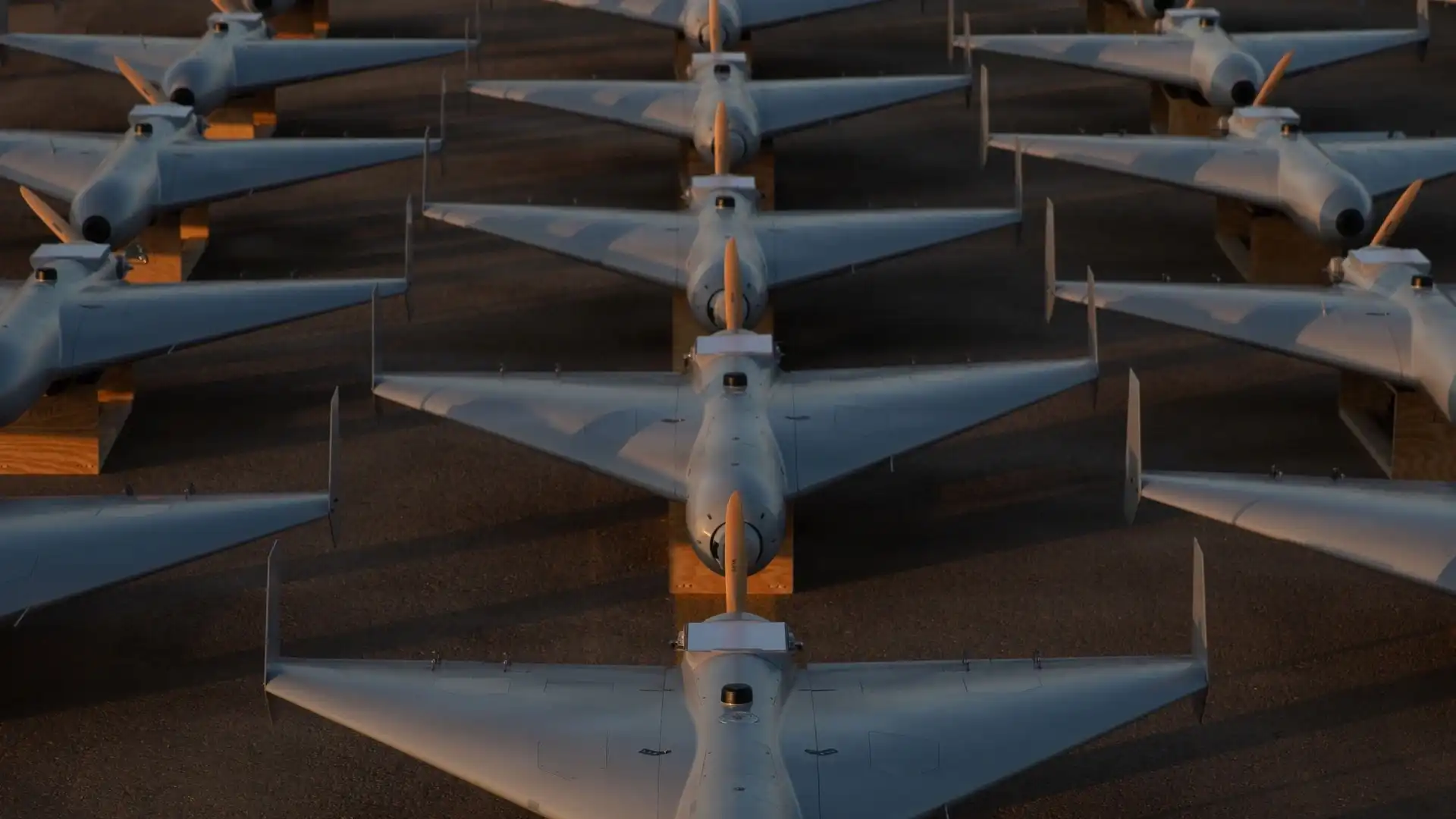
The US Department of War has selected Machina, through its Organic Industrial Base Modernization Challenge, to develop and qualify a metal airframe for a Low-Cost Uncrewed Combat Attack System (LUCAS)-class drone and field two expeditionary robotic factories to build it, the Los Angeles company announced on November 6, 2026. The 18-month trial is worth $9 million, Bloomberg reported.
The award comes as the Pentagon looks beyond a single source for the one-way attack drone that SpektreWorks of Phoenix derived from the Iranian Shahed-136. LUCAS entered combat on February 28, 2026, during Operation Epic Fury, less than three months after US Central Command stood up Task Force Scorpion Strike. The government owns the design, which allows other manufacturers to build it.
How Machina Plans to Qualify a LUCAS Drone Airframe
Machina Bellator, the company’s defense subsidiary, leads the effort. Development and qualification begin at Machina’s Los Angeles facilities, after which the company will deploy two Edge Factories to produce structures closer to the point of need. Each pilot site will initially center on one containerized RoboCraftsman cell, supported by forward-deployed engineers, software, and additional production equipment. Machina says the sites need minimal preparation, and a factory could be established in roughly a month, according to Bloomberg.
RoboCraftsman uses paired industrial robots to form sheet metal incrementally from digital geometry, a process Machina markets as RoboForming. With no dies or hard tooling involved, a design change becomes a software change rather than a new tooling cycle. Mehr said low-cost production at scale “requires a manufacturing model that can move as quickly as mission requirements change.”
The project is one of six selected by America Makes and the National Center for Defense Manufacturing and Machining under the challenge, which the Office of the Under Secretary of War’s Manufacturing Technology Office funds to advance production methods for the government’s depots, arsenals, and plants. Machina calls the work the largest single award in its history. The scope remains limited: chief executive Ed Mehr told Bloomberg the contract is meant to prove the technology rather than buy drones in quantity, and that follow-on orders are not guaranteed. Machina’s announcement does not identify the factory locations, planned output, or sponsoring military service.
In July 2026, Lockheed Martin awarded Machina a qualification contract supporting the Joint Air-to-Surface Standoff Missile, the first time an assembly from a Machina factory advanced to qualification for a missile system. Machina’s $124 million Series C round in February 2026 funds a 200,000-square-foot plant designed for up to 50 RoboCraftsman cells, while the Edge Factories test dispersal of single cells.
LUCAS Specifications, Unit Cost, and the Edge Factory Production Model
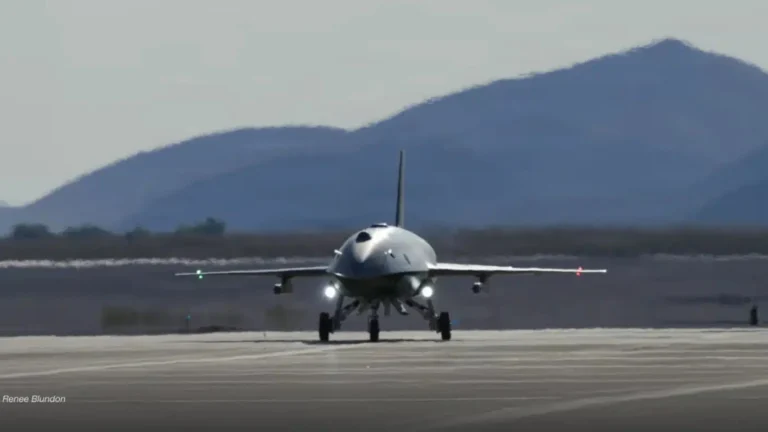
SpektreWorks has not published LUCAS specifications. Publicly available data for its related FLM 136 target drone indicate a length of about 3 meters, a wingspan of about 2.5 meters, a maximum takeoff weight of 180 pounds (81.5 kilograms), a 40-pound (18-kilogram) payload, six hours of endurance, and a 74-knot cruise speed. Published range figures run from about 650 to 714 kilometers. Those parameters set the bar for Machina: a structure light enough to preserve payload and range, at a price that justifies expending it.
LUCAS is widely reported at about $35,000 per round, while Machina is targeting roughly $15,000 per drone and says its method could eventually support tens of thousands of aircraft a year, according to Bloomberg. Available figures do not specify whether that target covers the engine, guidance, and warhead. Machina argues that formed sheet metal can undercut composite airframes, which typically depend on labor-intensive assembly. The alloy and structural weight for this airframe remain undisclosed, leaving open how metal construction would affect range and payload.
The technical basis is a workflow built with software firm nTop. The teams created a parametric airframe model, ran automated structural and computational fluid dynamics analysis across dozens of variants, and turned revised geometry into formed metal within days. Machina has since flown a demonstrator built the same way. The flight article, about 6 feet by 4.5 feet with four formed metal panels, reached completed assembly two weeks after final design lock. It is considerably smaller than the roughly 10-foot LUCAS, so scaling to a full-size airframe remains part of what the trial must prove.
Machina presents each Edge Factory as a Modular Open Systems Approach production node able to build a family of mission-specific airframes from one cell. Range and other requirements would change in the parametric model, on the same equipment. That flexibility bears on emerging requirements: US Army leaders discussed concepts in October for using LUCAS against warships and mobile ballistic missile launchers, missions that demand longer range, resistance to electromagnetic interference, and sufficient warhead effect.
Analysis: The trial will show whether airframe output can be separated from a fixed industrial site. Formed structure is only one constraint on one-way attack drone production, however. Engines, navigation and datalink components, and warheads would still move through conventional supply chains, and a forward factory ties down skilled engineers while presenting a target. If qualification data transfer from Los Angeles to dispersed cells, the Department gains a template that extends beyond LUCAS. If each site requires separate validation, the speed advantage narrows.
The next markers are airframe qualification in Los Angeles, disclosure of the two Edge Factory sites, and evidence that the $15,000 target holds at rate. An 18-month schedule points to results in the first half of 2028, although the start date has not been disclosed.