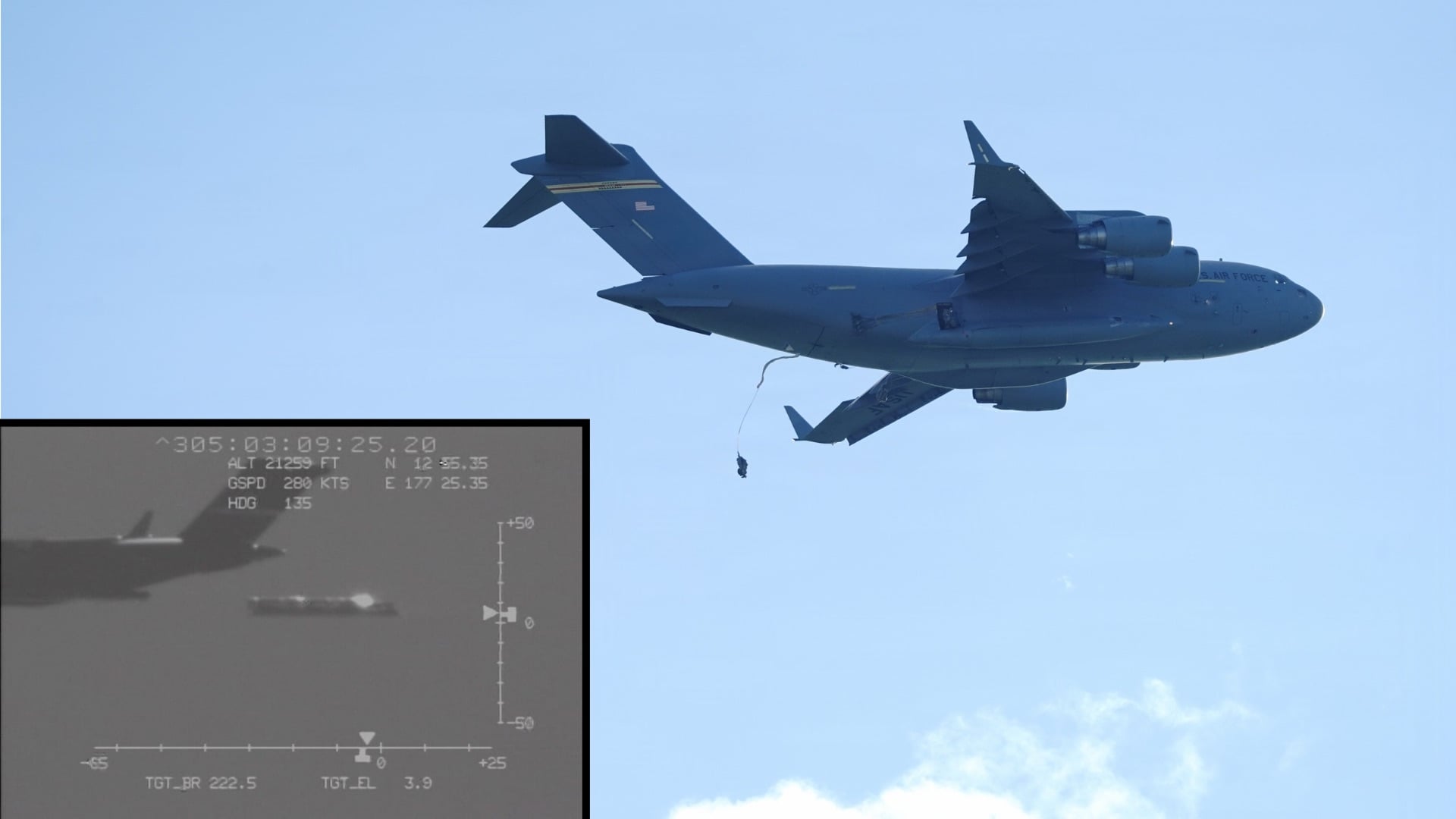
U.S. Air Force leaders said at the Airlift/Tanker Association’s 2026 Symposium in Kissimmee, Florida, that C-17 Globemaster III and C-130 Hercules airlifters are close to launching palletized cruise missiles. Gen. Kenneth S. Wilsbach, the Air Force chief of staff, addressed the Family of Affordable Mass Missiles-Palletized (FAMM-P) weapon on November 6, 2026, Air & Space Forces Magazine reported. The Dragon Cart launch program targets fielding in 2027.
The effort responds to a stockpile problem that Operation Epic Fury, the war with Iran, made concrete. U.S. strike aircraft fired roughly 1,100 Joint Air-to-Surface Standoff Missile-Extended Range (JASSM-ER) rounds, against an estimated prewar JASSM inventory of 4,400, according to figures tied to an April 2026 analysis by the Center for Strategic and International Studies. That analysis put JASSM lead times at about 24 months historically and often 36 months or more now.
How Palletized Cruise Missiles Leave the C-17 Cargo Hold
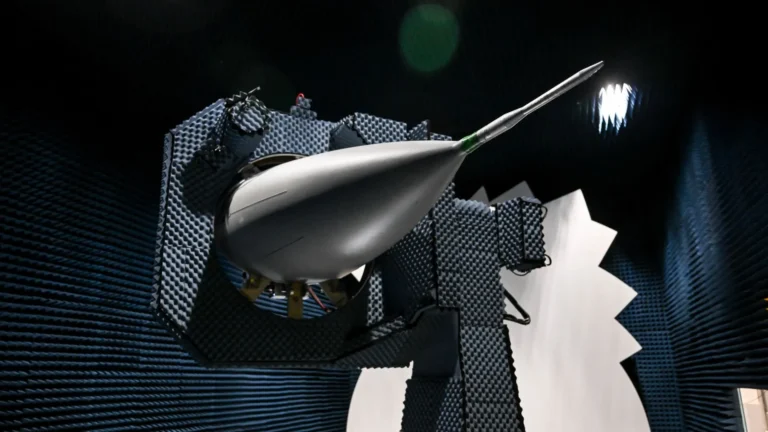
Dragon Cart places a specialized container loaded with cruise missiles on a standard airdrop platform. Crews release the load like any other airdrop. The container deploys a parachute, the missiles separate, start their engines, pull up, and fly toward their targets. Wilsbach said the concept goes beyond rolling unguided munitions off a ramp, describing the system as modular and the weapons as networked. Lt. Gen. Dan Tulley, commander of Air Mobility Command, told the same conference that C-130s and C-17s could deliver “mass fires on the adversary” with FAMM-P.
The system integrates standard airlift and airdrop equipment with the government-owned Battle Management System, according to the Air Force Life Cycle Management Center (AFLCMC). Program officials say the approach creates operational ambiguity for an adversary. The government also retains control of the technical baseline, allowing launch modules to be resized for new payloads through digital models.
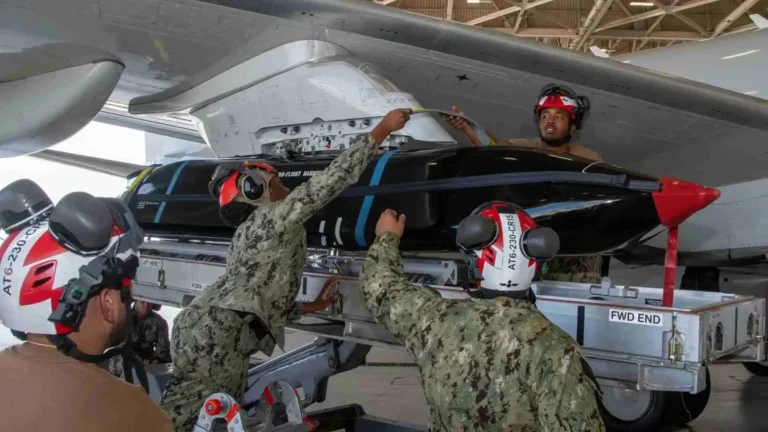
The concept descends from the Air Force Research Laboratory’s Rapid Dragon experiments, which began in 2019. In a December 2021 live-fire test at Eglin Air Force Base, Florida, an MC-130J Commando II dropped a four-cell pallet carrying one live JASSM-ER and three mass simulants. Available program documents do not specify a FAMM-P load per pallet. On April 1, 2026, management moved to AFLCMC’s Combat Readiness Directorate, making Dragon Cart a program of record on the Middle Tier Acquisition rapid fielding pathway.
FAMM-P and its sibling, FAMM-Lugged, carried by fighters and bombers, target ranges of 250 to 500 miles (400 to 800 kilometers). Budget documents identify the palletized version as the first priority.
FAMM Budget, Vendors, and the Cost Gap With JASSM
Wilsbach put each FAMM-P at about one-tenth the cost of a JASSM, with lead times measured in months rather than years. JASSM unit estimates run from about $1.5 million to $2.6 million depending on variant, implying roughly $150,000 to $260,000 per FAMM-P. The fiscal 2026 budget request priced 3,010 FAMM rounds at $656.3 million, or about $218,000 each.
Later budget lines run higher. The fiscal 2027 request seeks $355 million for 1,000 weapons, including $300 million in reconciliation funds and $55 million in base funding for an Extended Range variant. Planned buys then climb to 5,300 rounds in fiscal 2028, 5,920 in 2029, 7,700 in 2030, and 7,990 in 2031, for nearly 28,000 weapons and $12.6 billion. That total averages about $450,000 per round, roughly double the fiscal 2026 figure. The documents do not split quantities between palletized and lugged versions, so a FAMM-P unit price cannot be derived from them.
The Pentagon announced framework agreements on July 15, 2026, with Anduril for its Barracuda-500, CoAspire for the Rapidly Adaptable Affordable Cruise Missile, and Zone 5 Technologies for the AGM-188 Rusty Dagger. The agreements are not missile orders: the weapons must complete testing and qualification, and purchases depend on congressional appropriations. Anduril says its agreement runs seven years with deliveries starting in 2027, and that the Air Force intends to buy up to 8,000 rounds annually across all vendors.
Analysis: FAMM-P shifts part of the strike capacity problem from missile supply to airlift availability. The 7,990 rounds planned for fiscal 2031 compare with a projected JASSM buy of 860 per year, a ratio above nine to one. Each C-17 or C-130 sortie assigned to strike is a sortie not moving forces or cargo. Wilsbach told mobility Airmen that such weapons “blur the distinction” between combat and mobility mission sets, calling that a cultural shift. The Air Force’s 2025 request for information on a lugged affordable cruise missile called for a warhead of at least 100 pounds, against the 1,000-pound class on JASSM, positioning this class of weapon as a complement to high-end missiles rather than a replacement.
Next milestones include weapons qualification, congressional action on fiscal 2027 funding and multiyear authority, and first FAMM deliveries in 2027. The Air Force has sought industry input on FAMM-Beyond Adversary Reach, a variant with a range above 1,200 miles. Available Air Force statements have not confirmed pallet loadouts or the vendors for Dragon Cart prototype awards planned for May 2026.