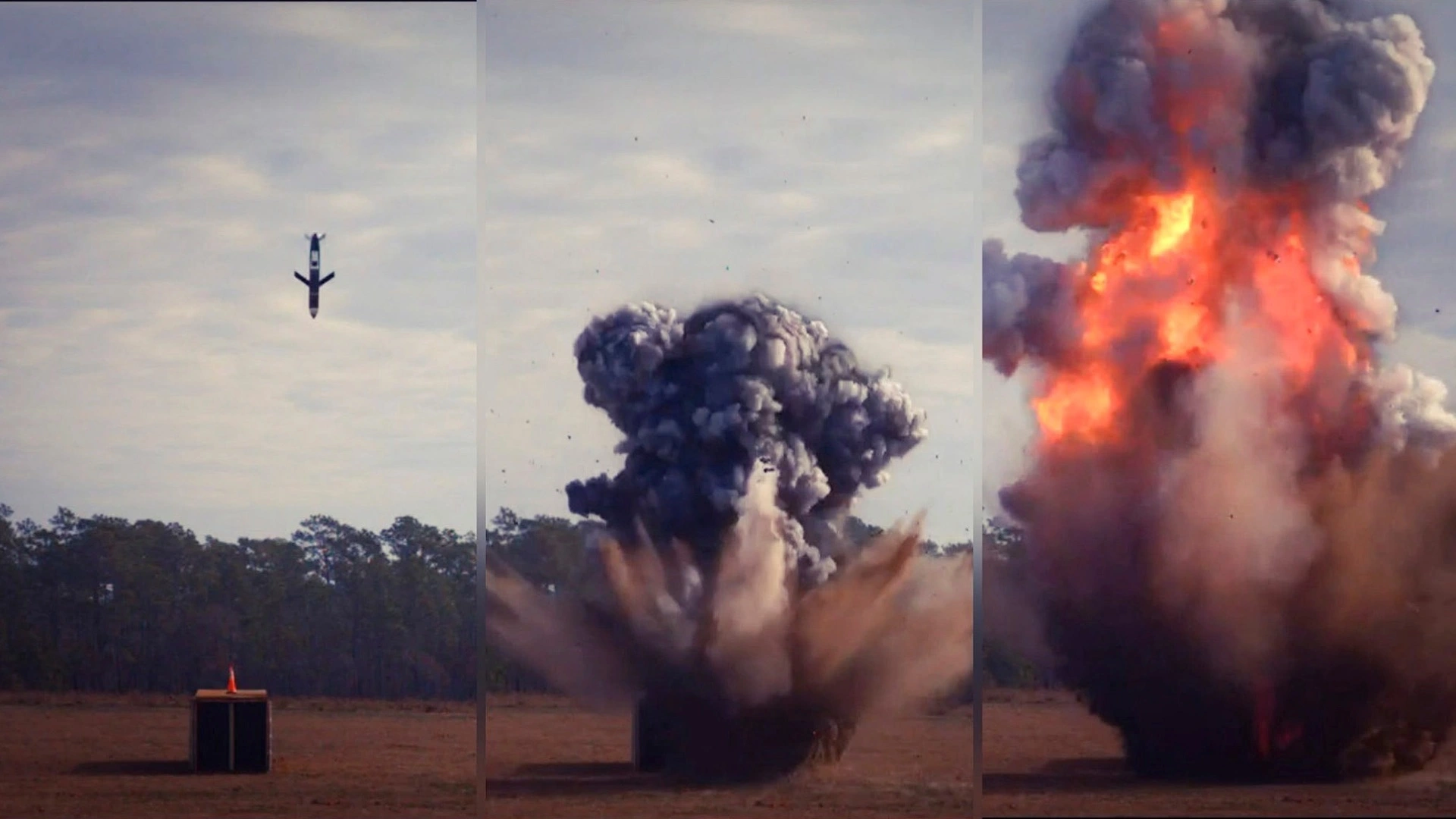
The Extended Range Attack Munition (ERAM) program is a U.S. Air Force effort to field a low-cost, mass-producible, air-launched cruise missile in the 500-pound class, with a range of at least 250 nautical miles (463 kilometers). Started in 2024 with Ukraine as the intended recipient, the ERAM program has two designs: Zone 5 Technologies’ AGM-188A Rusty Dagger and CoAspire’s Rapidly Adaptable Affordable Cruise Missile (RAACM). The State Department approved a possible sale of up to 3,350 rounds to Ukraine on August 28, 2025, at an estimated $825 million.
ERAM fills the gap between two weapon classes Ukraine already had. JDAM-ER kits, Small Diameter Bombs, and French Hammer weapons reach roughly 40 to 45 miles (64 to 72 kilometers), which keeps launch aircraft near the front. Storm Shadow and SCALP-EG reach around 300 miles but arrive in small numbers, at around $1 million or more each. ERAM gives up speed and warhead size to offer long standoff range at a price meant for purchases in the thousands.
Why Did the Air Force Create the ERAM Program?
The Air Force opened the effort in January 2024 with a Request for Information that did not mention Ukraine. Sixteen companies answered. A request for proposals issued in July 2024 by the Armament Directorate at Eglin Air Force Base, Florida, then stated that “Ukraine is the intended recipient” and described “an affordable mass weapon to be produced at scale.” Contracts went to Zone 5 and CoAspire in October 2024. Aviation Week reported in September 2025 that the Weapons Capacity Task Force behind ERAM had a $225 million budget.
Air Force acquisition leaders have singled out the program’s pace. Brig. Gen. Robert Lyons III told the Senate Armed Services Committee on March 24, 2026, that ERAM “entered production 14 months after the first contract was awarded.” On January 21, 2026, less than 16 months after that first award, a live-warhead shot at Eglin met the service’s primary objectives, including a full warhead detonation. Zone 5 said its Rusty Dagger was the weapon demonstrated. The Air Force did not say whether CoAspire’s missile took part.
ERAM Missile Range, Speed, and Accuracy Requirements
The Air Force published the same performance floor in January 2024 and again in November 2026. The arms sale notification to Congress adds propulsion, guidance, and target type.
- Class: 500-pound air-launched weapon
- Range: at least 250 nautical miles (463 kilometers)
- Speed: at least Mach 0.6; subsonic, turbojet-powered
- Accuracy: half of the weapons within 10 meters of the aim point, with or without heavy electromagnetic interference, including degraded GPS
- Effects: blast, fragmentation, and limited penetration, with variable fuze options
- Guidance: GPS/inertial, with an embedded unit using a SAASM, Y-Code, or M-Code receiver
- Targets: armored and soft stationary targets, per the notification
These are minimums, and delivered performance is less clear. Rusty Dagger has been reported at 300 nautical miles at low altitude and 500 nautical miles from medium altitude, while Zone 5 officials have also cited a strike range of 250 miles. CoAspire describes RAACM’s reach only as hundreds of miles.
The accuracy line is the demanding one, since 10 meters with GPS degraded is hard to hold on inertial navigation alone. Rusty Dagger reportedly has an option for autonomous visual navigation, and CoAspire says RAACM carries a long-wave infrared nose sensor. The 500-pound class also matches the Mk 82 bomb that older fighters already carry. Zone 5 says only 72 hours were needed to integrate Rusty Dagger on the F-16.
Who Makes ERAM? Zone 5’s Rusty Dagger and CoAspire’s RAACM
Zone 5 is a California company founded in 2011. Norway’s Kongsberg closed the purchase of a 90 percent stake in June 2026, with Zone 5’s management keeping the rest. Rusty Dagger has been cleared on four fighter types, and Zone 5 executive Tom Kanewske said in June 2026 that the year’s output would be “well above 1,000 units,” including rounds for the U.S. Air Force. Production is established in San Luis Obispo, California, is starting in the Dallas-Fort Worth area, and a franchised site is planned in Miamisburg, Ohio. The company says each site is designed to exceed 2,500 missiles a year by the end of 2027.
CoAspire, based in Virginia, builds RAACM at its Manassas plant under a U.S. government contract. The missile’s fuselage, wings, and fins are 3D-printed by Divergent Technologies, and its first disclosed flight test came from an A-4 Skyhawk in March 2025. CoAspire has published no unit cost or firm range. The split of the Ukraine order between the two designs has not been disclosed.
How Much Does an ERAM Cruise Missile Cost?
No official unit price has been published. The best public indicator is the notification to Congress, which assigns $739 million in Major Defense Equipment to up to 3,350 missiles and 3,350 embedded GPS/inertial units, or about $221,000 per missile and navigation unit. The other $86 million covers items such as missile containers, pylons, mission-planning hardware, training, and logistics support. Both amounts are estimated maximums.
That estimate sits close to the roughly $218,000 per round reported for the Air Force’s related affordable missiles, against more than $1.3 million for a Joint Air-to-Surface Standoff Missile. The Air Force’s five-year plan of $12.6 billion for nearly 28,000 such rounds averages about $450,000 each, so per-round figures should be read with caution. Ukraine’s purchase is funded by Denmark, the Netherlands, Norway, and U.S. Foreign Military Financing.
Has Ukraine Received and Used ERAM Missiles?
Aviation Week, citing Air Force documents, reported that a first lot of 840 missiles was due by the end of October 2026. The Air Force has not said publicly how many have reached Ukraine. Zone 5 has said Rusty Dagger is the only publicly reported operational missile in its class fielded by the Ukrainian military.
The strongest public claim of combat use concerns the Voronezh Semiconductor Devices plant, which makes electronics for Russian missiles and was hit on June 22, 2026. Russian military channels attributed the strike to Rusty Dagger after debris was traced to a Zone 5 antenna. Naval News reported that the missiles flew more than 200 miles and were launched from Ukrainian MiG-29s and Su-27s, with F-16s to be modified later. Neither Washington nor Kyiv has officially confirmed the weapon’s use.
How the ERAM Program Fits With FAMM and the 2026 Production Push
Kongsberg describes ERAM as the export initiative of the Air Force’s Family of Affordable Mass Missiles (FAMM). On July 15, 2026, the Pentagon announced FAMM framework agreements with Anduril for Barracuda-500, CoAspire for RAACM, and Zone 5 for Rusty Dagger, targeting up to 8,000 missiles a year once production ramps. The fiscal 2027 budget seeks $355 million for 1,000 FAMM rounds.
A new Request for Information, posted November 2, 2026, asks who can deliver more than 1,000 ERAM rounds, starting within three months of award and finishing within 15 months. The 2024 notice asked for more than 1,000 within 24 months, about 42 a month. The new terms imply more than 83 a month if first deliveries arrive at the three-month limit. The notice opens a two-step Other Transaction competition, requires the ability to obtain an active Top Secret/SCI facility clearance, and names no customer. A companion notice covers ERAM Glide, an unpowered 500-pound-class version with about 105 pounds of explosive.
Analysis: ERAM’s requirements are modest by cruise missile standards, and that is the design logic. Mach 0.6 and a 250-nautical-mile floor would not define a premium weapon, but they are enough to hold launch aircraft well back from the front at a cost that allows thousands of rounds. Lower cost does not remove the hard parts: 10-meter accuracy under jamming remains a demanding requirement, and sustaining more than 83 rounds a month would test a supply base that rests on two firms. The ERAM program’s real measure will be whether it can hold that rate, and whether Kyiv or Washington ever confirms what the missile has done in combat.