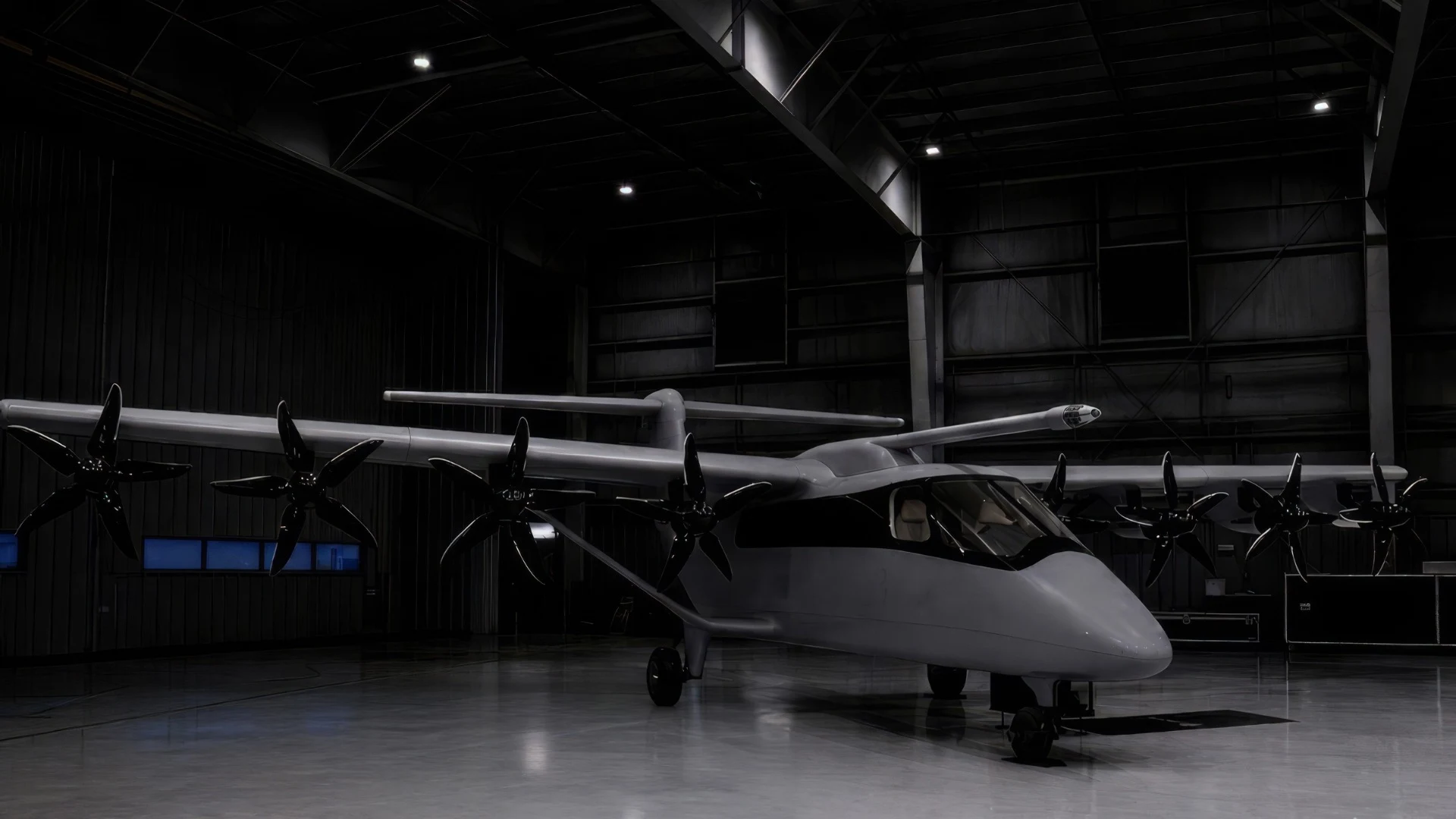
The Air Force Research Laboratory (AFRL) has awarded Electra Defense a $4.7 million innovative capabilities opening (ICO) contract to ground test and flight test the company’s hybrid-electric power and propulsion technologies, the Manassas, Virginia-based firm announced on November 9, 2026. The effort centers on the Electra EL9, a nine-passenger ultra-short takeoff and landing (Ultra-STOL) aircraft, and will generate performance data the U.S. Air Force will use to assess whether the design can support distributed operations under its Agile Combat Employment (ACE) doctrine.
The award extends a partnership that took shape in 2023, when AFWERX, AFRL’s innovation arm, granted Electra a Strategic Funding Increase (STRATFI) valued at up to $85 million to develop a full-scale preproduction aircraft. From late August to early September 2025, the company’s two-seat EL2 demonstrator was the only industry participant in AFRL’s Future Flag 25-3 experimentation event in Rome, New York, flying tactical airlift scenarios with the 109th and 103rd Airlift Wings and powering up an MQ-9 Reaper on the ground. ACE disperses aircraft, personnel and cargo across austere sites to complicate adversary targeting, which puts a premium on airlift that does not depend on long, prepared runways.
What the AFRL Contract Funds on the Electra EL9 Program
The ICO covers three lines of technical work. The first is verification of key hybrid-electric power and propulsion technologies. The second is extensive ground testing of the EL9 preproduction aircraft. The third is acoustic flight testing to characterize the aircraft’s ability to conduct battery-only, low-signature ingress and egress for special operations missions.
A parallel modeling and simulation effort will quantify operational effects: the ability to operate from a wider range of locations, support rapid dispersal of personnel and time-sensitive cargo, and reduce dependence on traditional aviation infrastructure and ground support equipment. According to the company, the findings will inform future Air Force technology development and acquisition decisions.
“Power and propulsion are fundamental to unlocking new capabilities for military aviation,” said Donn Yates, Vice President and General Manager of Electra Defense. “Through this effort, we’re moving to generate real-world aircraft performance data that will help the Air Force evaluate how these technologies can support more agile, distributed, and resilient operations.”
The period of performance, test locations and the airframe for the acoustic trials are undisclosed. With EL9 first flight expected in late 2027 or early 2028, early flight work may rely on the EL2.
EL9 Hybrid-Electric Architecture: Blown Lift and Distributed Propulsion
The EL9 uses eight electric motors distributed along the wing. Their propellers accelerate airflow over the wing and flaps, a blown-lift approach that generates high lift at low airspeed and, per Electra’s published specifications, allows takeoff and landing in as little as 150 feet. Four independent battery packs work with a Safran TG600 turbogenerator, a 600 kW unit derived from the Arrano helicopter engine and fitted with two GENeUS generators. The batteries recharge in flight, so forward sites need no charging infrastructure.
Publicly available specifications list a payload of nine passengers with baggage or 3,000 pounds of cargo, a 175-knot cruise speed, 330 nautical miles of range with payload and 1,100 nautical miles of ferry range. Electra Defense markets a military profile of 1,000 pounds carried over 1,000 nautical miles and 600 kW of exportable expeditionary power on the ground, a capability the EL2 demonstrated by powering up an MQ-9 at Future Flag. The company claims 2.5 times the payload, 10 times the range and 70 percent lower operating costs than helicopters and electric vertical takeoff and landing (eVTOL) aircraft; those figures have not been independently validated, which is precisely the gap this contract is meant to close.
Each attribute maps to an ACE problem. Short-field performance widens the pool of usable landing sites, onboard generation reduces the fuel and power footprint at a spoke location, and a battery-only acoustic mode supports quiet infiltration and exfiltration.
Analysis: The dollar value is modest, but the contract buys something the Ultra-STOL concept has lacked: government-directed, measured data on a preproduction airframe rather than demonstrator flights and manufacturer claims. Hybrid-electric Ultra-STOL aircraft would occupy a niche between rotorcraft and the C-130 for last-tactical-mile resupply, a gap ACE makes more pressing. The explicit focus on acoustic signature also suggests special operations users are part of the evaluation audience. The decisive question is transition: whether AFRL’s findings mature into a formal requirement or a program of record.
Next milestones include EL9 preproduction ground testing under the ICO, a first flight expected in late 2027 or early 2028, and FAA Part 23 certification ahead of a projected 2030 commercial entry into service. Electra also lists NASA, the U.S. Army and the U.S. Navy among its contracted customers; whether those efforts converge into a joint requirement remains an open question.