USS Nimitz (CVN 68) returned to Naval Station Norfolk, Virginia, on November 9, 2026, after its first East Coast training underway in support of carrier qualifications, logging 103 sorties, 442 arrested landings and 152 touch-and-goes. The U.S. Navy’s oldest active aircraft carrier supported F/A-18E/F Super Hornet aviators bound for the fleet and gave student naval aviators their first carrier landings and launches in the T-45C Goshawk.
USS Nimitz carrier qualifications now anchor the final months of a ship commissioned on May 3, 1975. The Navy moved its inactivation from May 2026 to March 2027, a 10-month extension aligned with the projected delivery of the future USS John F. Kennedy (CVN 79). Nimitz reached its final homeport on July 9, 2026, after a four-month deployment, then completed Precision Approach Landing Systems certification from October 5 to 8, 2026, in preparation for this work.
USS Nimitz Carrier Qualifications Cover Three Stages of Aviator Training
After a brief Carrier Air Traffic Control Center recertification, Nimitz opened the underway with qualifications for Carrier Air Wing (CVW) 1 and Strike Fighter Squadron (VFA) 106, the “Gladiators.” VFA 106 is a fleet replacement squadron (FRS), the stage at which naval aviators transition to a frontline aircraft type.
The FRS period served two groups: aviators heading to the fleet for the first time, and aviators returning from disassociated sea tours, which the Navy defines as sea-duty assignments in non-flying roles. For the first group, the period delivered their first arrested landings and catapult launches in the Super Hornet. For the second, it restored shipboard flying after time away from the cockpit.
Naval Air Systems Command lists the F/A-18E/F at a maximum takeoff gross weight of 66,000 pounds, with two General Electric F414-GE-400 turbofans producing 22,000 pounds of static thrust each. Nimitz launches and recovers that aircraft with four steam catapults and Mk 7 arresting gear, the legacy equipment fitted across the class, rather than the electromagnetic launch and Advanced Arresting Gear systems of the Ford class.
Cmdr. Michael Farley, the air boss aboard Nimitz, said the aviators would be ready to join the fleet after qualifying, whether on a first tour or with prior deployments. Capt. Joseph Furco, the ship’s commanding officer, said the crew’s two deployments to three areas of responsibility in less than two years give it experience to pass on to the aviators it trains.
The Navy reported totals only for the overall underway. It did not break them down by unit or say how many aviators qualified. The figures work out to about 4.3 arrested landings per sortie.
T-45C Student Landings Continue as UJTS Reshapes Aviator Training
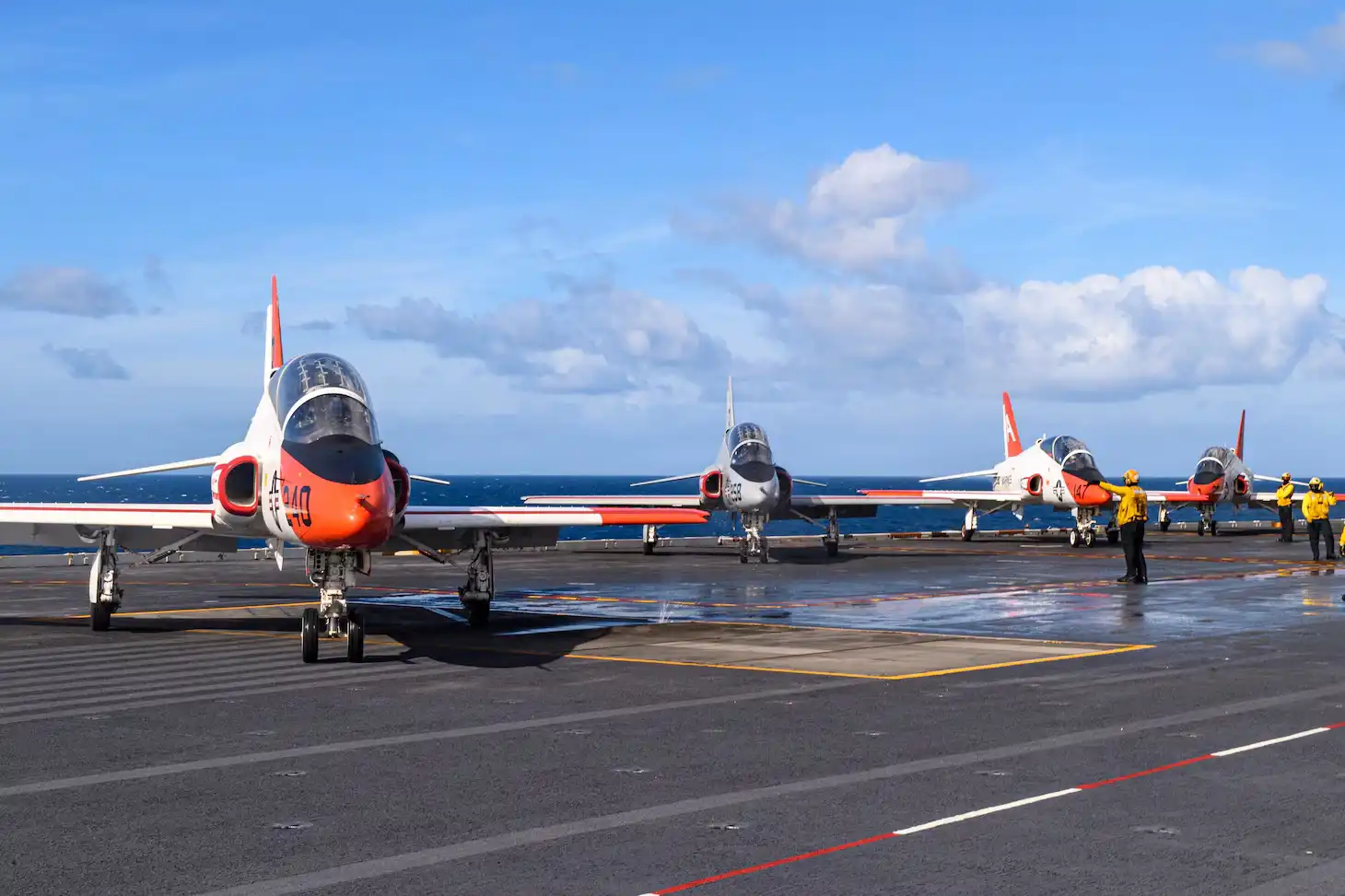
Following the air wing and FRS periods, student naval aviators from Training Air Wings (TRAWING) 1 and 2, under the Chief of Naval Air Training, practiced carrier landings and launches for the first time in the T-45C. A Navy image dated November 4, 2026, shows the trainers on the Nimitz flight deck in the Atlantic, in the U.S. 2nd Fleet area of operations.
According to the Navy’s fact file, the tandem-seat Goshawk uses one Rolls-Royce F405-RR-401 turbofan rated at 5,527 pounds of thrust, with a maximum takeoff weight of 13,500 pounds and a range of 700 nautical miles. The 52,500-pound gap between the trainer’s and the Super Hornet’s maximum takeoff weights illustrates the span of aircraft the flight deck handled in a single underway, with catapult and arresting gear settings adjusted for each type.
That student phase is already narrower than it once was. Carrier qualification is no longer a mandatory syllabus requirement for strike students, who now conduct their first carrier qualifications at an FRS in the jet they will fly, while E-2 Hawkeye pilots and international students still qualify in the T-45C. The Navy did not say which pipelines flew aboard Nimitz.
The Navy’s Undergraduate Jet Training System (UJTS) solicitation, released on March 26, 2026, seeks 216 aircraft to replace the T-45C, with first production deliveries expected from 2032. The program office says it intends to award the contract in the fourth quarter of fiscal 2027. The new aircraft will not be required to land on a carrier and needs to fly field carrier landing practice only to wave-off. Capt. Duane Whitmer, head of the UJTS program office, told The War Zone (TWZ) that the overall system, including simulators, must still train students to land on a carrier, and that discussing carrier qualification requirements after fielding would be premature while the T-45 is planned to fly through 2040.
Analysis: The remaining value of Nimitz lies in deck time. Each qualification period consumes days at sea from a carrier the Navy would otherwise be preparing for deployment, and USS Dwight D. Eisenhower (CVN 69) hosted T-45C student qualifications as recently as June 2026. Giving that task to a ship in its final months relieves hulls with deployments ahead. Inactivation will also remove an East Coast qualification deck. Kennedy began moving to Naval Station Norfolk after preliminary acceptance in September 2026, but the Navy plans to homeport it at Naval Base Kitsap-Bremerton no earlier than fiscal 2029, so it can offer only temporary East Coast relief at best.
Nimitz is scheduled to conduct multiple additional carrier qualification underways before deactivation and remains homeported in Norfolk as flagship of Carrier Strike Group 8. Furco said the knowledge gained aboard will “permeate the fleet for generations to come.” The Navy has not published dates for the remaining periods, and its latest release gives no inactivation date. The next marker is delivery of Kennedy, projected for spring 2027, since the March 2027 inactivation date was set to align with it.