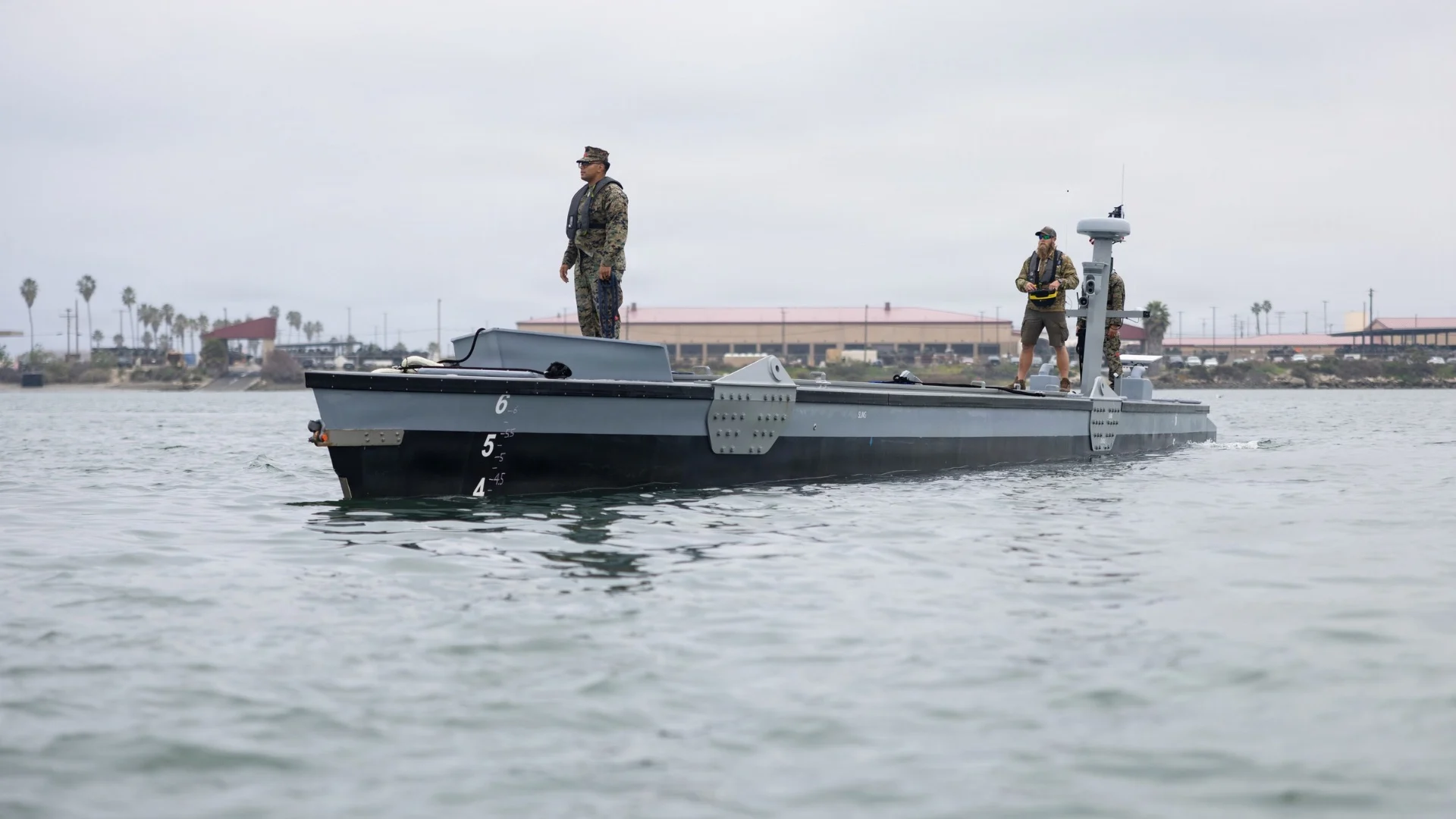
The Defense Innovation Unit (DIU) has awarded three prototype contracts under its Autonomous Low Profile Vessel (ALPV) project to Saronic Technologies, Sea Machines Robotics and Rudder Industries, a Portland, Maine, marine manufacturer working with the Department of War (DoW) for the first time. DIU announced the awards on November 9, 2026, framing the effort as critical to resupplying U.S. Marine Corps units dispersed across wide distances in contested littoral environments. Contract values, vessel quantities and the specific designs each company will deliver have not been disclosed.
The awards close out a Commercial Solutions Opening that ended on March 16, 2026, and move the ALPV concept from service experimentation toward scaled procurement. The Marine Corps has spent three years testing semi-submersible resupply craft modeled on the low-profile boats used by drug traffickers, operating them with the 12th Marine Littoral Regiment in Okinawa, the 1st and 2nd Marine Logistics Groups and the 31st Marine Expeditionary Unit. DIU acknowledged that the service has already prototyped several ALPV variants but stated that it “must move faster while reducing costs,” with the new project opening the field to commercial autonomy stacks and hull designs.
Autonomous Low Profile Vessel Requirements: 18,000 Pounds at 12 Knots
The DIU solicitation sets demanding performance targets. Preferred solutions must carry at least 18,000 pounds of cargo, including bulk liquids, across 1,000 to 2,000 nautical miles while fully laden in NATO sea state 5, and survive sea state 6. Fully loaded, the craft must sustain at least 12 knots in sea state 4 and loiter for up to 96 hours at reduced speed.
Cargo geometry is specified around standard Marine Corps logistics containers: a minimum of six Joint Modular Intermodal Containers (JMICs), each weighing 3,000 pounds, or two long containers of 5,100 pounds each, plus warehouse pallets and Pallet Containers (PALCONs). The vessel must discharge with minimal material handling equipment, support shore-to-shore, ship-to-ship and ship-to-shore distribution, including transfers with Military Sealift Command vessels, and ideally beach itself and self-withdraw after unloading.
Autonomy requirements carry most of the technical risk. The craft must navigate congested waterways and ports using M-Code GPS and active sensors, then switch to passive sensing under emissions control or when communications fail in Denied, Degraded, Intermittent and Limited (DDIL) conditions. Vendors must demonstrate assured position, navigation and timing in GPS-denied environments before prototyping ends. One operator must control multiple craft, hand control between operators and retask vessels dynamically, with manual remote control retained for first-mile and last-mile terminal guidance. The vessel must also resist tampering underway and accept a remote scuttle command.
Leidos Sea Specter Baseline Versus the DIU Resupply Target
The current Marine Corps ALPV, developed by Leidos and its subsidiary Gibbs & Cox, provides the benchmark. Publicly available specifications indicate the 65-foot semi-submersible, known as Sea Specter, uses a 230-horsepower Cummins diesel, carries between 2,000 and 4,627 kilograms of cargo in a 29-foot payload bay, and reaches 2,200 nautical miles at an 8-knot cruise. Its autonomy is provided by Sea Machines’ SM300 command and control system. Leidos delivered two prototypes to the Marine Corps Warfighting Laboratory (MCWL) in 2023.
The DIU target roughly doubles that payload: 18,000 pounds equals about 8,165 kilograms, some 76 percent above Sea Specter’s upper bound. Required laden speed rises 50 percent over the legacy cruise figure, in rougher seas. That combination implies more displacement and installed power, which works against the minimal freeboard and small radar, visual and infrared signature that define the low-profile concept. Hull designers will have to trade cargo volume against detectability.
DIU will offer awardees government furnished information to compress timelines, including reference ALPV hardware designs, technical data packages, interface control documents and baseline software architectures. The solicitation explicitly encouraged firms to adopt government-owned hull designs and focus resources on autonomy. A separate Naval Sea Systems Command (NAVSEA) contract worth $24.96 million, awarded to ReconCraft in July 2026, already covers ALPV deliveries through November 2028.
Saronic, Sea Machines and Rudder Industries Bring Different Strengths
The three awardees cover distinct industrial profiles. Saronic already holds Navy production agreements for its 24-foot Corsair and its 180-foot Marauder, selected in September 2026 under the Medium Unmanned Surface Vessel (MUSV) program, and was picked for an LCU 1700 landing craft prototype agreement. Sea Machines brings incumbency: its SM300 already steers the Marine Corps ALPV, and the firm completed MUSV at-sea testing and joined the Navy’s maritime drone marketplace. Rudder Industries, born from commercial-fishing experience, builds marine systems for markets that include fisheries, offshore energy and GPS-denied environments.
Government partners include Portfolio Acquisition Executive (PAE) Maritime, the Capabilities Development and Force Integration Directorate (CDFi), MCWL, the Direct Reporting Portfolio Manager for Robotic and Autonomous Systems (DRPM RAS), established in August 2026, and NAVSEA’s Combatant Craft Division.
Analysis: DIU is treating contested littoral logistics as a volume production problem rather than a bespoke shipbuilding program. The low-profile hull form is mature and cheap; the discriminators are autonomy that holds up under emissions control and jamming, one-to-many control that lets a small logistics detachment run a fleet, and a shore-to-boat loading workflow that actually saves Marine labor. For Stand-in Forces dispersed along the First Island Chain, throughput per operator, not individual vessel performance, will determine whether ALPVs can sustain distributed units under fire. Splitting the work across a venture-backed shipbuilder, an autonomy incumbent and a first-time defense entrant gives the Department competitive options before committing to production.
The solicitation requires prototypes to be demonstrable within 180 days of award, which points to at-sea demonstrations around mid-2027 if the clock started with this announcement. Successful prototypes may lead directly to follow-on production agreements without further competition, available to multiple DoW organizations. Key unknowns remain the dollar value of each award, the number of craft per vendor, whether teams adopt the government reference hull, and how the program will be divided between DRPM RAS and the existing NAVSEA ALPV buy.