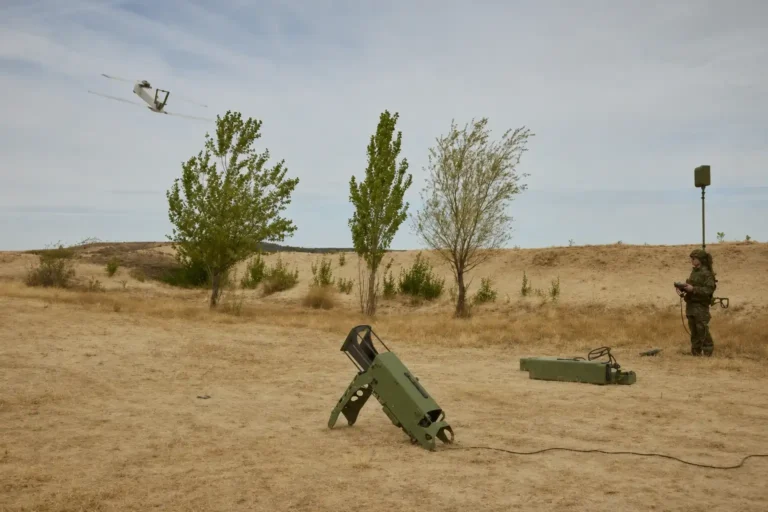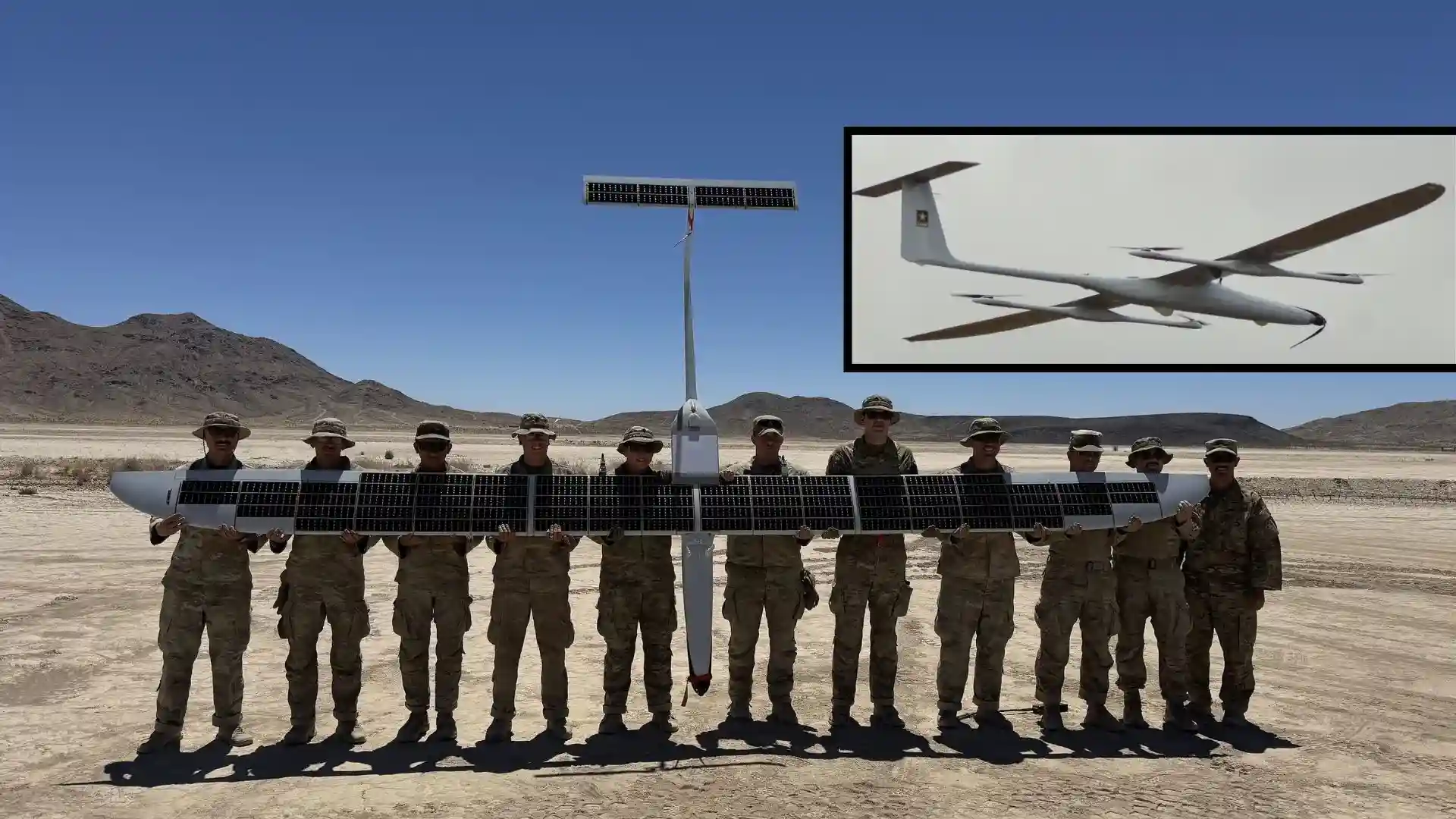
Kraus Hamdani Aerospace (KHA) announced on November 12, 2026, that the U.S. Army has selected its solar-electric K1000ULE drone as part of a major Army Program of Record. Under the award, the company will deliver Group 2, fully electric aircraft with vertical takeoff and landing (VTOL) capability, a selection that advances the platform’s integration into Army reconnaissance, surveillance, and target acquisition (RSTA) capabilities. KHA disclosed neither the program name nor contract value, quantity, or delivery schedule.
The selection moves the K1000ULE from a series of rapid-acquisition and expeditionary buys into the Army’s formal procurement baseline. A program of record carries a dedicated budget line, a sustainment plan, and a training pipeline. It arrives as the Army retires the RQ-7B Shadow and rebuilds its tactical drone fleet around lighter Group 2 systems under its Transformation in Contact initiative and the Pentagon’s Drone Dominance push.
K1000ULE Drone Specifications: Endurance, Payload, and VTOL Configuration
Publicly available specifications indicate the K1000ULE measures 3 meters (9.8 feet) long with a 5-meter (16.4-foot) wingspan and a maximum takeoff weight of 19.3 kilograms (42.5 pounds), inside the Pentagon’s 21-to-55-pound Group 2 band. Propulsion is entirely electric: lithium-ion batteries, recharged in flight by photovoltaic cells across the wing, drive a brushless motor and a folding propeller. Onboard autonomy lets the aircraft ride thermals with the motor off and the blades folded, the key to its endurance.
KHA quotes typical mission endurance above 24 hours, a service ceiling of 20,000 feet, and a range of about 1,600 kilometers (1,000 miles). In July 2023, a K1000ULE in its fixed-wing configuration stayed aloft for 75 hours and 53 minutes at the Pendleton UAS Range in Oregon, a flight KHA describes as a Group 2 endurance record; the World Air Sports Federation (FAI) has not ratified it. The modular bay carries two payloads at once, up to roughly 2.5 kilograms (5.5 pounds), with 50 watts of continuous power and bursts up to 1,000 watts. Options include an electro-optical/infrared (EO/IR) gimbal with up to 40x zoom, signals intelligence and electronic warfare (EW) packages, and Aerial Tier Network Extension (ATNE) radio relays. The design follows the Special Operations Command (SOCOM) Modular Payload Standard and a Modular Open Systems Approach (MOSA).
The VTOL configuration adds wing-mounted booms carrying lift motors and propellers, removing the launcher and recovery gear that gave the Shadow its large ground footprint. KHA cites a two-person crew and setup in under 15 minutes. The company has not published endurance figures specific to the VTOL variant, whose booms add weight and drag, a gap Army testing will need to close.
From APFIT to Program of Record: The K1000ULE Acquisition Path
U.S. Army Pacific (USARPAC) flew the aircraft in exercises across the Philippines, Guam, Saipan, and Hawaii between 2022 and 2024, then sponsored it for the Accelerate the Procurement and Fielding of Innovative Technologies (APFIT) program. That produced a $20 million award in October 2024 to equip the 1st Multi-Domain Task Force and Joint Special Operations Command. In April 2024, the Navy’s PMA-263 office had selected the VTOL variant for the Marine Corps’ Small Unit Remote Scouting System.
In September 2025, the Defense Innovation Unit added the K1000ULE to its Blue UAS Cleared and Select Lists. In April 2026, U.S. Air Forces Central (AFCENT) awarded KHA a sole-source indefinite-delivery/indefinite-quantity (IDIQ) contract with a $270 million ceiling for operations across the Middle East. On October 6, 2026, the aircraft reached award-ready status on the Army Applications Laboratory’s DevX Autonomy marketplace after a competitive assessment. The K1000ULE is also integrated into the Army’s Next Generation Command and Control (NGC2) environment through Anduril’s Lattice software.
“We engineered the K1000ULE around a fundamental operational need, keeping critical capabilities airborne for longer while reducing the burden on the forces using them,” said Stefan Kraus, KHA’s chief technology officer and co-founder.
Analysis: The RSTA language in the announcement matches the mission of the Army’s Long Range Reconnaissance (LRR) effort, the battalion-level Group 2 program that has so far bought AeroVironment’s P550 and Edge Autonomy’s Stalker Block 35X. KHA has not confirmed the program, so that link remains unverified. If the K1000ULE joins that portfolio, it brings a different trade: the P550 carries up to 15 pounds of payload for about five hours, while the K1000ULE carries about a third of that for multi-day sorties. Commanders would gain a persistent sensing and relay node rather than a sortie-based scout, and the Army would deepen a multi-vendor Group 2 model built on marketplace contracting rather than winner-take-all competitions.
Key unknowns remain the program designation, contract vehicle, ceiling value, quantities, and first-unit-equipped date. The next indicators will come from a Pentagon contract notice or fiscal 2027 procurement documents, and from whether the Army fields the aircraft at battalion level or keeps it with multi-domain task forces and special operations units. KHA’s in-flight laser power beaming trials with PowerLight Technologies at Shaw Air Force Base, South Carolina, point to further endurance growth, though that capability remains experimental.