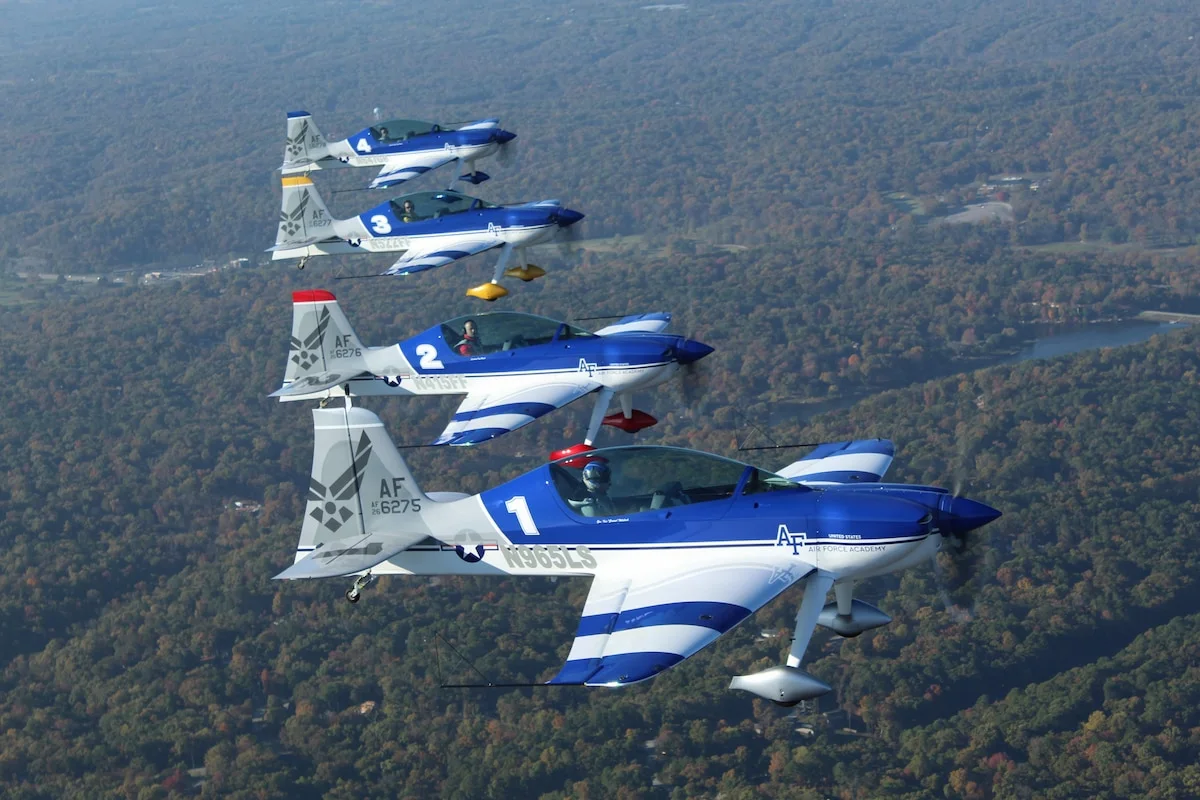
The U.S. Air Force publicly debuted the T-19A Kestrel on November 12, 2026, when the aircraft flew over the Cadet Wing’s noon meal formation at the U.S. Air Force Academy in Colorado. The flyover marked the formal arrival of the Academy’s first powered aerobatic aircraft, four airframes that recently completed final military certification flights, according to an official Air Force release.
The Kestrel fills a gap in the Academy’s airmanship program, which has relied on TG-16A sailplanes for aerobatic flying and on the T-53A, a militarized Cirrus SR20, for non-aerobatic powered instruction. It arrives amid a pilot shortfall officials put at roughly 2,000 aviators, while the T-7A Red Hawk advanced trainer meant to replace the T-38C Talon remains behind schedule. Air Force Chief of Staff Gen. Ken Wilsbach said the program went “from an idea to four aircraft built and delivered in 10 months.”
T-19A Kestrel Airframe: A Militarized GB1 GameBird Aerobatic Trainer
The T-19A is the Air Force designation for the GB1 GameBird, a tandem two-seat, single-engine aerobatic monoplane built by Bentonville, Arkansas-based Game Aerospace, formerly Game Composites. An Air Force spokesperson told Breaking Defense that the four aircraft were funded through corporate and civilian donations. The spokesperson valued the gift at $3 million and said the service invested approximately $400,000 of its own funds in initial spares, support equipment, and aircrew flight equipment. The service plans to budget about $1 million per year to sustain the fleet.
Publicly available manufacturer specifications indicate the GB1 is built largely of carbon fiber and powered by a Lycoming AEIO-580-B1A six-cylinder, fuel-injected piston engine rated at 303 hp, driving a four-blade MT constant-speed propeller. The airframe is certified to plus or minus 10 g, with a published roll rate of about 400 degrees per second, a cruise speed of roughly 200 knots, a range of about 1,000 nautical miles, and a 15,000-foot service ceiling. It spans 25.3 feet, measures 23 feet long, uses fixed tailwheel gear, and carries Garmin G3X Touch displays in both cockpits. The Air Force has not disclosed whether the T-19A configuration departs from the civil baseline.
A symmetrical 10 g envelope places the Kestrel in the unlimited aerobatic class, well beyond the load limits of the Academy’s existing powered fleet, and lets cadets build aerobatic experience before Undergraduate Pilot Training, training Moga said was “previously not possible.” The type earned Federal Aviation Administration and European Union Aviation Safety Agency type certification in 2017, giving the service a mature certification basis rather than a developmental airframe.
Six-Pilot Cadre and Davis Airfield Operations Shape the Kestrel Program
Academy Superintendent Lt. Gen. Paul D. Moga selected six active-duty pilots from the Academy staff and its 306th Flying Training Group as the initial cadre. They will write the aerobatic curriculum and phase the aircraft into the airmanship program. At the outset, cadre pilots will serve as the primary demonstration pilots at recruiting events and air shows nationwide. The longer-term plan calls for a national demonstration team and a competitive division flying in International Aerobatic Club and equivalent competitions.
The Academy also intends to select a cohort of cadets each year for mentoring in the T-19A, progressing from basic proficiency to advanced aerobatic performance, and is partnering with civilian aerobatic pilots and curriculum developers to build the program. Secretary of the Air Force Troy Meink said that “as the Kestrel program matures at USAFA, cadets will eventually take on a greater role in training and demonstrations.”
All T-19A operations will be based at the Academy’s Davis Airfield. The program will run under a Safety Management System tailored to low-altitude, high-performance aerobatics, with flight and ground operations following the more restrictive of FAA regulations and Air Force safety instructions. A group of cadets proposed the Kestrel name, a reference to the small falcon’s agility, acceleration, and precision.
Analysis: The Kestrel is a small program by acquisition standards, but its structure is instructive. By accepting a donated, already-certified commercial airframe and spending about $400,000 in service funds, the Air Force fielded a new training capability in 10 months, a pace Wilsbach called “unprecedented.” The model has limits: four aircraft serve an Academy airmanship program, not the undergraduate pilot pipeline, so any effect on the 2,000-pilot shortfall will be indirect. Its value lies in earlier cadet exposure to high-g flight and in testing whether off-the-shelf civil platforms can fill niche training roles faster than traditional procurement.
Near-term milestones include the cadre’s aerobatic syllabus, the first demonstration season, and selection of the initial cadet cohort. Open questions remain on when cadets will fly as demonstration pilots, whether the Academy will seek airframes beyond the initial four, and whether the roughly $1 million annual sustainment line holds through future budget cycles.