Taiwan’s Coast Guard Administration (CGA) is acquiring Devil Ray T24 autonomous unmanned surface vessels (USVs) from Maritime Tactical Systems, Inc. (MARTAC), the Melbourne, Florida-based manufacturer announced on October 13, 2026. The vessels will be co-produced, with part of the order built at a partner facility in Edgewater, Florida, and the remainder manufactured in Taiwan by MARTAC’s local partner, Confucian Co., Ltd. MARTAC’s announcement did not disclose the quantity, contract value, or production split.
The order marks the CGA’s first USV program and builds on a tripartite memorandum of understanding (MOU) that MARTAC, Confucian, and the state-owned National Chung-Shan Institute of Science and Technology (NCSIST) signed on September 18, 2025, at the Taipei Aerospace & Defense Technology Exhibition (TADTE). That framework covered joint research, supply chain integration, and co-manufacture of MARTAC hulls in Taiwan. The procurement follows a summer in which sightings of Chinese coast guard, research, and other government vessels around Taiwan reached record levels in June, July, and August, according to Taiwan’s Ministry of National Defense.
How the Taiwan Coast Guard USV Deal Splits Production
MARTAC did not name the Edgewater facility. The town is home to SŌLACE Boats, with which MARTAC announced a manufacturing partnership on September 15, 2026, designed to add capacity for 100 Devil Ray vessels per year.
Confucian Chief Executive Officer James Lee said MARTAC’s willingness, “from the very beginning, to establish co-production in Taiwan” was among the most important reasons for the selection.
MARTAC has since put a figure on the buy. On October 22, Chief Growth Officer Seamus Flatley told Taiwan News that the CGA had purchased 25 T24s, to be delivered in batches, with the first two set to ship before the end of 2026. The number matches the plan a senior Taiwanese official outlined to Nikkei Asia in July 2026: 25 USVs and two unmanned underwater vehicles (UUVs) for the CGA, procured through NCSIST working with MARTAC, with a first prototype targeted for testing in the first half of 2027.
Hardware is already in the water. On October 7, 2026, Ocean Affairs Council Minister Kuan Bi-ling, CGA Director-General Chang Chung-lung, and National Security Council Secretary-General Joseph Wu watched a pre-production T24, co-developed with NCSIST, operate alongside a Shield AI V-BAT drone at the coast guard’s Taipei Harbor base, according to local reports. Both systems were being prepared for the October 10 National Day parade.
Devil Ray T24 Specifications: Speed, Payload, and Marsupial Hosting
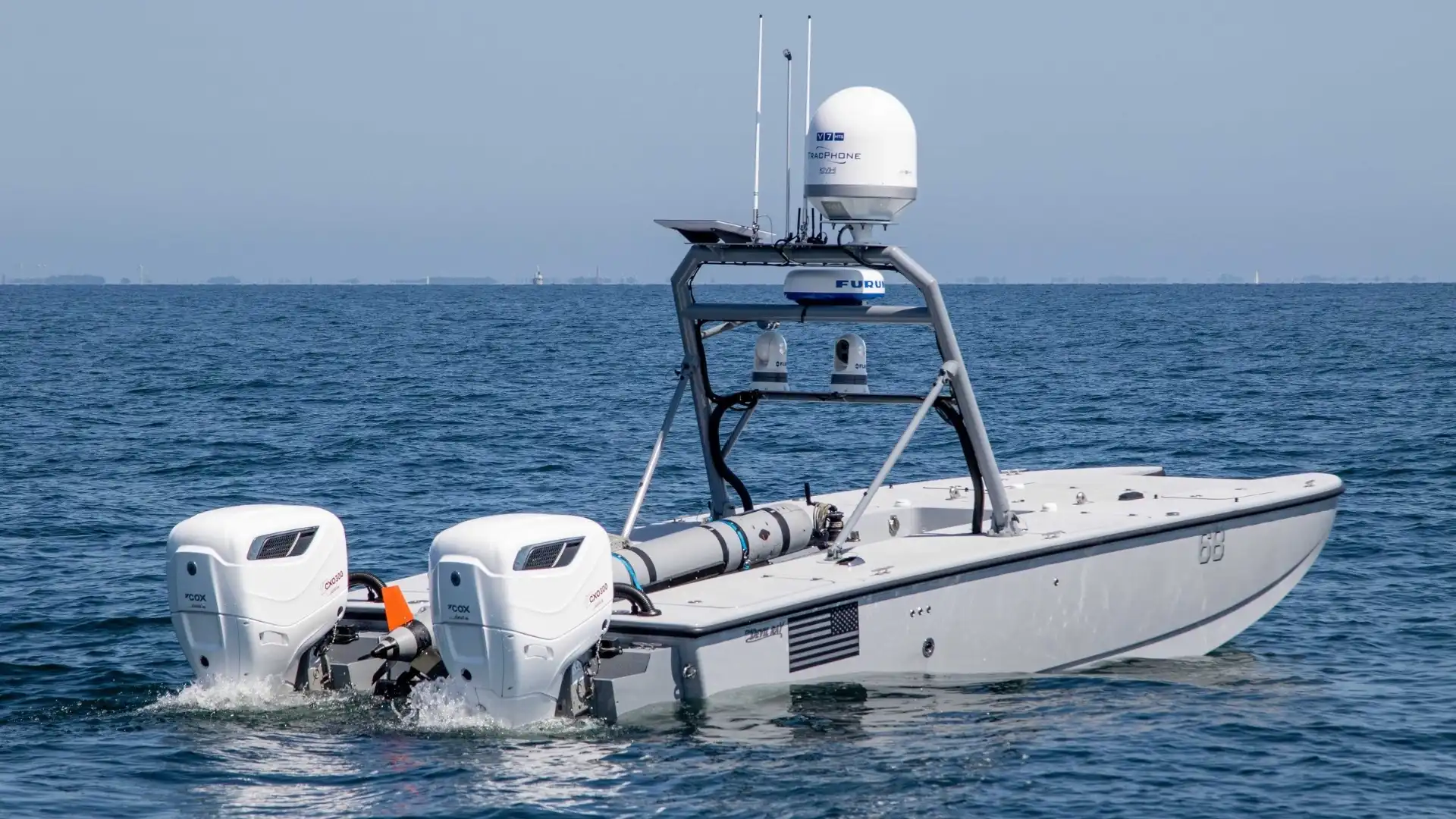
MARTAC lists the T24 at 27.5 feet (8.4 m) in length with a 3 m beam and burst speeds exceeding 50 knots. Publicly available specifications indicate a maximum payload of 1,800 pounds (816 kg) and an open-ocean cruising range of up to 600 nautical miles. Current specifications list inboard diesel power, with a gas option. Earlier company literature cites a 24-foot (7.2 m) hull and 60-knot-plus bursts, a variance likely tied to measurement and configuration.
Launched in 2023, the T24 was MARTAC’s first Devil Ray designed from the keel up as a production, payload-agnostic multirole platform. Its patented catamaran hull, rated at 6G in current company specifications, and open deck support above- and below-surface sensors over line-of-sight and satellite datalinks. The boat can natively host smaller MANTAS T8 and T12 USVs, as well as aerial and underwater drones; the all-electric T12 measures 12 feet (3.6 m) and carries 64 kg at burst speeds above 30 knots. MARTAC lists command-and-control resilience among the platform’s strengths.
Those parameters map directly onto the missions the CGA has named: long-range search and reconnaissance, investigation, and remote rescue. A 600-nautical-mile range is several times the width of the Taiwan Strait, roughly 70 nautical miles at its narrowest, allowing the service to shadow vessels without committing a crewed cutter.
Analysis: The co-production clause matters as much as the hull count. In June 2026, Taiwan’s Cabinet proposed a NT$210 billion (about $6.6 billion) special budget to buy domestically produced unmanned systems through 2031, including 1,320 USVs, with the stated aim of building local supply chains; lawmakers passed an opposition-drafted unmanned vehicle industry act on August 27. A U.S.-designed hull partly built by Confucian and tied to NCSIST fits that industrial logic, while giving Taipei a mature autonomy stack. Operationally, the CGA sits on the front line of gray-zone pressure from the China Coast Guard, and an uncrewed, long-endurance sensor node lets it extend surveillance without stretching a crewed fleet. For MARTAC, the Taiwan order now sits alongside its November 9, 2026, delivery of two Devil Ray T38 USVs to the Philippine Marine Corps, widening its footprint among frontline Indo-Pacific partners.
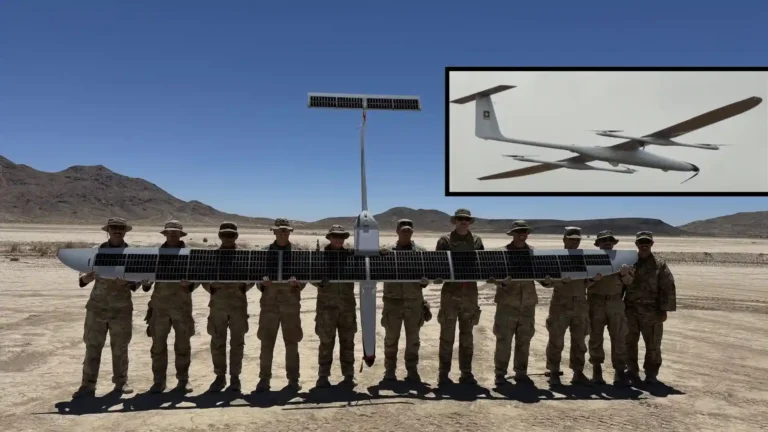
Key unknowns remain the payload fit, whether NCSIST integrates domestic sensors, and how the T24 will be networked with the CGA’s V-BAT and AeroVironment Jump 20 aerial drones. The first two T24s, which Flatley told Taiwan News would ship before the end of the year, are the next milestone to watch, along with the prototype test targeted for the first half of 2027 and any move by the Ministry of National Defense to adopt the T24 for military roles.