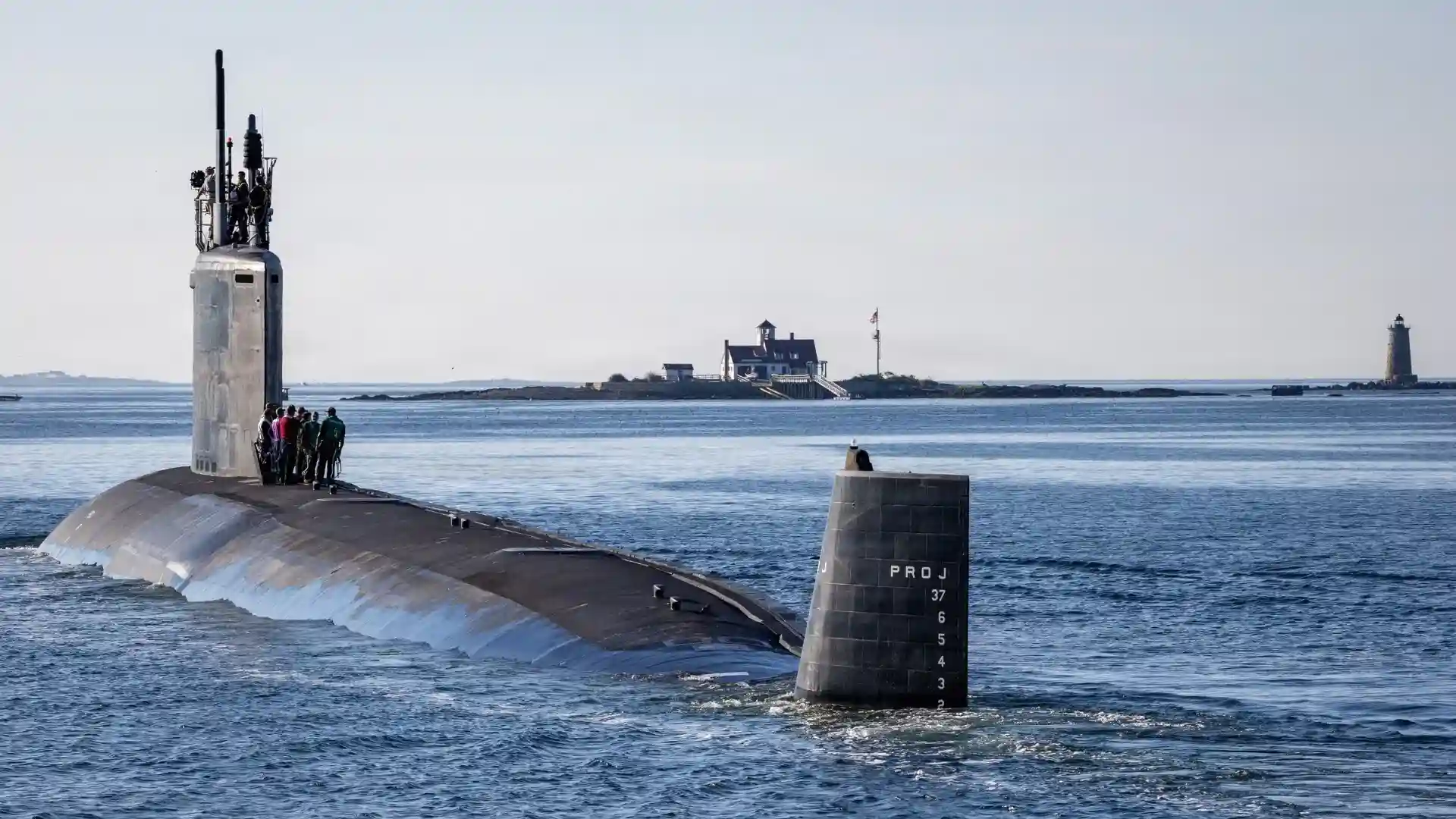
The U.S. Navy’s next nuclear attack submarine, SSN(X), will be faster, spend less time in maintenance and operate as a mothership for a constellation of undersea drones, Rear Adm. Andrew Miller, the service’s head of submarine requirements, said on November 12, 2026, at the Naval Submarine League’s annual conference in Arlington, Virginia. The Navy is finalizing the program’s analysis of alternatives (AoA) and wants Milestone A approval, the formal entry into early development, before the end of 2026.
SSN(X) is intended to succeed the Virginia class, which the Navy has bought since FY1998. The service completed its internal AoA in November 2025, and the Pentagon’s Cost Assessment and Program Evaluation (CAPE) office endorsed the requirements in March 2026. The schedule has already slipped twice: the FY2024 budget planned the first boat for FY2035, the FY2025 shipbuilding plan deferred it to FY2040, and the latest plan places construction start in the early 2040s.
SSN(X) Nuclear Attack Submarine Requirements Point to a Clean-Sheet Hull
According to Miller, the AoA reached a firm conclusion: dominating high-end peer threats in the middle of the century requires a new design rather than another Virginia block upgrade. He described the Virginia class as a world-class warship that will remain the backbone of the attack fleet for decades, but said the expanded payload capacity, larger electrical and hydrodynamic margins and architectural flexibility the Navy now needs cannot be retrofitted into the existing hull form.
In August 2026, the Navy set five top-level characteristics for the boat:
- Higher flank speed and tactical control speed
- Improved operational availability
- Decisive lethality
- Superior stealth and layered survivability
- Organic hosting and command and control of robotic and autonomous systems
Tactical control speed, the highest speed at which a submarine can still use its own sonar effectively, determines how quickly a boat can reposition without going deaf, which matters for trailing fast, quiet adversary submarines. Operational availability targets the maintenance bottleneck at U.S. public shipyards, where attack boats have spent long periods idle awaiting dock space. Electrical margin is the enabler for future sensors, high-power payloads and the command-and-control load of a drone network.
Funding remains in the development phase. The Navy’s FY2026 budget requested $622.8 million for SSN(X) research and development: $366.0 million for class development and $256.8 million for next-generation fast-attack nuclear propulsion, indicating work on a new reactor plant.
Seawolf-Class Lethality in a Columbia-Class Diameter
The Navy is pursuing a hull diameter larger than the Virginia class and closer to the Columbia-class ballistic missile submarine, USNI News reported. Publicly available specifications put the Virginia-class beam at 34 feet, the Seawolf class at 40 feet and the Columbia class at 43 feet. The service wants performance comparable to the three-boat Seawolf class, the late Cold War design built for speed, quieting and a heavy torpedo room. Open-source data credits Seawolf with eight 26.5-inch torpedo tubes, a magazine of about 50 weapons and a submerged displacement of 9,138 tons, against four 21-inch tubes and about 7,800 tons for early Virginia boats.
The Congressional Budget Office (CBO), in its review of the FY2025 shipbuilding plan, noted that the Navy’s vision for the boat remains faster, stealthier and able to carry more torpedoes than the Virginia class. CBO assumed a submerged displacement of about 10,100 tons, roughly 11 percent more than Seawolf, and estimated average unit procurement cost at $8.7 billion in constant FY2024 dollars, against a Navy estimate of $7.1 billion. For comparison, a Virginia-class boat fitted with the Virginia Payload Module (VPM) has an estimated procurement cost of about $5.0 billion when bought at two per year under the Navy’s FY2026 budget submission, according to the Congressional Research Service.
The Navy has not disclosed SSN(X) length, tube count, tube diameter, vertical launch capacity, crew size or reactor type. Those parameters will define whether the design delivers Seawolf-level horizontal payload or trades torpedo room volume for drone hosting.
Undersea Drone Mothership Role Shaped by the Chinese Submarine Buildup
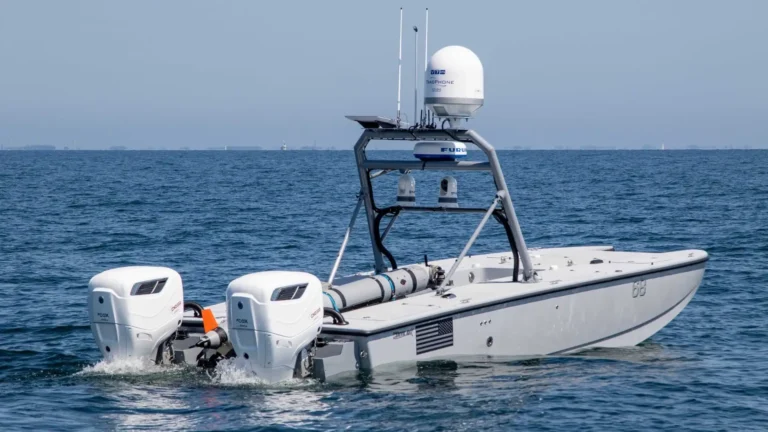
Miller framed the drone requirement as a change in the submarine’s basic role, moving it “from a standalone hunter-killer to a capital mothership.” Under that concept, uncrewed undersea vehicles launched directly from torpedo tubes would extend the sensing and engagement reach of each crewed boat. The Navy has not identified which vehicles SSN(X) would carry or how they would be recovered.
The threat case was laid out earlier at the same conference by Rear Adm. Chris Cavanaugh, who warned that the U.S. undersea advantage is real but not assured. He cited a Chinese seabed-mapping effort in the Western Pacific reported by Reuters in March 2026 and the People’s Liberation Army Navy’s nuclear attack submarine program, and assessed that China could field 20 to 40 comparable submarines over the next decade while improving their quality. Cavanaugh also pointed to growing Chinese and Russian cooperation and to Russia’s Poseidon, a nuclear-armed, nuclear-powered autonomous torpedo that open sources describe as roughly 20 meters long.
Analysis: The mothership requirement explains the size of the boat. Hosting, launching and controlling uncrewed vehicles consumes volume, power and tube capacity that a Virginia-diameter hull cannot provide without sacrificing weapons load, so the Navy is effectively buying a larger, costlier platform to multiply each hull’s reach. That logic carries a quantity risk. At CBO’s $8.7 billion estimate, SSN(X) would cost well above a VPM-equipped Virginia, while the Congressional Research Service reports that Virginia-class production has run at about 1.1 to 1.2 boats per year since 2022, short of the two-per-year rate the Navy has sought. If China builds 20 to 40 new attack submarines in a decade, distributed drone sensing becomes the Navy’s main lever for covering more ocean with fewer crewed hulls, which makes autonomy integration as critical to the program as the hull itself.
The next decision point is Milestone A, which the Navy hopes to secure by the end of 2026. The FY2028 budget request will show whether the Navy accelerates design funding or holds to an FY2040 first buy. Key unknowns remain the propulsion plant, final displacement and cost, and how the Navy will sustain submarine design teams across the gap between Columbia-class and SSN(X) design work.