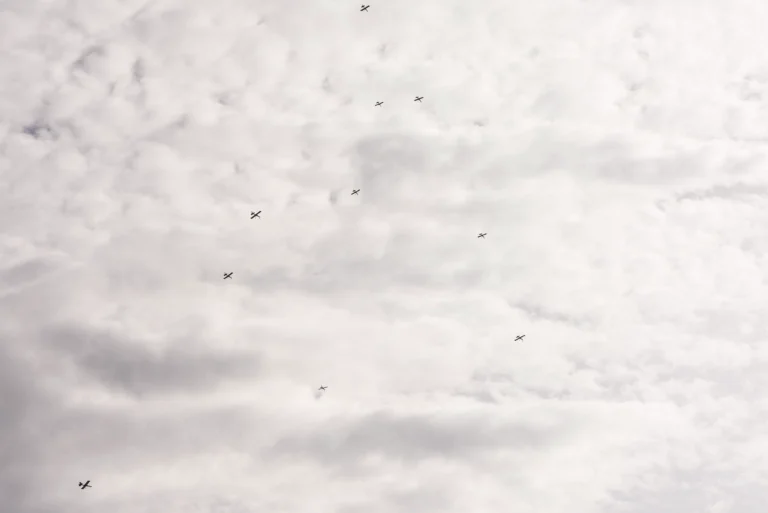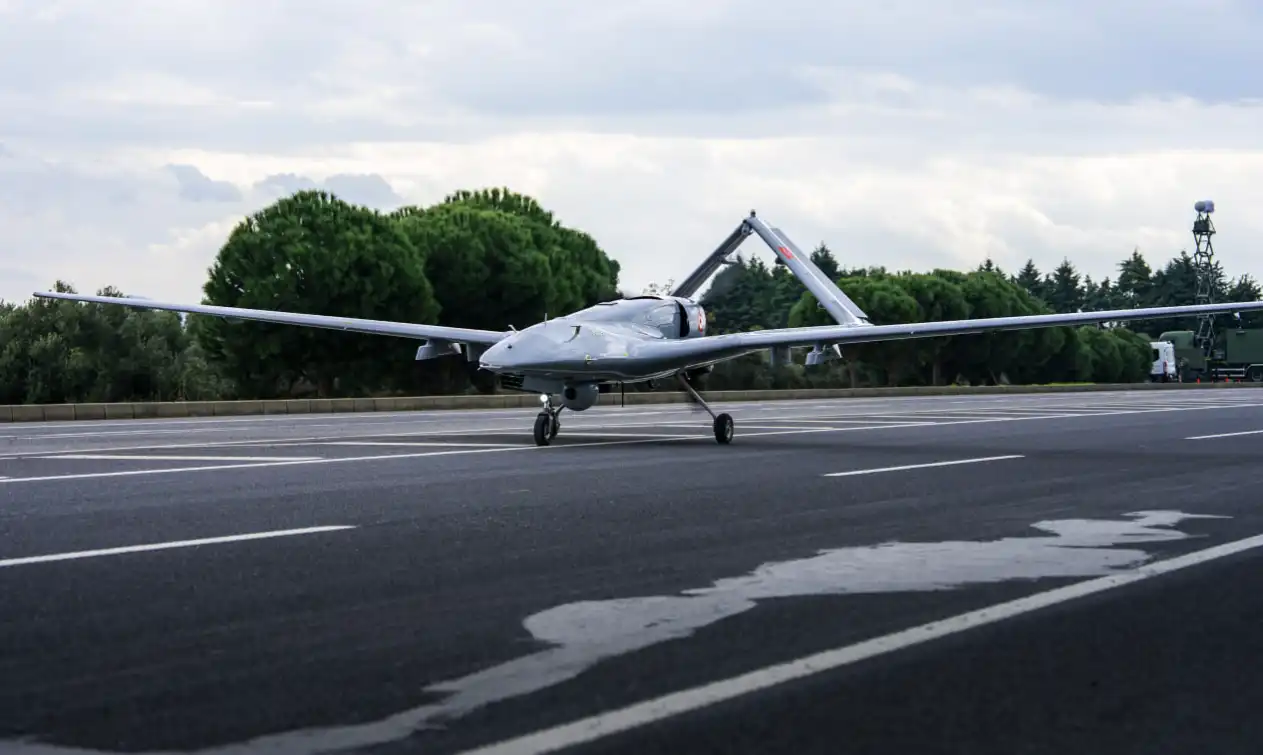
Türkiye’s AKINCI and Bayraktar TB2 unmanned combat aerial vehicles (UCAVs) landed on and took off from the Manisa-Balıkesir Highway on November 12, 2026, in an emergency response exercise simulating the loss of conventional runways. Baykar ran the drill in coordination with the Ministry of National Defense (MSB) and the General Directorate of Highways (KGM). It was the first practical application of a Baykar field study program for operating without airfields, the company said.
Baykar launched the field studies so that its unmanned aircraft can keep operating without interruption even when runways are unavailable. The company said the exercise was built on site surveys conducted at various locations across Türkiye and on the highway routes identified through them, pointing to a pre-mapped network rather than a one-off stunt.
AKINCI Highway Landing Tests Dispersed Operations Without Runways
Three aircraft launched from separate bases and converged on the same stretch of road. A Bayraktar TB2 used by Baykar for training and test activities departed from Keşan, an AKINCI departed from Çorlu, and a second TB2 drawn from the Turkish Land Forces Command inventory departed from İzmir. All three landed on the highway and took off again. Including an operational Land Forces airframe alongside company aircraft shows the concept is being exercised with service assets, not only manufacturer test vehicles.
The two platforms sit at opposite ends of Baykar’s portfolio. Baykar’s published specifications describe the TB2 as a medium-altitude long-endurance (MALE) aircraft with a 12 m wingspan, a 6.5 m length, a 700 kg maximum takeoff weight (MTOW), and a 150 kg payload, powered by a single 100 hp piston engine. Its service ceiling is 22,000 ft and its endurance exceeds 20 hours.
The AKINCI is a far heavier proposition. Baykar lists it at 6,000 kg MTOW with a 1,500 kg payload, a 20 m wingspan, a 12.3 m length, and twin turboprops rated at 450 hp, 750 hp, or 850 hp depending on variant, with a 40,000 ft service ceiling. Recovering an aircraft of that span and weight on a public road places much tighter demands on carriageway width, pavement strength, and roadside obstacle clearance than the TB2 does. Both types are offered with fully autonomous takeoff and landing, which reduces reliance on runway approach aids.
Baykar did not disclose the length or width of the highway segment, which AKINCI variant flew, whether autonomous landing modes were used, or whether the aircraft carried munitions. These details will decide whether the concept scales.
Extending Highway Operations to KIZILELMA and Bayraktar TB3
Baykar said the operational concept is being expanded to cover every unmanned aircraft it develops, with the goal that all its platforms can use suitable highway routes. That explicitly includes KIZILELMA, which Baykar describes as Türkiye’s first indigenous unmanned fighter jet, and the Bayraktar TB3, designed to operate from ships with short runways. Baykar’s specifications put the TB3 at 1,600 kg MTOW with a 14 m wingspan.
KIZILELMA is the hardest case. A jet-powered combat aircraft lands faster and needs more distance than a turboprop, so fewer road segments are likely to qualify. Baykar has not published a runway requirement for the type.
The drill also mobilized a broad inter-agency apparatus. The Manisa Governorship, the Provincial Gendarmerie Command, and the Provincial Police Department enforced security along the route while fire and ambulance teams stood by. Teams from the Turkish Armed Forces (TAF) service commands observed on site, alongside the General Directorate of Security, the Gendarmerie General Command, and the Coast Guard Command under the Ministry of Interior.
Analysis: The landing itself matters less than what it signals about Turkish force posture. Türkiye is now applying dispersal logic to its unmanned combat fleet. Dispersal multiplies potential operating locations and complicates an adversary’s targeting. The binding constraint is support: fuel, ground control stations, satellite links, and munitions handling must also reach the road, and Baykar has not shown that part of the chain. Commercially, the concept strengthens Baykar’s pitch to the 40 countries that have signed export agreements with it, 37 for the TB2 and 16 for the AKINCI.
Baykar has set no public timeline for qualifying KIZILELMA or the TB3 on highways, and the TAF has not said whether road operations will enter routine training. The company, which reported a record $2.2 billion in exports in 2025 and derives 90% of its revenue from abroad, may fold the capability into its export offer. Follow-on drills at other surveyed routes and formal TAF doctrine for dispersed unmanned operations are the next indicators.