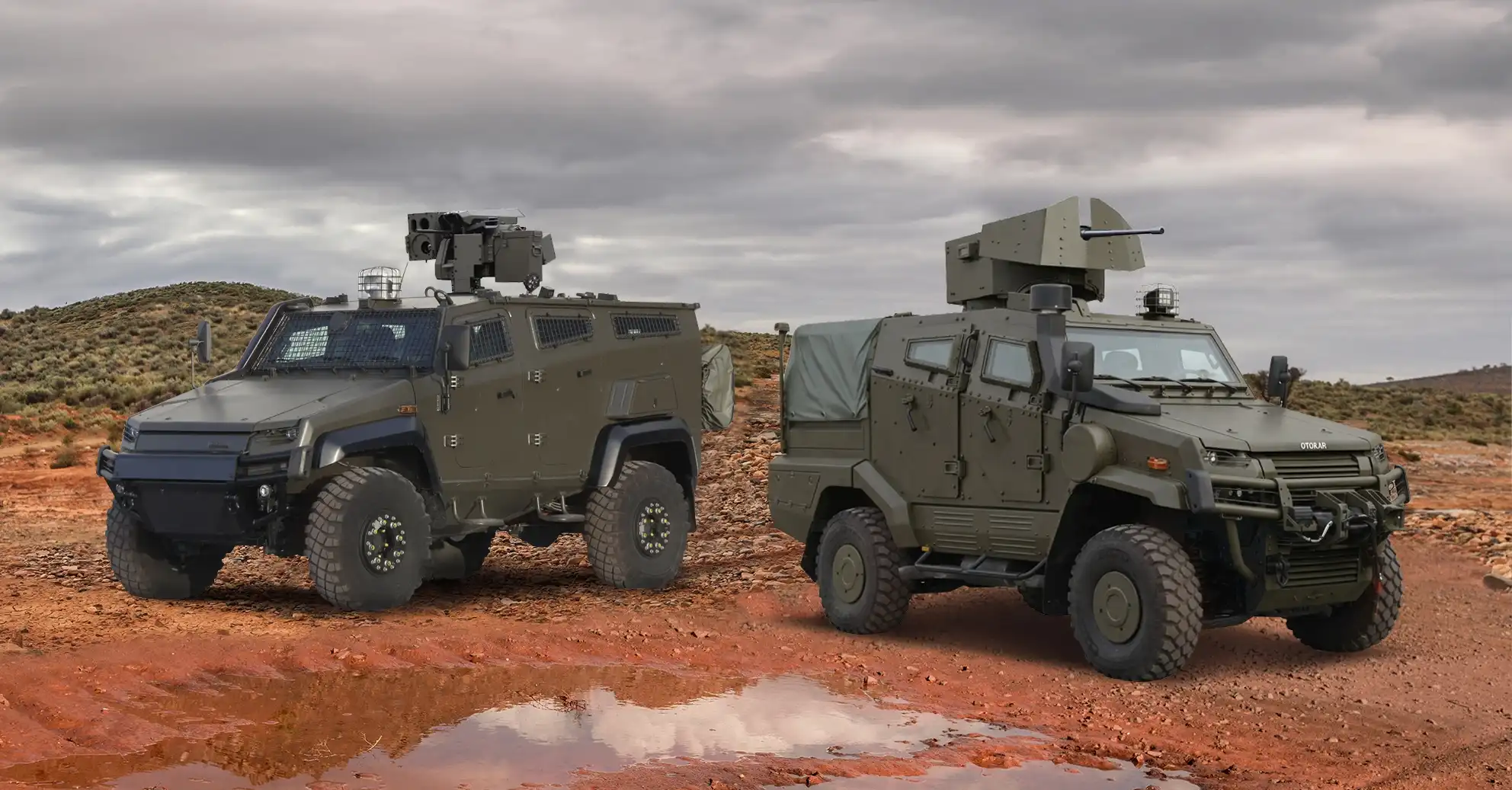
Otokar 4×4 armored vehicles will enter the Turkish Land Forces inventory under a new contract with Türkiye’s Secretariat of Defense Industries (SSB), the company announced on November 16, 2026. The agreement covers 4×4 tactical wheeled armored vehicles and their after-sales services, with deliveries scheduled for completion by the end of 2028.
Neither party has disclosed the contract value, the number of vehicles, or the platform selected. The award returns Otokar to its home market while large export programs fill its order book: the company has been Türkiye’s top land systems exporter for two consecutive years and disclosed a $1.47 billion export contract for wheeled armored vehicles to an undisclosed customer in October 2026.
What the SSB Contract for Otokar 4×4 Armored Vehicles Covers
The contract bundles vehicle deliveries with after-sales services for the vehicles entering the Land Forces inventory. A delivery window of roughly 25 months from the announcement suggests a production-ready baseline rather than a clean-sheet design.
Otokar CEO Aykut Özüner said the company is “proud to serve once again in our home market,” adding that Otokar remains committed to “providing armored vehicles and services that respond the evolving needs and requirements of users.”
The Sakarya-based manufacturer has supplied military vehicles to NATO and the United Nations since the 1980s, and its original Cobra 4×4 entered service in 1997. Turkish orders for the current-generation Cobra II began in late 2015, including a €47.5 million (about $52 million) contract for 82 vehicles with related systems, maintenance, and support, followed in July 2016 by a €106.1 million order for Turkish security forces. In 2017, the Turkish Armed Forces deployed Cobra II vehicles fitted with radar, target detection, and thermal camera systems along the Syrian border. Otokar states it has produced more than 33,000 military vehicles for over 80 end users in nearly 50 countries.
Cobra II Protection, Mobility, and Mission Configurations
Otokar has not confirmed which vehicle the SSB selected. The Cobra II is the current-generation 4×4 that Otokar has supplied to Turkish forces since those 2015 orders, and its publicly available specifications indicate the likely performance baseline for any Land Forces variant.
The baseline Cobra II has a gross vehicle weight of up to 14,500 kg and carries up to 11 personnel, including driver and commander. Power comes from a 360 hp turbocharged diesel coupled to an automatic transmission and a two-speed transfer case, giving roughly 25 hp per tonne at maximum weight. Fully independent suspension, differential locks, and 395/85 R20 run-flat tires support a top speed of 110 km/h and a 700 km road range. The vehicle fords 1,000 mm of water, climbs 60 percent gradients, and clears 500 mm vertical obstacles.
The Cobra II’s combat weight is roughly double that of the original Cobra, a 6.2-tonne vehicle powered by a 190 hp V8 that used HMMWV-derived components. The added mass buys mine, IED, and ballistic protection, which Otokar describes as high but does not publish against STANAG 4569 levels for the baseline model. The heavier Cobra II MRAP variant reaches 19,000 kg and offers mine protection upgradeable to demanding STANAG 4569 levels.
Modularity is the operational argument. Otokar lists armored personnel carrier, command and control, ambulance, satellite communications, reconnaissance and surveillance, mortar fire detection, anti-tank, radar, recovery, and air defense configurations, along with remote weapon station and jammer fits. For the Land Forces, that range allows one chassis to cover border surveillance, convoy protection, and short-range air defense, simplifying training and spares.
Analysis: The award matters less for its undisclosed size than for its timing. Otokar must deliver to the Land Forces by the end of 2028 while executing Romania’s order for 1,059 Cobra II vehicles, of which 278 are built in Türkiye and the rest locally, and while preparing deliveries under the $1.47 billion export contract that begin in 2027. The Romanian program is also carrying a dispute with procurement agency Romtehnica over local production milestones, now before Romanian courts. Three programs converging on the same production base in 2027 and 2028 make industrial throughput, not design maturity, the variable to watch.
Otokar is listed on Borsa Istanbul and routinely files material contracts with the Public Disclosure Platform, so a filing could still reveal the contract value. The key open questions remain the platform designation, the number of vehicles, the mission equipment and weapon stations specified, and the date of first acceptance by the Land Forces Command.