On November 12, 2026, the Swedish government asked the Riksdag for authority to sell up to 20 CB90 combat boats to France, together with associated training and support equipment. The request, filed in the defence section of the government’s 2027 budget proposal, frames the transaction as a government-to-government deal in which Sweden would order the Combat Boat 90 (CB90) fast assault craft and deliver them to France, with the agreement itself expected in 2027.
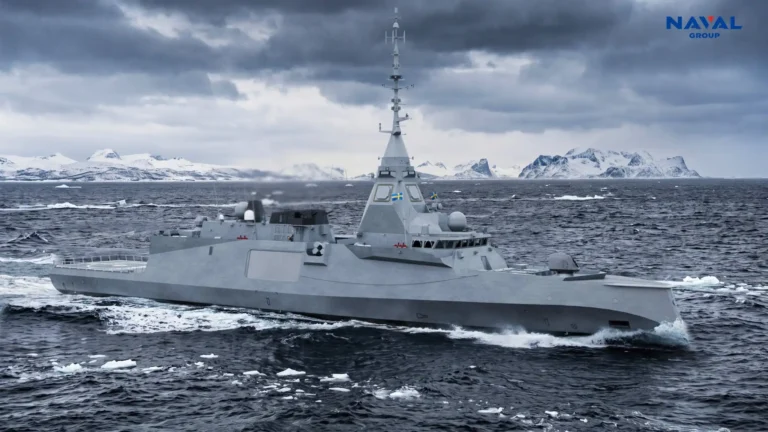
The proposal is not a purchase contract; it seeks parliamentary authority to sign one. “France has identified a need to acquire combat boats of the Stridsbåt 90 type,” the government stated, adding that the sale would proceed at France’s request and that “revenue from the sale shall cover the state’s costs.” No value, delivery schedule or French variant has been set. The request comes less than three months after Sweden signed a SEK 47 billion (approximately €4.3 billion) contract with Naval Group on August 31, 2026, for four Luleå-class frigates derived from the French Navy’s Defence and Intervention Frigate (FDI), and follows a May 2026 report by French outlet La Lettre that Paris could buy Saab-built CB90s as part of an industrial compensation arrangement around that deal.
CB90 Combat Boats Under Evaluation With French Navy Fusiliers
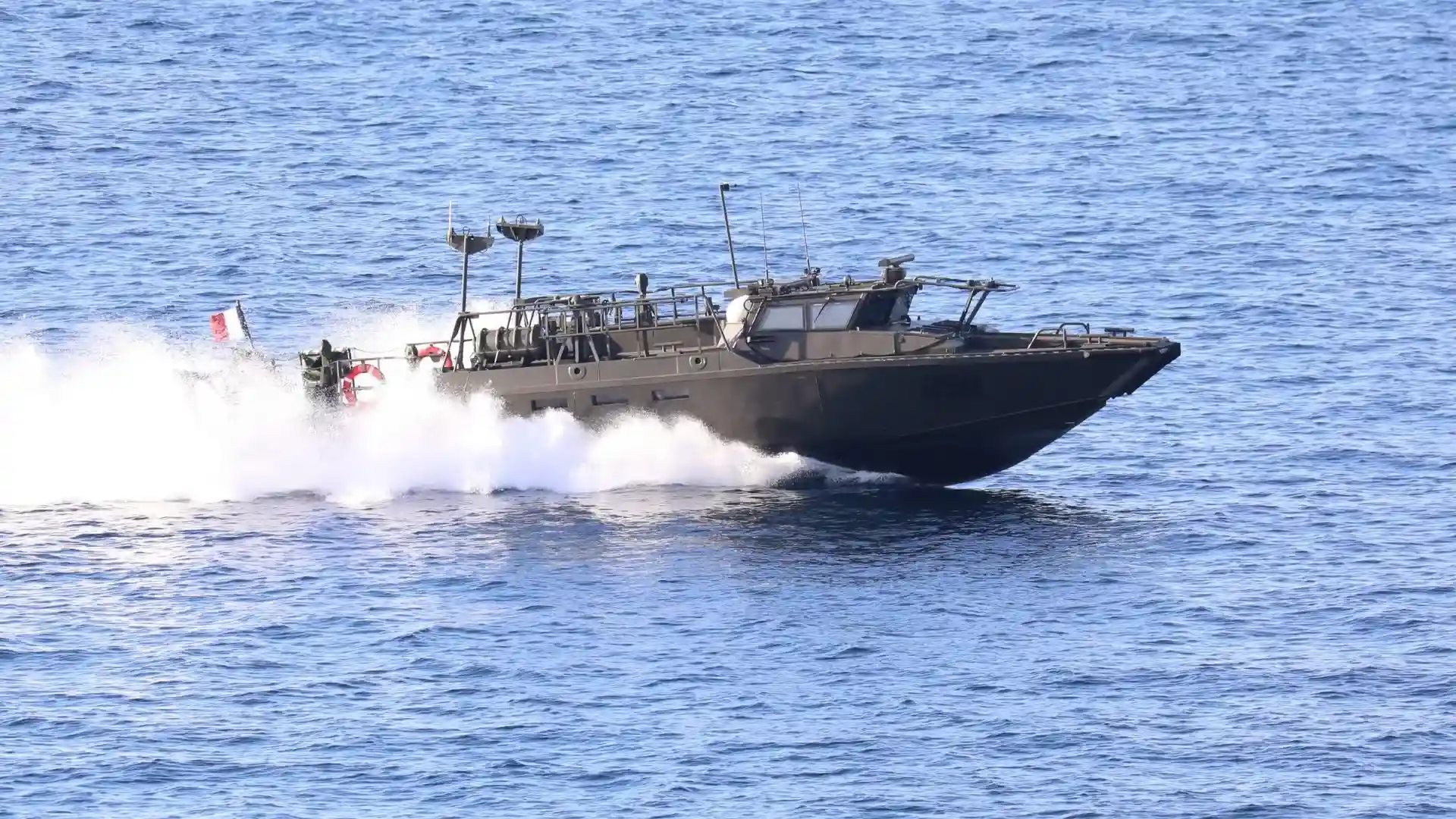
The French Navy’s Maritime Force of Naval Infantry and Commandos (FORFUSCO) has been evaluating three CB90s on an 18-month loan from the Royal Swedish Navy. The first boat arrived at Toulon aboard the amphibious assault ship Mistral on July 15, 2025, and joined the Détroyat naval infantry battalion. The other two reached Brest by road on July 30, 2025, for the Amyot d’Inville battalion. Swedish personnel trained the French crews before the boats began operating under the French flag.
The trials cover four mission sets: protection of naval installations, interception of vessels at sea, coastal surveillance, and amphibious operations including beaching and troop disembarkation. Open-source reporting indicates the loaned boats are of the CB90HSM standard, the latest variant in Swedish service, and that early testing included operations from a Mistral-class ship. That pairing matters: it gives FORFUSCO a single craft able to move from harbor security to ship-to-shore insertion. Begun in July 2025, the loan runs into early 2027.
CB90HSM Specifications and the VFM Interceptor Gap
Publicly available specifications for the CB90HSM list an overall length of 16.3 m, a hull length of 14.9 m, a beam of 3.8 m and a draught of 0.9 m. Displacement is 18 tonnes light and 24.5 tonnes at maximum load. Two 900 hp diesel engines drive twin mixed-flow waterjets, giving a top speed above 40 knots fully loaded, a cruise speed of 38 knots, and a range of 300 nautical miles at cruise speed. The aluminum craft carries a crew of three and up to 21 equipped troops, who disembark over a bow ramp.
The HSM includes provisions for a remote weapon station. Swedish boats have typically carried 12.7 mm heavy machine guns, and in February 2026 Sweden ordered eight Rheinmetall SeaSnake 30 remote 30 mm gun systems for its newest boats. The French weapon fit remains unknown.
The evaluation follows the collapse of the vedettes de fusiliers marins (VFM) program, under which the French defense procurement agency (DGA) ordered 12 fast interceptors from Quimper-based shipbuilder Ufast in March 2018. The 15 m, 15-tonne composite boats were rated at 40 knots, but only two, Bir Hakeim and Laffaux, were delivered before the contract was cancelled, and Ufast filed for bankruptcy in March 2024. The VFM was optimized for escort and harbor protection; the CB90 matches its speed while adding the lift of a half platoon. For cost reference, Sweden’s own order for 22 CB90 Next Generation boats, booked in the second quarter of 2025, was valued at approximately SEK 900 million, though export pricing, training and support packages would change any French figure.
Analysis: By having the Swedish state procure the boats and pass them on at cost, Paris gains access to an active production line at Saab’s Docksta yard, already building 32 CB90 Next Generation boats for the Swedish Navy under orders placed in 2024 and 2025, without running a new competition after the VFM failure. For Stockholm, the sale adds reciprocity to a bilateral defense relationship now anchored by the frigate contract, and it gives Saab, which lost that frigate competition alongside British partner Babcock, a French naval customer. The binding constraint is industrial: Docksta’s capacity to absorb up to 20 additional hulls alongside Swedish deliveries will determine how quickly FORFUSCO closes its fast-boat gap.
The Riksdag must first approve the authority as part of the budget process. A government-to-government agreement would then follow in 2027, once FORFUSCO concludes its evaluation. Key unknowns remain open: the final number of boats within the 20-unit ceiling, the variant, whether CB90HSM, Next Generation or a newer configuration, the weapon fit, the contract value and the delivery schedule. Neither government has disclosed any of them.