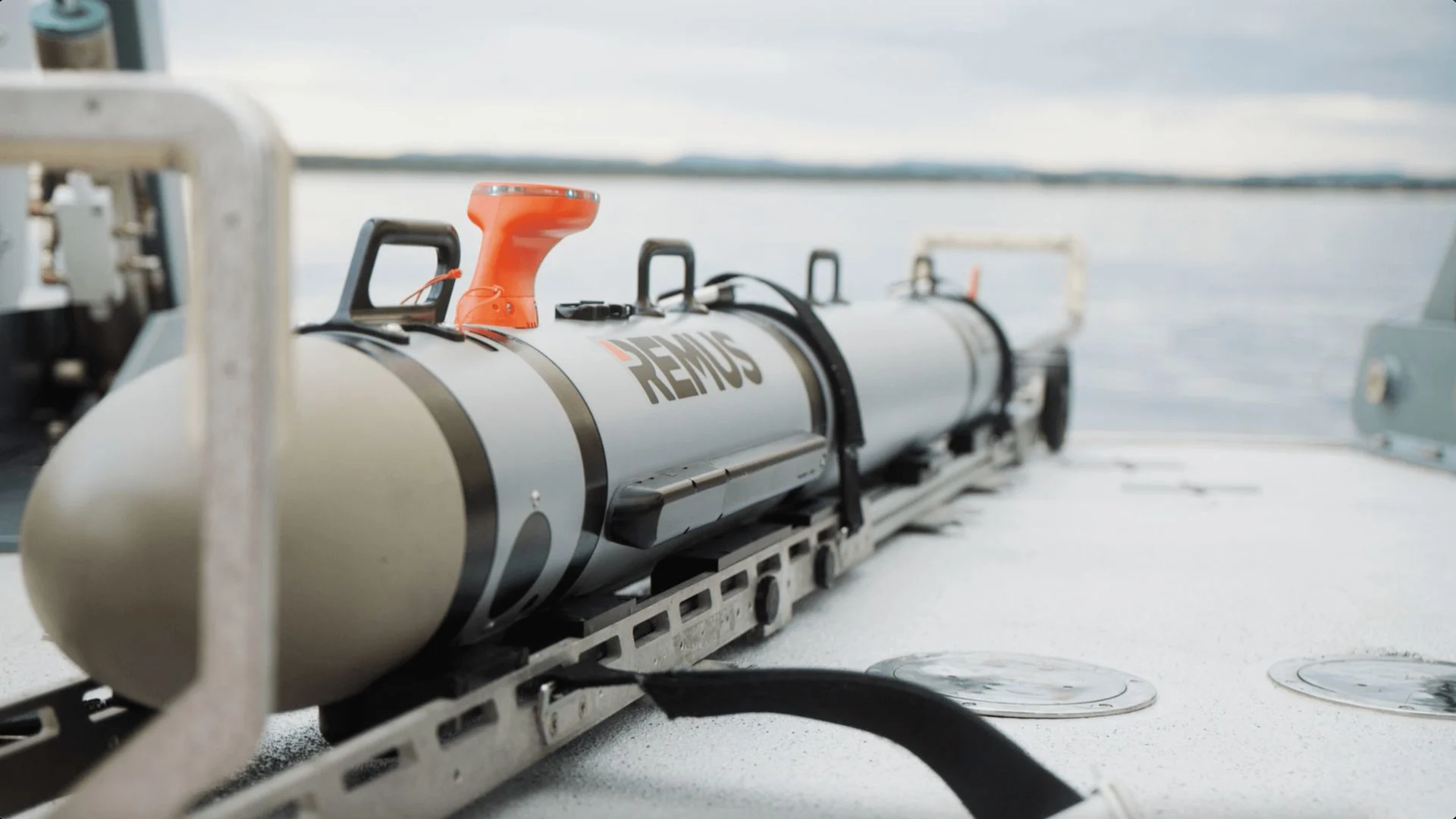
HII has received an updated U.S. Navy contract to build 82 additional Lionfish UUVs, the service’s small unmanned undersea vehicles (SUUVs), the company announced on November 16, 2026. The order lifts the number of Lionfish vehicles HII will build, test and deliver to 175, under a five-year production program that can scale to 200 vehicles and carries a total potential value exceeding $347 million.
The award follows an option-year production contract HII announced in July 2026. HII had delivered 50 Lionfish SUUVs as of October 21, 2026, from its unmanned systems production campus in Pocasset, Massachusetts, which the company recently expanded. The program dates to 2023: in October that year, HII announced that Naval Sea Systems Command (NAVSEA) had placed an initial $19.8 million order for nine vehicles, support equipment and engineering services, under a contract built to grow to 200.
From OTA Prototype to Lionfish UUV Full-Scale Production
Lionfish is the Navy’s SUUV program of record, built on HII’s commercial REMUS 300 platform. The vehicle emerged from a rapid prototyping initiative run with the Defense Innovation Unit (DIU), and the Navy selected the REMUS 300 as its next-generation SUUV in early 2022. According to HII, Lionfish is the Navy’s first successful transition from an Other Transaction Authority (OTA) prototype effort to full-scale production, a result the company says demonstrates the accelerated application of dual-use commercial technologies to Department of War capabilities.
The new lot of 82 vehicles implies that 93 were already on order before this modification. HII delivered the first two production vehicles in April 2025 and completed its 42nd Lionfish at the end of 2025. With 50 delivered, 125 vehicles remain in the production pipeline. HII did not disclose the dollar value of this specific award, the delivery schedule for the new lot, or the split between mission configurations.
HII also describes Lionfish as the first and only cyber-compliant unmanned underwater vehicle in production for the Navy. That status carries operational weight: a vehicle that exchanges mission data with host platforms and command nodes is a potential attack surface, and meeting Navy cybersecurity requirements weighs on integration into fleet networks.
“The updated award reflects the U.S. Navy’s continued investment in Lionfish and its operationally proven capabilities,” said Duane Fotheringham, president of the Unmanned Systems group in HII’s Mission Technologies division. He added that his team remains focused on delivering autonomous systems that give sailors and Marines critical undersea warfare capabilities.
REMUS 300 Specifications: Depth, Endurance and Modular Payloads
Lionfish incorporates service-requested modifications to the baseline REMUS 300, whose published specifications frame the vehicle’s envelope. The REMUS 300 is a small-class, two-person-portable vehicle with a 305 m (1,000 ft) depth rating and a 19 cm (7.5 in) hull diameter, rising to 20.7 cm with the largest battery. Three rechargeable lithium-ion battery options set endurance: 1.5 kWh for about 10 hours, 3.0 kWh for about 20 hours, and 4.5 kWh for up to 30 hours. Across those configurations, length grows from 2.03 m to 2.64 m and weight from 48.5 kg to 70.3 kg. Maximum speed exceeds 4 knots, and maximum range reaches 165 km in the long-endurance setup.
The REMUS 300 is a development of the REMUS 100, the platform behind the Navy’s Mk 18 Mod 1 Swordfish, which was designed to search, classify and map the very shallow water region. The 305 m rating extends coverage beyond very shallow water into deeper littoral and continental shelf areas, where moored and bottom mines, seabed infrastructure and submarine activity are concerns.
The REMUS 300 complies with the Navy’s Modular Open Systems Architecture (MOSA) and Unmanned Maritime Autonomy Architecture (UMAA) standards, and HII offers software and hardware development kits for third-party payload and autonomy integration. That architecture lets one hull cover mine countermeasures, intelligence, surveillance and reconnaissance (ISR), anti-submarine warfare and electronic warfare by swapping payloads. HII’s announcement does not detail the sensor fits on the Navy’s Lionfish lots, including sonar type.
Analysis: The 82-vehicle order matters less as a single contract than as evidence that the OTA-to-production pathway can deliver quantity. The program’s ceiling of more than $347 million across 200 vehicles works out to roughly $1.7 million per unit, a figure that also covers support equipment and engineering services. That cost profile allows the Navy to employ small UUVs in numbers in contested littorals, where mine clearance and seabed surveillance carry high risk for crewed platforms. The REMUS lineage also supports coalition work: HII has delivered more than 750 REMUS vehicles to over 30 countries, including 14 NATO members, and says more than 90% of those delivered over the past 25 years remain in service. A shared platform family simplifies common training, data handling and maintenance across allied mine countermeasures forces.
The next markers are the delivery cadence for the remaining 125 vehicles, whether the Navy exercises options to reach the 200-vehicle ceiling before the five-year program ends, and which payload configurations it fields across mission sets. HII links the expanded Pocasset campus to growing global demand for autonomous maritime platforms. The open question is whether the Navy will pursue a follow-on buy beyond 200 units as it builds out its unmanned undersea force.