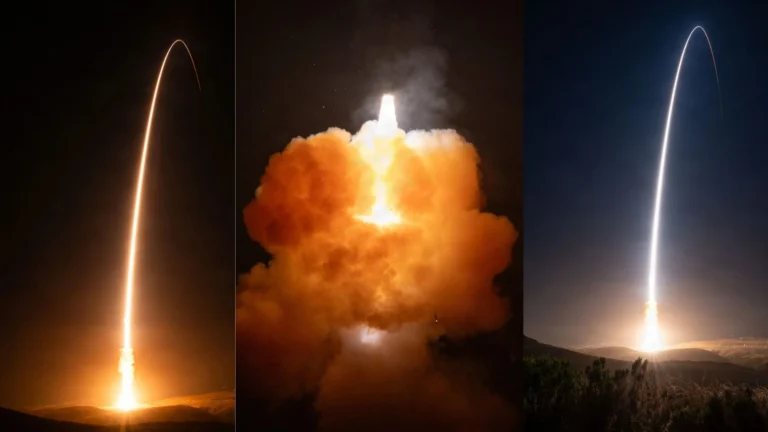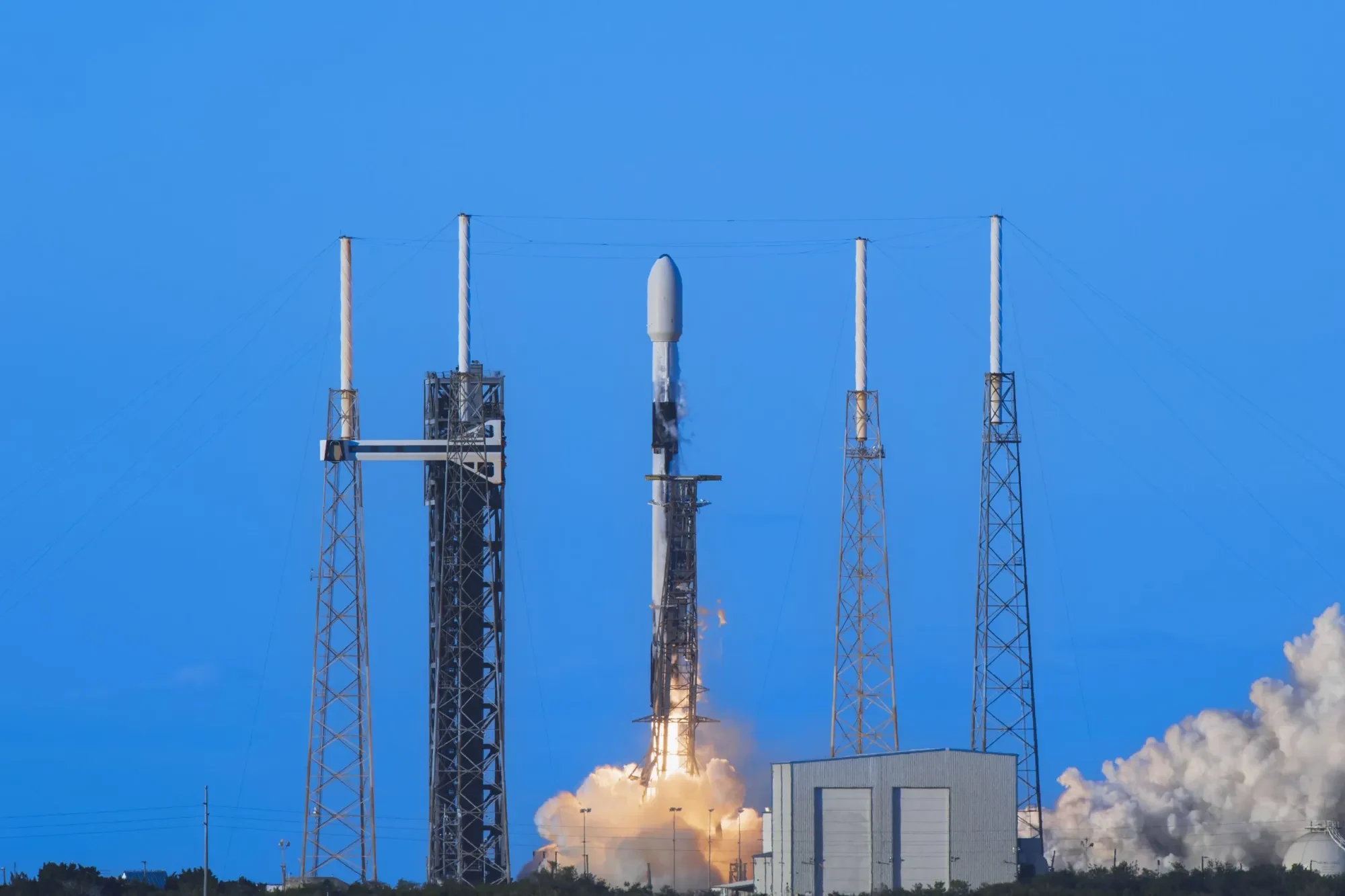
The U.S. Space Force on November 16, 2026, awarded SpaceX, United Launch Services and Blue Origin contract modifications worth up to $985 million combined for National Security Space Launch (NSSL) Lane 2 launch services. The modifications apply to the three NSSL Phase 3 Lane 2 contracts, according to the Pentagon’s contract announcement. Work will be performed at the contractors’ facilities, Cape Canaveral Space Force Station and Kennedy Space Center in Florida, and Vandenberg Space Force Base in California, with completion expected by April 2033. No funds were obligated at award.
Lane 2 is the high-assurance half of the NSSL Phase 3 strategy, reserved for must-go payloads and demanding orbits, including National Reconnaissance Office (NRO), GPS and Wideband Global SATCOM missions. Space Systems Command (SSC) awarded the three firm-fixed-price, indefinite-delivery contracts on April 4, 2025, for about 54 missions ordered from fiscal 2025 through fiscal 2029, worth roughly $13.7 billion: about $5.9 billion for 28 SpaceX missions, $5.4 billion for 19 United Launch Alliance (ULA) missions and $2.4 billion for seven Blue Origin missions. The new ceiling equals about 7 percent of that total. It arrives one day after a ULA Vulcan Centaur failed to reach orbit.
What the $985 Million NSSL Lane 2 Modification Does Not Say
The announcement covers modification P00006 to SpaceX contract FA8811-25-D-B002, P00004 to United Launch Services contract FA8811-25-D-B003 and P00006 to Blue Origin contract FA8811-25-D-B005. It does not break the $985 million down by provider, state how many additional missions it could fund or explain what prompted the change. Because these are indefinite-delivery vehicles, the figure is ordering capacity rather than committed money; funds flow only when SSC issues task orders for individual missions. The April 2033 end date also runs past the fiscal 2027 to fiscal 2032 launch window the Space Force projected in 2025.
Demand is one plausible driver. Earlier in 2026, SSC issued a sources sought notice for up to 25 high-priority, risk-sensitive missions in fiscal 2027 through 2029, six, nine and 10 per year respectively, and said it planned to buy them through existing Lane 2 contracts. The Pentagon has not linked that notice to the new ceiling. The move does follow the July 2026 expansion of the Lane 1 contracts, whose ceiling rose from $5.6 billion to $17 billion.
So far, Lane 2 work has gone to two providers. In the fiscal 2026 assignment round announced in October 2025, SpaceX received five missions priced at $714 million and ULA two missions at $428 million. Blue Origin received none, pending certification of its New Glenn rocket.
Vulcan and New Glenn Setbacks Leave Lane 2 Reliant on Falcon
The Space Force suspended Vulcan from NSSL missions after a GEM 63XL solid rocket booster anomaly on the USSF-87 flight of February 12, 2026, a repeat of the nozzle loss seen on the October 2024 Cert-2 flight. Both missions still reached orbit. During the investigation, the Space Force swapped six missions from Vulcan to SpaceX’s Falcon 9 and Falcon Heavy, SSC confirmed on October 21, 2026.
The November 15 flight was meant as a step back toward national security work. A Vulcan VC6L carrying 40 Amazon Leo broadband satellites lifted off from Space Launch Complex 41, but an anomaly about 10 minutes into flight prevented it from reaching orbit, and the payload was lost. ULA has not disclosed a cause. Vulcan’s first stage runs on two Blue Origin BE-4 engines, a version of the engine New Glenn clusters seven of, so a BE-4 finding could touch both vehicles. No such link has been established.
New Glenn has its own hurdles. Blue Origin chose a four-flight certification path, which the Space Force accepted. The rocket flew in January 2025, November 2025 and April 2026, when an upper-stage anomaly left a commercial satellite in a lower-than-planned orbit. On May 28, 2026, a vehicle exploded during an integrated hotfire test at Launch Complex 36, an event Blue Origin traced to a main oxygen valve on one BE-4. Return to flight has reportedly slipped to January 2027. For now, Falcon 9 and Falcon Heavy are the only rockets flying Lane 2-class payloads.
Analysis: The $985 million adds contracting headroom, not launch capacity. Lane 2 was built on three providers to guarantee assured access for payloads the United States cannot afford to lose, yet with Vulcan sidelined and New Glenn uncertified, it currently operates as a single-provider lane. Spreading the increase across all three contracts keeps SSC able to move missions between vehicles, as the 2026 swaps showed, without recompeting work. The cost is concentration: every high-value NRO, GPS and WGS launch now rides on the Falcon family, which SpaceX plans to phase out once Starship flies regularly.
SSC has yet to say how the $985 million is allocated or which missions it covers. The next milestones are ULA’s failure investigation and any decision to return Vulcan to NSSL service, New Glenn’s return to flight and its remaining certification flights, and upcoming Lane 2 mission assignments, where Blue Origin’s share depends on completing certification.