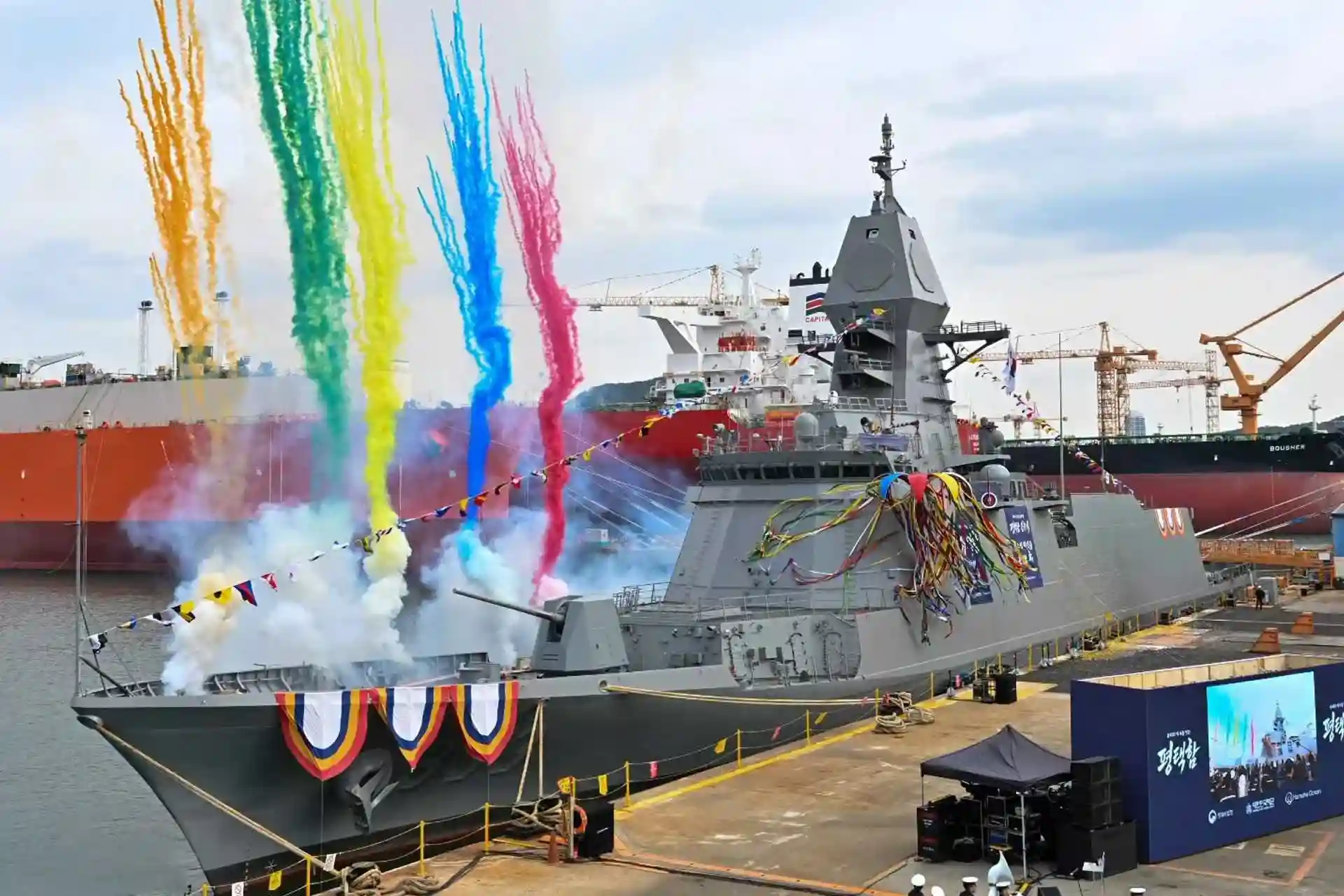
The Republic of Korea Navy launched the ROKS Pyeongtaek frigate, a 3,600-ton guided-missile warship, at Hanwha Ocean’s Okpo shipyard in Geoje on November 18, 2026, the Navy and the Defense Acquisition Program Administration (DAPA) said. The fifth hull of the six-ship Ulsan-class Batch-III program, also designated FFX Batch-III or the Chungnam class, the 129-meter warship will enter sea trials before delivery to the Navy in December 2027.
The launch keeps South Korea’s frigate recapitalization on a tight cadence. Batch-III replaces aging frigates and patrol combat corvettes, some in service since the 1980s. HD Hyundai Heavy Industries delivered the lead ship, ROKS Chungnam (FFG-828), on December 18, 2024. SK Oceanplant is building hulls two through four, including ROKS Jeonnam, launched November 25, 2025. Hanwha Ocean won the final pair in 2023 under a 790 billion won ($600 million) contract, and laid the keel of the sixth hull in July 2026 for a launch planned in February 2027.
Pyeongtaek Frigate Sensor Mast and Phased-Array Radar Architecture
The defining upgrade over the Incheon-class (Batch-I) and Daegu-class (Batch-II) frigates is the Integrated Sensor Mast (ISM), a stealth-shaped structure developed by Hanwha Systems. It carries a four-face fixed Multifunctional Phased Array Radar (MFR) and, per publicly available specifications, infrared search-and-track sensors. Earlier batches relied on a rotating search radar paired with separate tracking radars. The fixed-array arrangement allows the ship to detect, track and engage multiple air and surface targets simultaneously in any direction, a function Korean officials compare to the U.S. Aegis system.
Hanwha Systems unveiled the MFR in 2019, describing it as South Korea’s first fully digital active electronically scanned array (AESA) radar. Open-source reporting credits the class with engaging up to eight aerial threats at once; DAPA has not published an official figure. The operational gain is reaction time: continuous 360-degree tracking closes the gaps a rotating antenna leaves against sea-skimming anti-ship missiles.
Armament centers on a 5-inch (127 mm) main gun and a 16-cell Korean Vertical Launching System (K-VLS). The Navy lists anti-ship missiles, ship-to-ship guided missiles, tactical ship-to-surface missiles and long-range anti-submarine torpedoes among the frigate’s weapons. Publicly available specifications identify these as the K-SAAM surface-to-air missile, quad-packed in K-VLS cells, the SSM-700K Haeseong anti-ship missile, the Haeryong tactical land-attack missile and the Hongsangeo (Red Shark) long-range anti-submarine torpedo. Open sources put full-load displacement at about 4,300 tons and beam at roughly 15 meters.
Hybrid Propulsion and Anti-Submarine Warfare in the West Sea
Anti-submarine warfare (ASW) drove much of the Batch-III design. The Pyeongtaek uses hybrid electric propulsion to reduce underwater radiated noise, pairing a hull-mounted sonar with a towed-array sonar. Publicly available specifications for the class describe a combined diesel-electric or gas (CODLOG) plant built around a Rolls-Royce MT30 gas turbine and electric propulsion motors, with a top speed of about 30 knots. Electric drive keeps the frigate quiet on patrol; the turbine provides sprint speed to prosecute a contact. A flight deck and hangar accommodate one helicopter.
The ship is named for the port city south of Seoul that hosts the Navy’s Second Fleet, responsible for the contested maritime border with North Korea in the West Sea. The shallow, cluttered waters near the Northern Limit Line degrade sonar performance and favor small submarines, a threat underscored by the 2010 sinking of the corvette ROKS Cheonan, which a multinational investigation attributed to a North Korean torpedo. “The Pyeongtaek will serve as a core force protecting the West Sea,” said Rear Adm. Lee Gu-seong, director general for planning and management at Navy headquarters.
Analysis: The Pyeongtaek matters beyond the Second Fleet because the Chungnam class is now a candidate for the U.S. Navy. Under an August 13, 2026, presidential memorandum, the Navy has been assessing the Chungnam, Japan’s export Mogami variant and Türkiye’s Istanbul class under a “Finland model” that allows up to two hulls to be built abroad before production moves to U.S. yards. The assessment was due November 12; no selection has been publicly announced, and both the House-passed and Senate Armed Services Committee versions of the Fiscal Year 2027 National Defense Authorization Act would bar buying foreign-built warships. Eligible builders must own or build a U.S. shipyard, a requirement Hanwha meets through its ownership of Hanwha Philly Shipyard. A three-yard build sustaining frequent launches is the serial capacity Washington lacks after canceling the Constellation class. “Based on this proven technology, we expect it to contribute significantly to future defense exports,” said Jung Jae-jun, head of DAPA’s Future Force Project Division.
Harbor acceptance and sea trials will run through 2027 ahead of the December 2027 delivery, while Hanwha Ocean completes the sixth hull and builds the first two FFX Batch-IV frigates under a contract running to December 2030. At the ceremony, Defense Minister Kang Shin-chul said the Navy is now advancing toward nuclear-powered submarines and manned-unmanned command vessels. The open questions remain the U.S. Navy’s foreign frigate decision and whether Congress allows it to proceed.