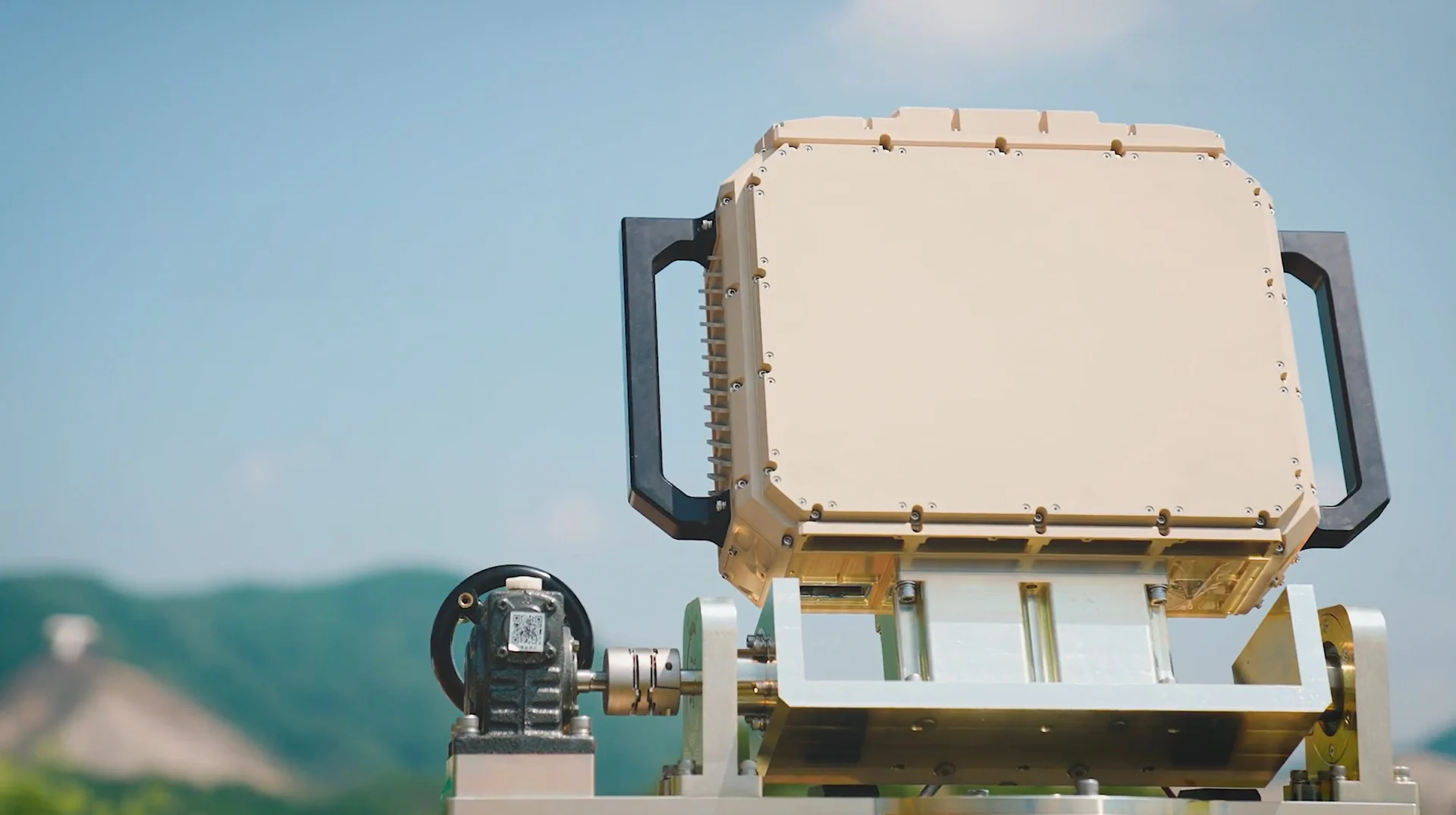
Hanwha Systems has signed a pilot contract to export its Short-Range AESA Radar to US defense technology company Rebellion Industries for counter-drone missions, the South Korean company announced on November 18, 2026. Signed on November 16, the deal covers an all-in-one, AI-enabled active electronically scanned array (AESA) radar built to detect and track drones and other low-altitude threats for counter-unmanned aircraft systems (C-UAS) missions. Neither the number of radars nor the contract value has been disclosed, and deliveries will proceed in sequence through early 2027.
The deal is Hanwha Systems’ second major entry into the US market, after Boeing selected the company in December 2025 to supply the Eagle Large Area Display (ELAD) cockpit display for the F-15EX Eagle II and South Korea’s F-15K. It builds on Hanwha’s Middle East radar exports, including a contract worth about KRW 1.2 trillion (roughly $1 billion) signed with the United Arab Emirates in 2022 for Hanwha Multi-Function Radars (MFR) on the Cheongung-II Medium-Range Surface-to-Air Missile (M-SAM) system. The timing matches rising US demand for low-altitude sensing around domestic sites: on October 16, 2026, the Federal Emergency Management Agency (FEMA) announced $250 million in fiscal 2027 C-UAS grant funding.
Short-Range AESA Radar Design: All-in-One Architecture and AI Classification
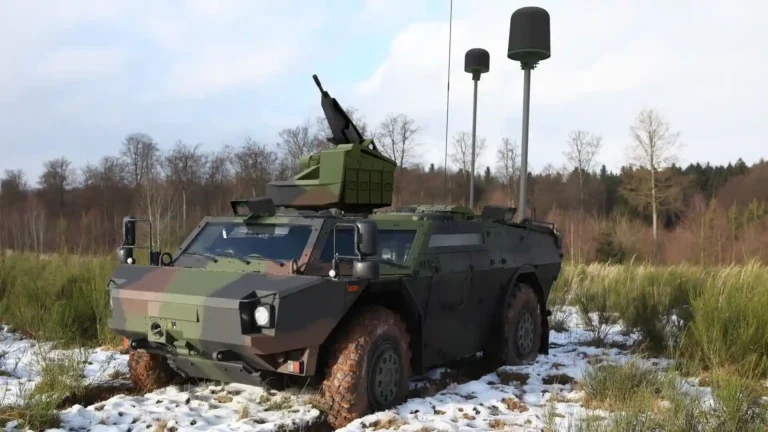
Hanwha Systems began developing ultra-lightweight, ultra-compact short-range radars in 2024 and recently completed an export-oriented model. The design integrates the antenna, main unit, and power supply into a single enclosure. That layout underpins Hanwha’s claim that the sensor can be mounted on tanks, armored vehicles, and small vessels, as well as on civilian facilities and vehicles.
The radar is optimized for drones and small unmanned aerial vehicles (UAVs), but Hanwha says it also detects and tracks other close-range threats penetrating at low altitude and low speed, including attack helicopters and low-flying aircraft. Target identification relies on artificial intelligence (AI) processing that, according to the company, separates birds and other living creatures from unmanned aircraft and other airborne objects, and holds performance in fog, dust, and electromagnetic interference.
Bird discrimination is the operational crux. Small quadcopters and Group 1 fixed-wing drones present radar cross-sections and velocity profiles close to those of large birds, and at a civilian site where every alert triggers a security response, false alarms quickly erode operator confidence. A classifier that reliably suppresses bird tracks determines whether a radar can run with minimal supervision around a refinery or a stadium.
Hanwha has not released key performance parameters. Detection range against a defined drone class, operating frequency band, azimuth and elevation coverage, track capacity, weight, and power draw all remain undisclosed, as does the transmit/receive module technology. These figures will decide how many radars a site requires and how the system compares with short-range C-UAS radars already fielded in the United States.
How Hanwha and Rebellion Industries Plan a Dual-Use C-UAS Platform
Under the agreement, the two companies will integrate the radar with Rebellion Industries’ Sensor OS software and jointly design and develop a dual-use C-UAS platform for defense and civilian customers. Rebellion describes itself as building the operating system for airspace sovereignty and presents Sensor OS as a hardware-to-software layer that fuses multiple sensor feeds into a single track picture. In that architecture, the Hanwha radar provides the low-altitude detection layer while the software fuses its tracks with other sensor feeds.
Initial deployments will prioritize US civil infrastructure, including oil refineries, corporate data centers, logistics centers, and sports stadiums. The pilot therefore tests the system in commercial settings first. According to Hanwha, the companies are already discussing follow-on contracts for large-scale additional supply within the United States.
Hanwha Systems plans to install automated production lines at its Gumi Plant to establish mass production of the radar, a step the company says will improve price competitiveness in domestic and export markets. Price will weigh more heavily as the number of radars a site or a unit must field grows.
The new radar fills the layer beneath Hanwha’s existing MFRs, which serve the M-SAM and Long-Range Surface-to-Air Missile (L-SAM) systems against ballistic missiles and aircraft at medium-to-high altitudes and longer distances. A Hanwha Systems official said the company is receiving inquiries “not only from the US but also from various regions overseas” and expects the radar to become “another powerful K-defense export product, following our Multi-Function Radars (MFR).”
Analysis: The contract matters less for its size, which remains undisclosed, than for its route into the US market. By entering through a domestic software integrator and civilian infrastructure customers rather than a Department of Defense program of record, Hanwha gains operating experience on US soil without first clearing a full military acquisition cycle. If the Sensor OS integration performs at refineries and data centers, the same radar-and-software package becomes a candidate for installation defense and maneuver-force C-UAS requirements.
Deliveries run through early 2027, and the follow-on negotiations will show whether the pilot converts into volume orders. Open questions include published performance data, the schedule for the automated Gumi lines, whether a US military customer evaluates the integrated system, and how the radar will be paired with defeat effectors, which neither company has addressed.