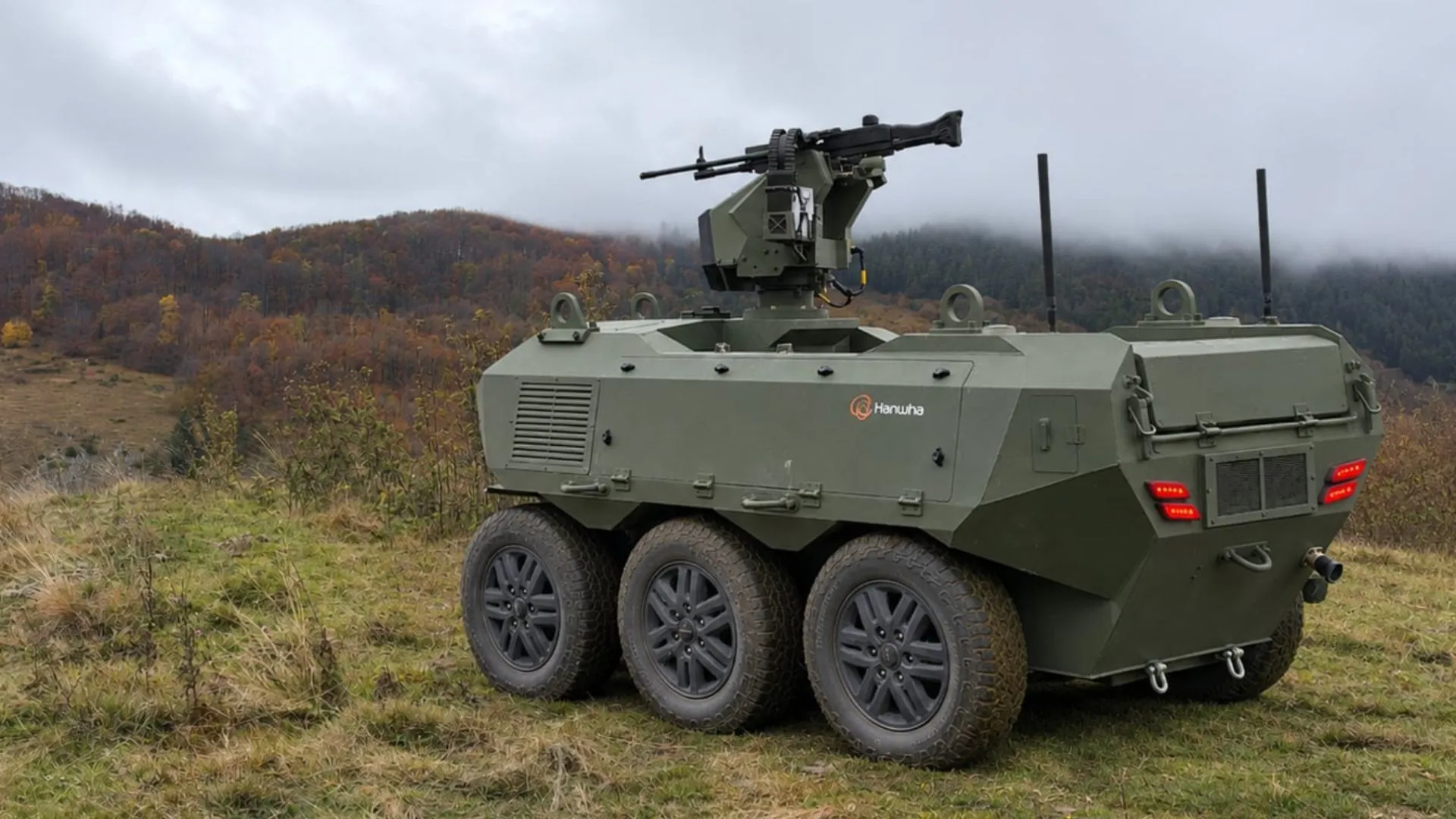
Hanwha Aerospace Romania (HARO) fielded the GRUNT 6×6 unmanned ground vehicle (UGV) and a Hanwha Systems counter-unmanned aircraft system (C-UAS) during EXPERIMENT 26.2, a Romanian Land Forces technology trial held October 26 to 30, 2026, at the Prislop training range in Argeș County. Both systems were integrated with Romanian command networks, the company announced on November 19, 2026.
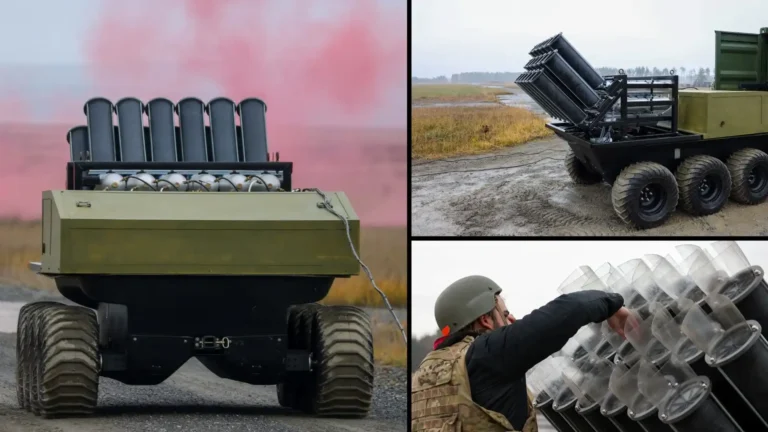
The exercise gathered Romanian military personnel and 27 defense industry participants to assess emerging technologies under realistic operational conditions. Team HARO also deployed the THeMIS tracked UGV built by Estonia’s Milrem Robotics, its partner for Romania’s national UGV program under a teaming agreement signed on May 14, 2026, at the Black Sea Defense & Aerospace (BSDA) exhibition in Bucharest. HARO is expected to act as prime contractor. Romania has not publicly disclosed the program’s quantities, budget, or competition timeline.
Hanwha GRUNT UGV Links to Romanian C4ISR Network in Trial
GRUNT is the next-generation evolution of the ARION-SMET, the multipurpose 6×6 UGV that Hanwha Aerospace developed and that South Korea’s Defense Acquisition Program Administration selected in July 2026 for the Republic of Korea Army’s first multipurpose UGV program. GRUNT moves from the all-electric drive of the roughly 2-tonne ARION-SMET to a hybrid propulsion system and carries payloads of approximately 900 kg, combining autonomous and remotely controlled functions. When it presented GRUNT at BSDA 2026 in May, Hanwha gave it an operational range of approximately 290 km and listed logistics transport, casualty evacuation, reconnaissance, surveillance, and combat support among its missions.
At Prislop, GRUNT crossed mountainous and forested terrain on reconnaissance and surveillance missions, using electro-optical and infrared (EO/IR) sensors to detect personnel and vehicles concealed in complex terrain. The more consequential result was network integration. GRUNT connected to the Romanian military’s C4ISR system and transmitted surveillance footage and vehicle-position data to the command post in real time. It also demonstrated that it could maintain video transmission over an alternative communication link in the event of a primary network failure.
HARO Business Development Manager Denis Lee described the C4ISR integration as “an important step towards deeper operational and technological cooperation.” The trial builds on a manned-unmanned teaming (MUM-T) demonstration that Hanwha staged near Bucharest in May 2026, pairing GRUNT with the TIGON wheeled armored vehicle and THeMIS. Hanwha lists the tracked, hybrid-powered THeMIS with a payload capacity of up to 1,200 kg, giving the team a wheeled and tracked offer across Romania’s mixed terrain.
How Hanwha Systems C-UAS Jammed Drones in Rain and Fog
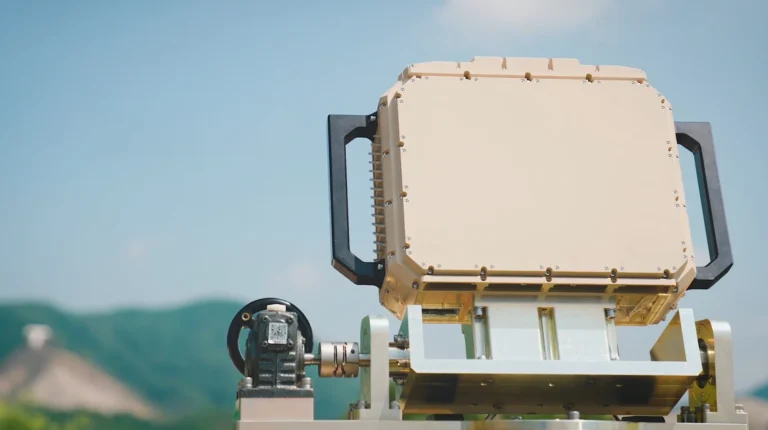
Team HARO also fielded an integrated C-UAS solution built around an intelligent command-and-control (C2) system. The sensor and effector set included a domestically developed short-range active electronically scanned array (AESA) radar based on core technologies of the multifunction radar used by South Korea’s M-SAM (Medium-range Surface-to-Air Missile) system, a TAS-815K EO/IR camera, a radio-frequency (RF) scanner, and a jammer. Hanwha describes the architecture as modular, with sensors and countermeasures tailored to the mission and environment.
During the exercise, the system completed the detection, tracking, and electronic jamming missions assigned by the Romanian military, neutralizing multiple drones by forcing them to hover or return to home. It performed reliably in rain and dense fog, conditions that degrade EO/IR tracking and make radar cueing decisive. Hanwha did not identify the drone types engaged, and the configuration shown included no kinetic effector.
Integration again stood out. Using NATO-aligned communication standards, the C-UAS exchanged operational information with Romanian C2 systems. Jae Yong Kim, Director of the C-UAS Business Center at Hanwha Systems, framed this as a step toward supporting integrated air defense operations with Romania and other European partners.
Analysis: EXPERIMENT 26.2 says less about raw platform performance than about Hanwha’s ability to plug into a NATO member’s command architecture, the main barrier for a non-European supplier on the alliance’s eastern flank. Romania has faced repeated Russian drone incursions and debris since 2023 during strikes on Ukrainian Danube ports, making short-range C-UAS a pressing requirement. Combined with the 2024 contract for 54 K9 howitzers and 36 K10 resupply vehicles and the H-ACE Europe plant at Petrești, Hanwha is positioning itself as a full land-systems partner. The soft-kill results remain a limited data point, however: return-to-home behavior is typical of commercial-type drones, and Hanwha did not say whether the system faced hardened military UAS with autonomous navigation or fiber-optic control.
The next decision point is Romania’s formal UGV requirement, which will also draw rivals such as Otokar, which displayed a UGV for Romanian forces at BSDA 2026. HARO says it intends to expand its participation in multinational exercises, including NATO-led activities, while H-ACE Europe prepares local K9 production with potential expansion into other land systems.