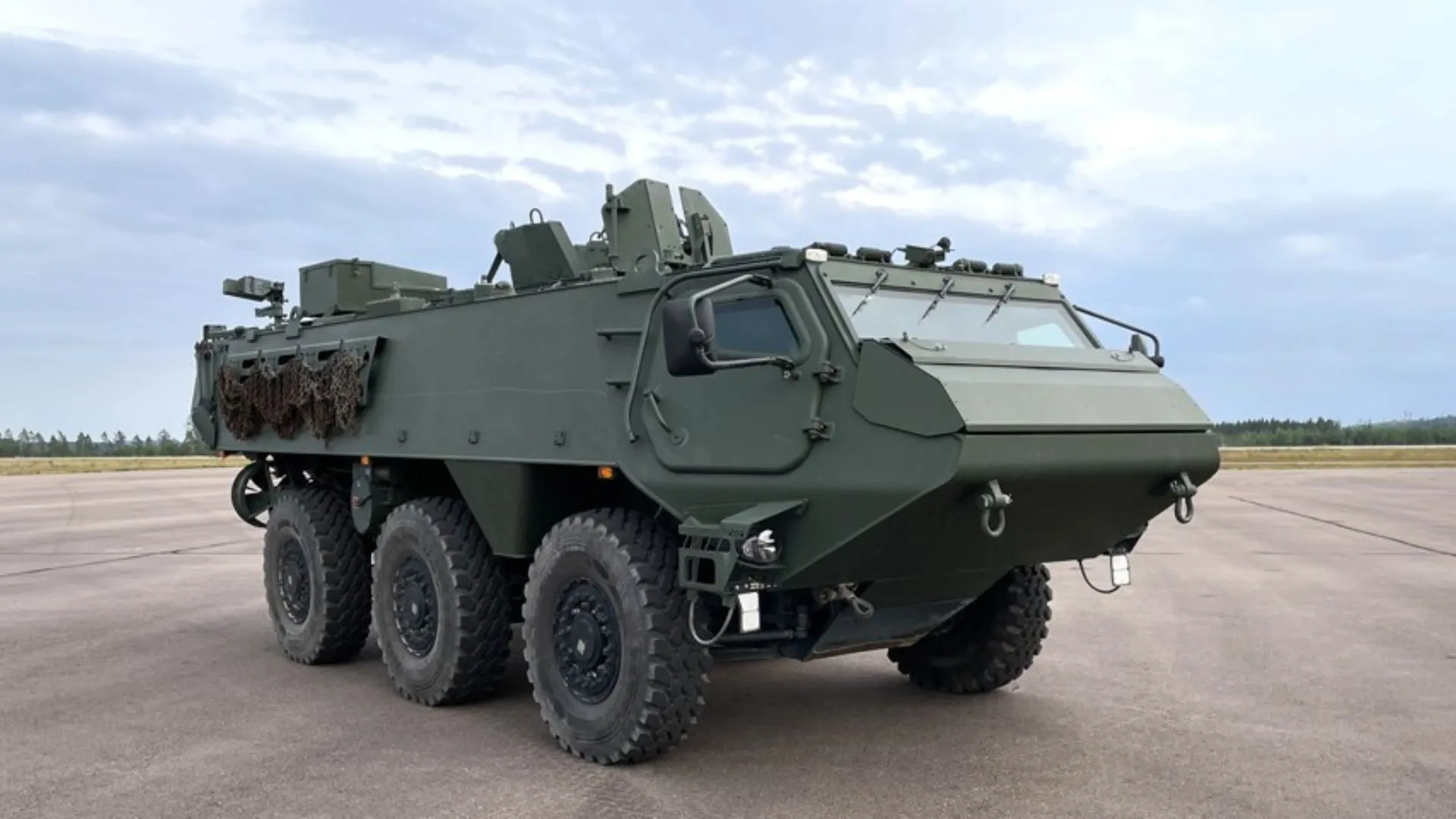
The Netherlands signed the Technical Arrangement of the Common Armoured Vehicle System (CAVS) program on November 19, 2026, the first step toward joining the Patria 6×6 armored vehicle effort as its eighth nation. State Secretary for Defence Derk Boswijk signed on behalf of the Netherlands at the Dutch Ministry of Defence stand during the NIDV Exhibition Defence & Security (NEDS) 2026 in Rotterdam, Patria announced.
The Dutch signature extends a coalition that has grown from two founding members to seven in five years. Finland and Latvia launched CAVS in 2020, Sweden joined in 2022, Germany in 2023, Denmark in April 2025, and the United Kingdom and Norway signed on September 9, 2025. According to Patria, the program has generated orders for nearly 2,000 Patria 6×6 vehicles, including options, and nearly 500 deliveries, up from just over 300 deliveries reported in February 2026. Production runs in Finland and Latvia, and an August 2026 framework agreement with KNDS Deutschland Maintenance covers the assembly and final integration of German vehicles in Germany.
Netherlands CAVS Program Entry Begins at the Technical Arrangement Stage
The Technical Arrangement is the entry point of a staged accession path that continues with the Research and Development Agreement and the Framework Agreement, which opens serial procurement. Signing the first document makes a country a participating partner but does not commit it to buy vehicles. Norway illustrates the tempo. Oslo signed the Technical Arrangement in September 2025, joined the R&D Agreement in February 2026, signed the Framework Agreement in May 2026, and ordered 20 Patria 6×6 vehicles, including command-and-control variants, with options for 40 more, in August 2026, roughly 12 months from first signature to first order.
The Dutch Ministry of Defence has not disclosed a planned quantity, variant mix, budget, or delivery timeline. The armored vehicle package Boswijk presented to the House of Representatives on October 26, 2026 covered additional CV90 infantry fighting vehicles, a new tracked Armoured Combat Support Vehicle, Wisent-2 heavy recovery vehicles, bridge-laying tanks, and breaching vehicles, with no reference to a 6×6 requirement.
The platform family is not new to the Dutch. The Royal Netherlands Army operated the Patria XA-188, a member of the Pasi 6×6 family, and agreed in 2010 to sell 81 of them to Estonia as it transitioned to the Boxer 8×8. Jussi Järvinen, Executive Vice President of Patria’s Protected Mobility business area, said the Netherlands already “cooperates closely with several CAVS participating countries,” including within the UK-led Joint Expeditionary Force (JEF). Patria said the program remains open to European and NATO nations with comparable 6×6 requirements.
Patria 6×6 Specifications and Its Place in the Dutch Wheeled Fleet
Publicly available specifications give the Patria 6×6, also designated XA-300, a maximum combat weight of 24 tonnes with up to 8,500 kg of payload. Power comes from a Scania DC09 five-cylinder in-line diesel rated at 294 kW (394 hp) and 1,870 Nm, coupled to a ZF automatic transmission with seven forward and two reverse gears. The vehicle is 7.5 m long, exceeds 100 km/h on roads, covers more than 700 km, and fords to 1.5 m, with amphibious capability offered as an option. It carries a crew of two in the front cabin and up to 10 dismounts in the rear compartment.
Baseline protection is STANAG 4569 Level 2 ballistic and mine protection, with an optional Level 4 package made possible by the payload margin, and the vehicle rides on a fully independent suspension. National configurations share the common Patria 6×6 platform: Germany holds 349 firm orders across four variants as a Fuchs successor, and German, Swedish, and Norwegian vehicles are being fitted with the Kongsberg Protector RS4 remote weapon station. Variants delivered or on order include APC, command-and-control, medical evacuation, and NEMO turreted mortar versions.
For the Netherlands, a 24-tonne 6×6 would sit between the Bushmaster 4×4 protected mobility vehicle and the Boxer 8×8, rated at up to 38.5 tonnes. That positioning points to support roles and large-fleet protected transport rather than a Boxer substitute, though the Dutch MoD has not stated an intended role.
Analysis: The strategic logic is logistical as much as technical. All three Royal Netherlands Army combat brigades are integrated into German Army divisions, and Germany, with up to 876 vehicles under contract including options, is one of the largest CAVS customers. A shared 6×6 would give Dutch and German units common spares, training pipelines, and maintenance procedures inside the same formations, while the JEF overlap extends that commonality to the Nordic and Baltic flank. The constraint is industrial bandwidth: Lithuania announced plans in May 2026 to procure up to 936 Patria 6×6 vehicles, and late entrants will compete for production slots with nations already at the order stage.
The next decision points are Dutch accession to the CAVS Research and Development Agreement and Framework Agreement, and an A-letter to parliament under the Defence Materiel Process setting out the national requirement. Quantity, variants, budget, and the work share for Dutch industry remain undisclosed. On the Norwegian timeline, a first Dutch order would fall around late 2027.