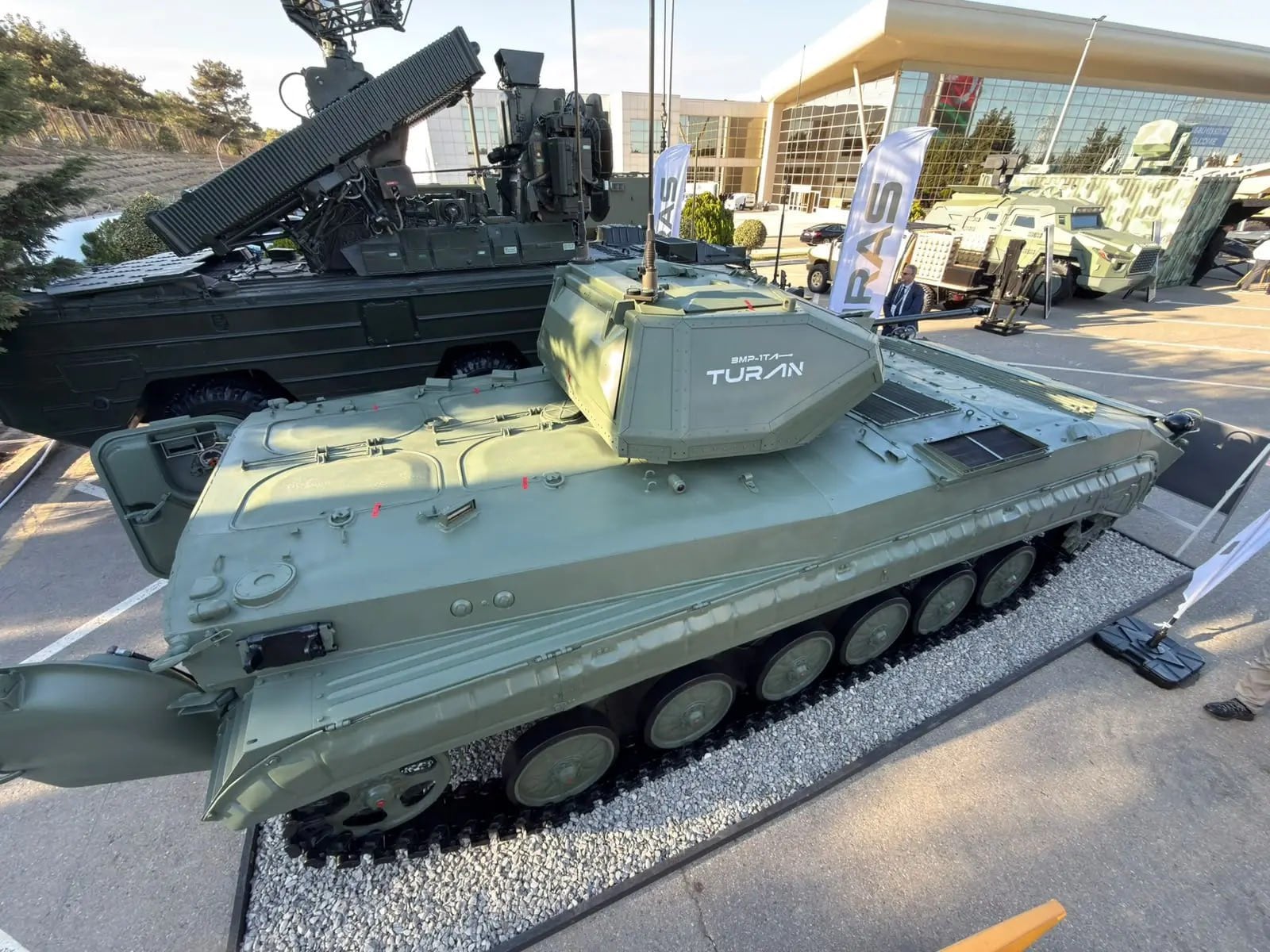
Azerbaijani defense company MİRAS and Makine Kimya Azerbaijan (MKA), the Baku-based subsidiary of Türkiye’s state-owned Makine ve Kimya Endüstrisi (MKE), unveiled the BMP-1TA TURAN infantry fighting vehicle (IFV) modernization at ADEX 2026 in Baku on September 30, 2026. The package removes the Soviet-era BMP-1’s 73 mm gun turret and installs a new turret with a 30 mm dual-feed autocannon, a coaxial 7.62 mm machine gun and an electro-optical fire control suite, with airburst ammunition intended to counter small drones.
The debut coincided with a Memorandum of Understanding (MoU) signed the same day by MKA and MİRAS, which operates under Azerbaijan’s Ministry of Defense. The MoU covers modernization of BMP-1 IFVs in Azerbaijani Army service and joint defense industrial projects in Azerbaijan, and extends to weapons, ammunition, maintenance and refurbishment. It builds on an armored vehicle modernization agreement MKE and MİRAS signed at SAHA 2026 in Istanbul in May. MKE set up MKA in Baku in December 2025. MKE’s official release designates the vehicle BMP-1T (TURAN), while BMP-1TA appears in other show coverage.
BMP-1TA TURAN Turret: 2A42 Cannon, Sensors, and Fire Control
The BMP-1 entered Soviet service in 1966 as the first mass-produced IFV. Publicly available specifications describe a 13.3-tonne amphibious vehicle powered by a 300 hp UTD-20 diesel, carrying a crew of three and eight dismounts. Its one-man turret mounts the 2A28 Grom 73 mm low-pressure smoothbore gun, a coaxial 7.62 mm PKT and a rail for the 9M14 Malyutka anti-tank guided missile. The 2A28 fires rocket-assisted rounds with an effective range of roughly 800 m and elevates to only about 33 degrees, which rules out engaging aerial targets.
The TURAN turret replaces that armament with the 2A42 30×165 mm dual-feed autocannon and a coaxial PK-family 7.62x54mmR machine gun. The 2A42 also arms the BMP-2, the BMD-2 and the Mi-28 and Ka-52 attack helicopters; open-source data credit it with selectable rates of 200 to 300 and 550 to 800 rounds per minute. For Baku, the choice keeps the upgraded BMP-1 on the 30×165 mm ammunition already stocked for its BMP-2 fleet, avoiding a parallel logistics chain. The dual-feed system lets the gunner switch between standard belts and airburst rounds without reloading.
MKE states the turret offers a wider elevation range and continuous 360-degree rotation, with electro-optical and thermal sights, automatic target tracking, advanced stabilization and a digital control architecture linking crew stations. Onboard countermeasures are also fitted. Show reporting indicates the turret can accept guns from 25 mm to 40 mm, leaving room to migrate to NATO-standard calibers later. Stabilization and thermal imaging give the BMP-1 a fire-on-the-move and night engagement capability its original fit lacked. MKE has not published maximum elevation, turret weight, protection level, ready-round capacity or crew configuration, and no anti-tank guided missile launcher has been announced.
How MKE’s TOLGA Experience Shapes the BMP-1 Counter-Drone Role
MKE says the modernization aims to protect the vehicle against drone threats by drawing on its experience with the TOLGA short-range air defense (SHORAD) system; the company does not present the turret itself as a TOLGA product. TOLGA, unveiled at IDEF 2025, layers a radar, electro-optical sensors and a jammer rated to 10,000 m with gun turrets in 35 mm, 20 mm, 40 mm and 12.7 mm, effective at 3,000 m, 1,000 m, 500 m and 300 m respectively. Its fragmentation anti-drone rounds detonate at a set time and distance to form a cloud of metal fragments around the target. MKE completed qualification of the 12.7 mm and 20 mm rounds in February 2026.
The fuze for the TURAN’s 30 mm airburst round has not been disclosed. Options range from a fixed-time fuze similar to those used in TOLGA’s smaller calibers to a proximity fuze or a programmable time fuze set at the muzzle by the fire control system. Programmable rounds offer the tightest fragment placement but require additional turret hardware. MKE has also not stated whether a 30×165 mm airburst round has completed qualification.
The requirement reflects recent combat experience. Azerbaijan’s own use of armed drones and loitering munitions in the 2020 Second Karabakh War, and the losses first-person-view (FPV) drones have inflicted on armored vehicles in Ukraine, have pushed mechanized forces to seek organic counter-drone fires rather than relying solely on dedicated air defense units. A high-elevation 30 mm gun firing airburst rounds would give each BMP-1 a self-defense option against small drones at angles and ranges the 2A28 cannot cover.
Analysis: The BMP-1TA matters less as a vehicle than as a model. A single turret swap converts a 1960s hull into an IFV with stabilized day and night fires and a planned counter-drone layer, while preserving Russian-standard ammunition and shifting sustainment toward an in-country MKE subsidiary. For Azerbaijan, it reduces dependence on Russian upgrade paths for a legacy fleet. For MKE, it creates an exportable kit for the dozens of armies still fielding BMP-1s. The trade-offs are real: publicly available specifications rate the hull’s frontal armor only against heavy machine gun fire, and without a missile the vehicle loses the Malyutka’s anti-tank reach.
Key unknowns remain: the number of vehicles to be converted, where the work will take place, contract value and timeline, the airburst fuze design and any missile integration. The September 30 MoU is a framework, not a production contract. A firm order or a live-fire demonstration of the 30 mm airburst round against drones would mark the next step.