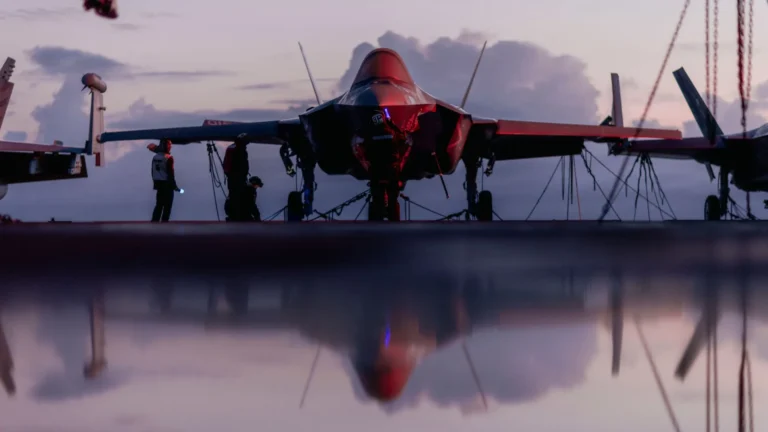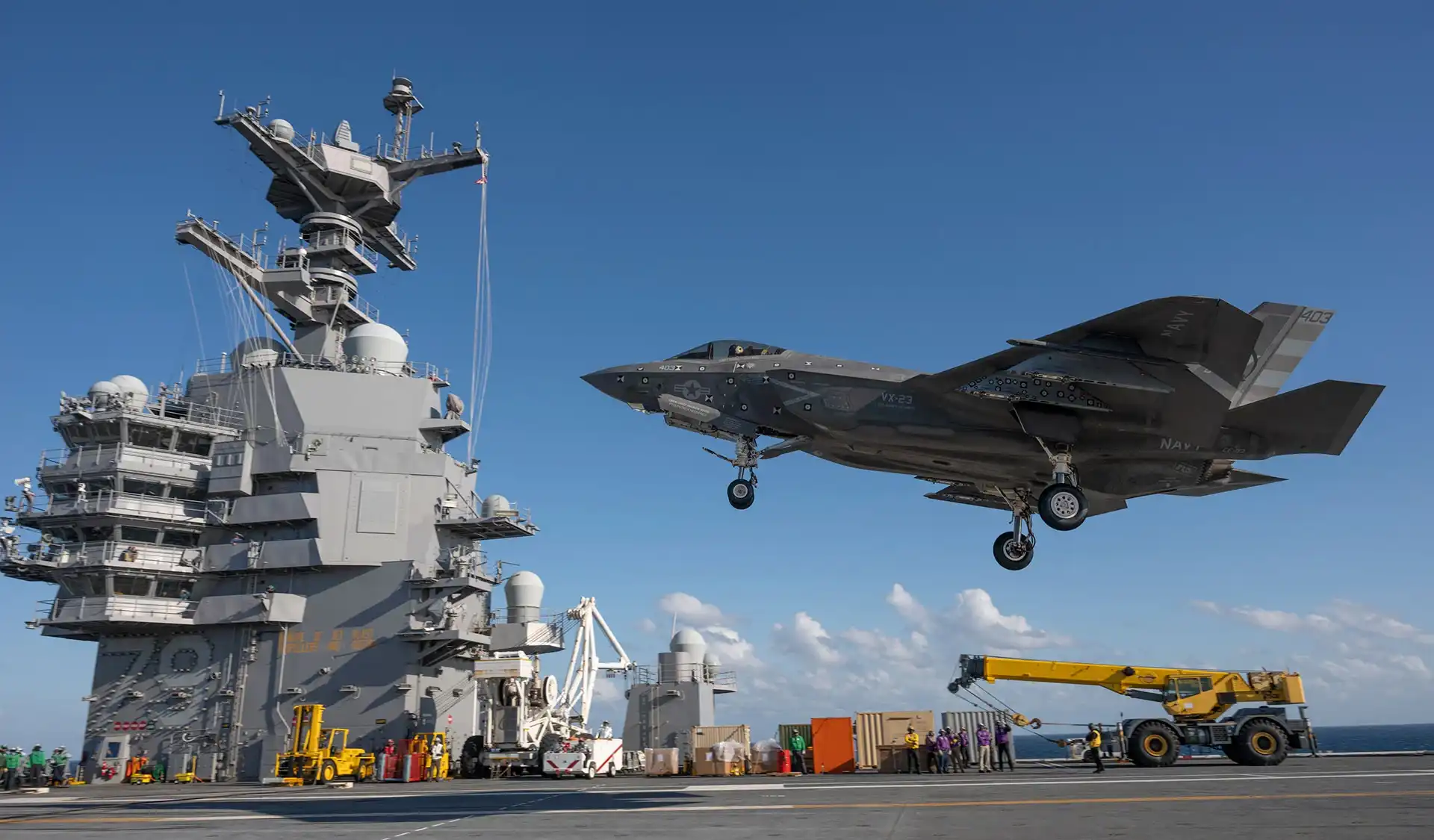
Two US Navy F-35C fighters logged 122 catapult launches and 122 arrested landings aboard the future USS John F. Kennedy (CVN 79) in October 2026, the jet’s first flights from a Ford-class carrier. Lockheed Martin announced the results on November 19, 2026, after 11 days of at-sea testing. The first arrested landing took place in the Western Atlantic on October 13, 2026, the Navy’s 251st birthday, followed by the first launch from the ship’s Electromagnetic Aircraft Launch System (EMALS) the next day.
The trials close a gap that has followed the Ford-class program for years. USS Gerald R. Ford (CVN 78), commissioned in 2017, has deployed with air wings built around F/A-18E/F Super Hornets and EA-18G Growlers rather than the Navy’s fifth-generation fighter. Congress responded in the Fiscal Year 2020 National Defense Authorization Act by requiring Kennedy to be able to deploy with the F-35C before completing its post-shakedown availability, prompting the Navy to switch in 2020 to a single-phase delivery that folded F-35C modifications into construction. Kennedy reached preliminary acceptance on September 29, 2026, and formal delivery is planned for March 2027, a date the Navy’s FY2026 budget tied to completing Advanced Arresting Gear (AAG) certification and Advanced Weapons Elevator work.
F-35C Ford-Class Carrier Testing: 34 Sorties, 122 Traps on EMALS and AAG
The two jets, flown by test pilots from Air Test and Evaluation Squadron 23 (VX-23), the “Salty Dogs” of Naval Air Station Patuxent River, Maryland, logged 34 flights during the Aircraft Compatibility Testing period. The at-sea phase followed shore-based trials conducted between January 2024 and May 2025, including AAG arrestments at Naval Air Warfare Center Aircraft Division Lakehurst, New Jersey.
Ford-class ships replace the steam catapults and Mk 7 hydraulic arresting engines of the Nimitz class with two new systems. EMALS uses linear induction motors to accelerate aircraft along a more precisely controlled power profile, reducing peak structural loads on the airframe. AAG uses a turbo-electric energy-absorbing system designed to recover a broader range of aircraft weights and approach conditions. The redesigned flight deck and relocated island also change airflow, exhaust dynamics, and deck handling.
According to Lockheed Martin, the integrated test team collected data to verify EMALS and AAG software and shipboard installations, validate F-35C loads and structural models for launch and recovery, and develop the Aircraft Launch Bulletins and Aircraft Recovery Bulletins that will govern fleet operations from Ford-class decks. The team also assessed supportability and confirmed mission-systems software stability during what the company called the first carrier use of initial Block 4 software. The company did not specify which Block 4 capabilities were loaded.
F-35C Carrier Variant Design and the Kennedy Integration Path
Publicly available specifications indicate the F-35C carries nearly 20,000 pounds of internal fuel, the largest load of the three F-35 variants, and offers a combat radius of more than 600 nautical miles on internal fuel. Its wing spans 43 feet, roughly 8 feet wider than the F-35A’s, with larger control surfaces for slow-speed carrier approaches, while reinforced landing gear and a carrier-rated tailhook absorb catapult and arrestment loads. A single Pratt & Whitney F135-PW-400 turbofan powers the aircraft.
A larger-winged, heavier fighter places different energy demands on catapults and arresting gear than a Super Hornet, which is why launch and recovery bulletins must be validated for each fleet configuration.
The integration effort dates to November 18, 2011, when F-35C test aircraft CF-3 made the first EMALS launch at Joint Base McGuire-Dix-Lakehurst. At sea, the F-35C had operated only from Nimitz-class carriers since its first shipboard trials aboard USS Nimitz (CVN 68) in November 2014. “For the first time, the aircraft has demonstrated launch and recovery operations from a Gerald R. Ford-Class flight deck,” said Sean Jackson, vice president of Lockheed Martin’s F-35 Development Program. “With the completion of this test phase, the Navy has now cleared the F-35C for operations across its entire fleet of aircraft carriers.”
Analysis: The Kennedy trials validate the interface between aircraft and launch and recovery equipment, the precondition Congress set for fielding the ship, but they do not by themselves make the F-35C deployable from every Ford-class hull. Lockheed Martin’s fleet-wide clearance statement speaks to aircraft-ship compatibility; operational deployment also depends on ship-side modifications for F-35C maintenance, logistics, and secure mission planning that Kennedy received during construction and that Ford, whose air wings still fly without the jet, has yet to demonstrate. The data also arrives three months after a presidential memorandum, signed August 13, 2026, ordered the Pentagon to plan the replacement of EMALS and the Advanced Weapons Elevators with steam and hydraulic systems on the future USS Doris Miller (CVN 81). The 122 F-35C launches and 122 arrested landings aboard Kennedy give program officials a concrete data point in that debate.
Kennedy’s next milestones are completion of AAG certification and formal delivery, planned for March 2027, followed by a post-shakedown availability during which the congressional F-35C requirement must be met. Open questions include when Ford will receive equivalent F-35C modifications, when Block 4 capability reaches operational carrier squadrons, and which carrier air wing will bring the F-35C on Kennedy’s first deployment.