Leidos will build and support 14 Medium Range Air Defense Radar (MRADR) systems for the US Marine Corps under a $40.8 million award, the company announced on November 18, 2026. The award moves the low-signature sensor from prototyping toward broader fielding, with work expected to be completed by August 2028.
The award, executed through Leidos subsidiary Dynetics as a follow-on contract modification managed by Marine Corps Systems Command (MARCORSYSCOM) in Quantico, Virginia, targets a specific vulnerability in Marine Corps force design: ground radars that emit at high power become targets. Under the Expeditionary Advanced Base Operations (EABO) concept, small and dispersed Marine units are expected to operate inside an adversary’s weapons engagement zone, where a detectable emitter can be geolocated and struck. MRADR is designed to provide persistent, 360-degree surveillance while minimizing the risk of revealing the position of the force it protects.
From MELPS Prototypes to MRADR Air Defense Radar Production
MRADR descends from the Marine Expeditionary Long Range Persistent Sensor (MELPS), which Dynetics developed through an Office of Naval Research (ONR) effort on multi-domain radar in contested environments. MELPS itself is derived from the Army Long Range Persistent Surveillance (ALPS) system that Dynetics built to detect attack drones and cruise missiles, and Leidos demonstrated a MELPS prototype at Project Convergence 2022 in the San Diego area.
The program entered formal development in 2023, when Leidos received a $32 million contract through the Consortium Management Group, an other transaction agreement (OTA) consortium manager, to develop four MRADR prototypes over two years. In mid-2025, Dynetics received a further $24.9 million order for six production-representative model systems, according to Marine Corps Systems Command; the November 2026 company release does not reference that award.
The new modification, valued at $40,776,966, covers the manufacture, delivery, and support of 14 production-representative model systems. The Department of War first listed the modification in its contract announcements in early September 2026. It also covers retrofitting four MRADR prototypes and four MELPS systems, which Leidos describes as an option, along with depot-level technical manual support, program management, engineering changes, logistics, and software support. More than $35.7 million in fiscal 2025 and 2026 procurement and research and development funds was obligated at award. Work will be performed in Huntsville, Alabama (87.5 percent) and Woodlake, California (12.5 percent).
Low-Signature Sensing and Integration With the Marine GBAD Kill Chain
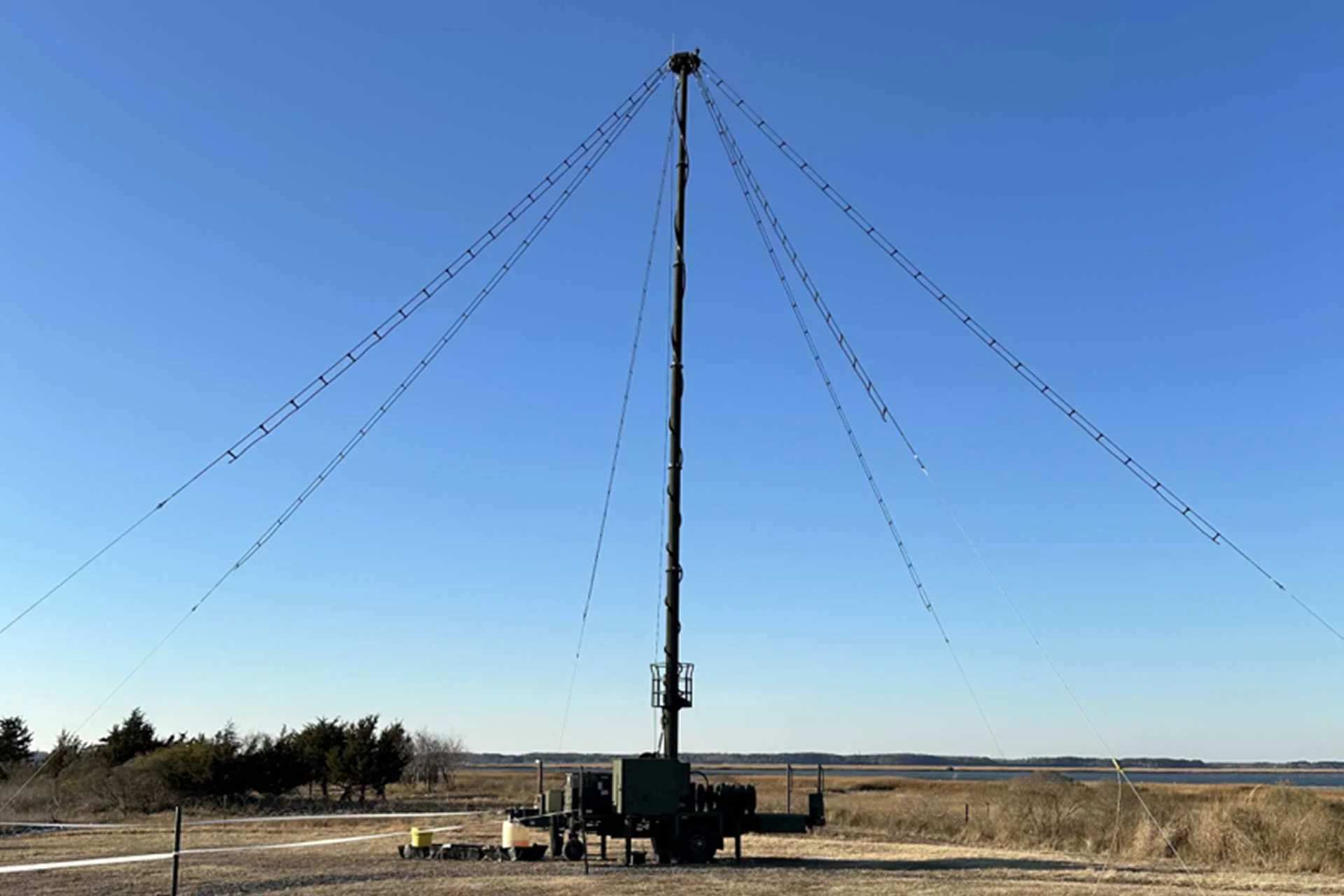
Leidos describes MRADR as a mobile system combining advanced antenna technology with sophisticated signal processing. The MELPS architecture it builds on uses digitized antennas and receivers to generate a 360-degree air picture without a detectable electromagnetic footprint. Leidos has not disclosed whether MRADR operates as a purely passive sensor, as a low probability of intercept (LPI) radar, or as a combination of both. Frequency band, instrumented range, track capacity, system weight, and host vehicle have not been published.
The target set is defined more clearly. Marine Corps material identifies cruise missiles, helicopters, fixed-wing aircraft, and uncrewed aircraft systems as the threats MRADR must detect, track, and identify. The radar is intended to feed the Marine Corps ground-based air defense (GBAD) architecture, including the Medium Range Intercept Capability (MRIC), the service’s Iron Dome-derived interceptor system, and transporter erector launchers on Amphibious Combat Vehicle chassis. It connects to launchers and command nodes over a secure wireless network and is planned to operate alongside the AN/TPS-80 Ground/Air Task-Oriented Radar (G/ATOR), the Northrop Grumman active electronically scanned array (AESA) radar that anchors Marine air surveillance.
“Marines need air defense capabilities that can keep pace with an increasingly complex operating environment,” said Matt Becker, vice president of Leidos Defense Sensors.
Analysis: The order matters less for its dollar value than for what it signals about Marine Corps sensor doctrine. G/ATOR delivers long-range coverage but radiates at power levels that a peer adversary’s electronic intelligence networks can locate. A low-signature medium-range layer allows units to maintain a local air picture while larger emitters remain under emission control, which aligns directly with the survival logic of stand-in forces in the Western Pacific. The quantities remain modest, however: 14 new-build production-representative systems and eight retrofits do not equal full-rate production, and the absence of published performance data means the low-signature claim has yet to be validated against operational electronic support measures. The shared ALPS lineage also gives Leidos a common sensor base across Army and Marine Corps air defense, a position the company is extending to homeland defense.
Deliveries under the modification run through August 2028. Key unknowns include the Marine Corps’ total procurement objective, the timing of any full-rate production decision, and integration testing results with MRIC. Fiscal 2027 budget justification documents should provide the first indication of the quantities the service intends to field across its littoral and air defense units.