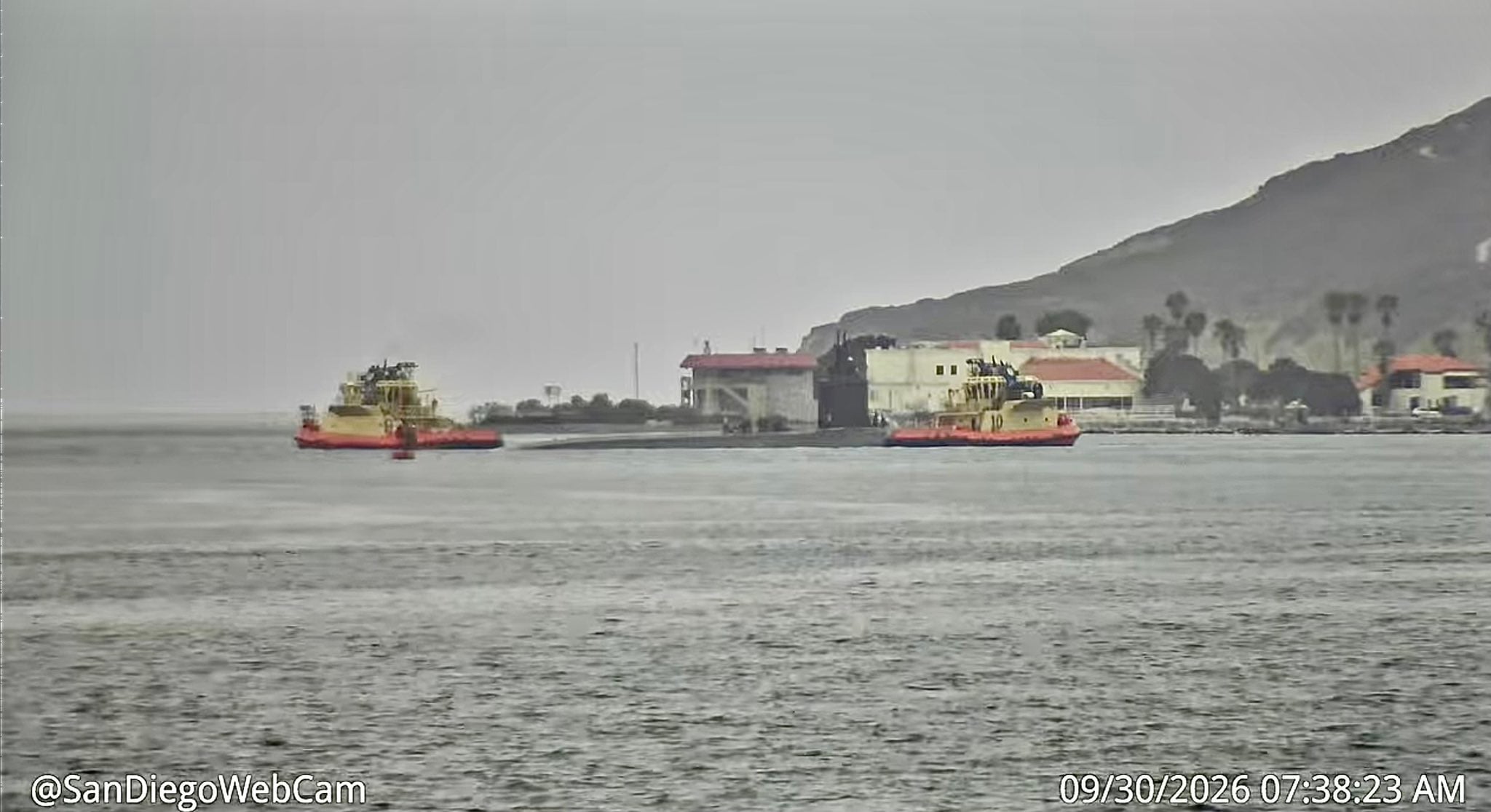
The US Navy Los Angeles-class attack submarine USS Santa Fe (SSN 763) conducted a quick turn in San Diego Bay on September 30, 2026, according to publicly available harbor webcam footage. Imagery time-stamped 7:38 a.m. local time shows the surfaced boat off Point Loma with two harbor tugs alongside, close to the submarine piers of its homeport, Naval Base Point Loma.
The Navy has not disclosed the purpose of the stop. A quick turn typically lets a submarine embark or land personnel, parts or stores without ending an underway period. The movement comes four and a half months after Cmdr. Miguel Recalde relieved Cmdr. Eric Knepper as commanding officer on May 15, 2026, and a year after Santa Fe returned from a six-month deployment to the US Indo-Pacific Command area of responsibility on September 29, 2025. That deployment included Submarine Exercise (SUBEX) 25-1 with a Japan Maritime Self-Defense Force (JMSDF) submarine near Yokosuka.
USS Santa Fe’s 688i Design: Propulsion, Weapons and Combat System
Built by General Dynamics Electric Boat in Groton, Connecticut, and commissioned on January 8, 1994, Santa Fe belongs to Flight III, the final 23 hulls from USS San Juan (SSN 751) to USS Cheyenne (SSN 773), designated 688i. That standard moved the forward diving planes from the sail to retractable bow positions, hardened the sail for surfacing through ice, added acoustic quieting, introduced the AN/BSY-1 combat system and enabled mine laying from the torpedo tubes.
Publicly available specifications indicate a length of 362 feet (110.3 meters), a 33-foot beam and a submerged displacement of about 6,900 tons. One S6G pressurized water reactor drives two steam turbines and a single shaft, rated at roughly 35,000 shaft horsepower, though some open sources cite 30,000 to 33,500 shp. Navy materials credit the boat with more than 25 knots and diving beyond 800 feet; open-source estimates put top submerged speed near 30 to 33 knots and test depth around 950 feet.
Armament comprises four 21-inch torpedo tubes for Mk 48 Advanced Capability (ADCAP) heavyweight torpedoes and 12 Vertical Launch System (VLS) tubes for Tomahawk land-attack cruise missiles forward of the sail. Because the VLS cells do not draw on torpedo-room stowage, a 688i carries a strike load without sacrificing its anti-submarine magazine, a layout the Virginia class kept in Blocks I and II before adopting two Virginia Payload Tubes in Block III. Santa Fe embarks roughly 15 officers and 140 enlisted sailors and is tasked with anti-submarine, anti-ship and strike warfare plus intelligence, surveillance and reconnaissance (ISR).
Point Loma’s Submarine Squadron 11 and the Shrinking 688i Fleet
Santa Fe spent most of her career in Hawaii, operating from Pearl Harbor after transiting to the Pacific in March 1995, before arriving at Portsmouth Naval Shipyard in Kittery, Maine, in August 2019 for an extensive maintenance availability. The shipyard undocked her on December 14, 2020, and delivered her back to the fleet on February 25, 2022. She then shifted homeport through the Panama Canal, reaching Point Loma on March 30, 2022.
She now operates under Commander, Submarine Squadron 11 (CSS-11) with USS Scranton (SSN 756), USS Hampton (SSN 767) and USS Springfield (SSN 761), which arrived from Naval Base Guam on July 21, 2026. Springfield followed the departure of USS Alexandria (SSN 757) to Puget Sound Naval Shipyard in Bremerton, Washington, for inactivation. All four squadron boats are Flight III hulls commissioned in the early 1990s, making CSS-11 a squadron built entirely around the Improved Los Angeles design.
The wider 688i drawdown is accelerating. San Juan was decommissioned at Keyport, Washington, on August 6, 2026, exactly 38 years after commissioning, and parts removed from her will help sustain the remaining boats. USS Newport News (SSN 750), the last Flight II boat, left service in January 2026. In April 2026, the Navy halted the overhaul of USS Boise (SSN 764), sidelined since 2015, after Navy Secretary John Phelan said it had already cost $800 million and required another $1.9 billion. Open sources disagree on the exact figure, but fewer than two dozen Los Angeles-class boats remain in commission, against 25 Virginia-class submarines in service after USS Massachusetts (SSN 798) commissioned on March 28, 2026.
Analysis: Routine harbor movements by boats like Santa Fe carry more weight as the 688i cohort thins. Open sources indicate Flight II and III hulls received reactor cores sized for the life of the ship, so remaining service is bounded by core energy as much as hull condition. The Boise decision signals the Navy will not spend scarce shipyard capacity on deep overhauls of long-idled hulls, leaving recently refitted boats such as Santa Fe to bridge the attack submarine gap while Virginia-class output stays below the Navy’s two-per-year target.
The purpose and length of the September 30 stop remain unconfirmed, as does whether Santa Fe is working up toward another deployment under Recalde. The next indicators are any Navy announcement on the boat’s operating schedule, the fiscal 2027 inactivation list, which will show how many more Flight III boats leave the force, and Virginia-class delivery rates at Electric Boat and Huntington Ingalls Industries’ Newport News Shipbuilding.