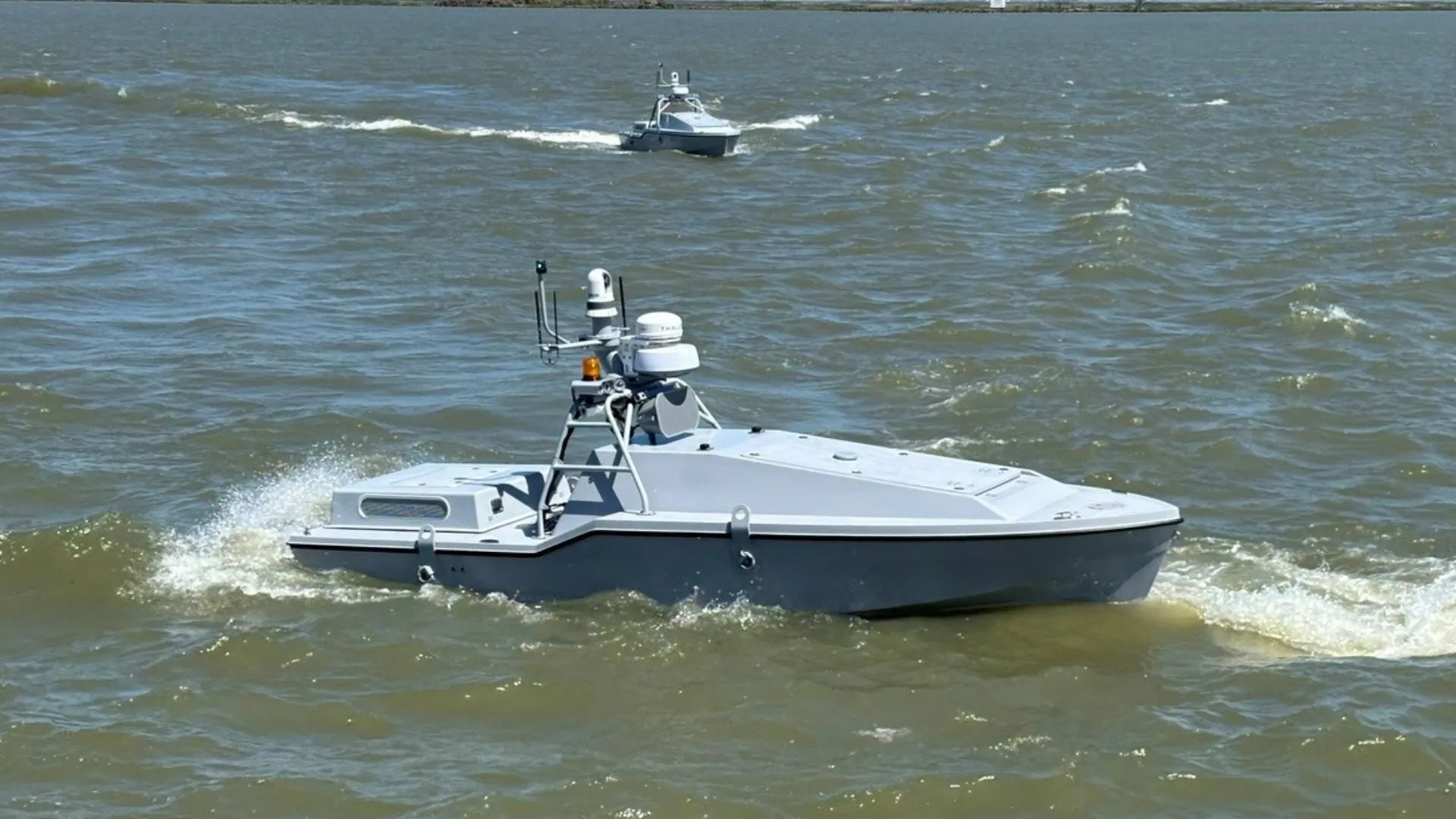
The U.S. Army Combat Capabilities Development Command (DEVCOM) Ground Vehicle Systems Center (GVSC) has completed multi-day evaluations of Saronic Technologies’ Corsair autonomous surface vessel at the Army’s two strategic ammunition ports, Military Ocean Terminal Sunny Point (MOTSU) in North Carolina and Military Ocean Terminal Concord (MOTCO) in California. The Army disclosed the evaluations on November 19, 2026, framing them as a test of whether commercial unmanned surface vessels (USVs) can help offset manning shortfalls and an unreliable crewed boat fleet at both terminals.
The stakes are logistical rather than tactical. Both terminals belong to the 596th Transportation Brigade of the Military Surface Deployment and Distribution Command (SDDC). MOTSU is the nation’s largest ammunition terminal and the Army’s primary East Coast deep-water port, while MOTCO is the West Coast’s primary military ammunition port and supports munitions delivery to forces in the Pacific. A surveillance gap on the water at either site exposes the munitions pipeline to sabotage or surface attack at a moment when operations in the U.S. Central Command (CENTCOM) area of responsibility place a premium on uninterrupted throughput. The Corsair trials build on GVSC’s 2025 assessment of HavocAI’s autonomy software and Rampage vessel during the Northern Strike exercise.
How GVSC Fast-Tracked Saronic Corsair Testing at Army Ammunition Ports
The request came from the ports themselves. According to GVSC mechanical engineer Marco Schoener, MOTCO officials contacted his team in January seeking a fast, cost-effective answer to manning difficulties, compounded by the condition of the patrol craft in use at both terminals. “They had issues with their boats breaking down often,” Schoener said. “The idea was to supplement with something autonomous to survey and detect any surface threats on the water.”
GVSC already had a candidate. Saronic had approached the center months earlier to pitch its vessels for port security, and the two parties formalized the relationship through a Cooperative Research and Development Agreement (CRADA). GVSC then coordinated with both terminals to stand them up as test sites within a few months. Lt. Col. Lauren Cabral, commander of the 834th Transportation Battalion at MOTCO, described a “short flash to bang” between the request and the demonstration.
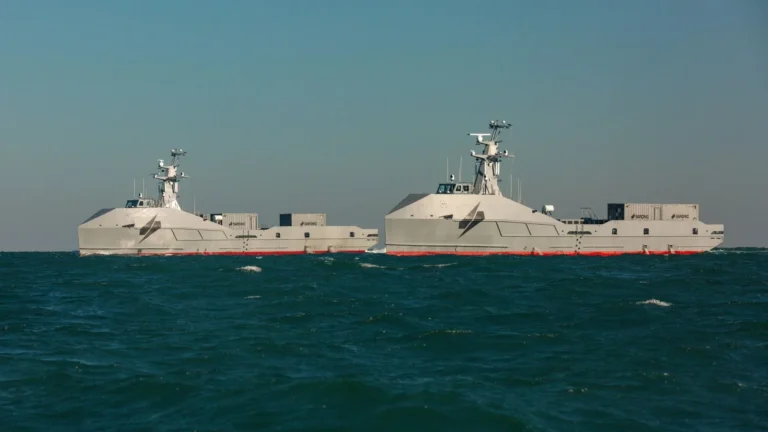
At Concord, manned teams operated the USVs remotely. Across the port demonstrations, the vessels showed threat deterrence and rapid response capabilities while reducing the operational burden on crewed patrol units. Army imagery shows two Corsairs operating at Concord during a demonstration on May 14, 2026, but the Army has not released test dates for Sunny Point, detection ranges, false-alarm rates, or any other quantitative performance data. A CRADA also carries no procurement commitment, so the trials do not yet amount to an Army acquisition decision.
Corsair Sensor Suite, Range, and Payload for Harbor Security
Publicly available specifications indicate the Corsair is a 24-foot (7.3-meter) monohull with inboard diesel propulsion, a top speed above 35 knots, a range exceeding 1,000 nautical miles, and a modular payload capacity of 1,000 pounds. For the port demonstrations, each vessel carried radar and cameras on all sides for 360-degree coverage, with GPS and satellite links allowing operators to pass complex directives. GVSC also says the autonomy stack improves with each sortie, a claim the Army has not quantified.
In a harbor, the 1,000-nautical-mile range matters less than persistence on station and sprint speed. A 35-knot USV can loiter along a wharf line and sprint toward an approaching contact, reducing the window an intruder has to reach a moored ammunition ship. The Army did not say whether any demonstration vessel carried non-lethal or lethal effectors. By comparison, HavocAI’s 14-foot Rampage is a solar-electric USV rated at about 15 knots and designed for long-duration missions.
The Corsair also brings operational credibility. On June 8, 2026, a Corsair operated by U.S. 5th Fleet’s Task Force 59 located and recovered two Army AH-64 Apache crew members after their helicopter went down near the Strait of Hormuz, arriving roughly two hours after the incident according to CENTCOM. The Navy is already buying the platform under a $392 million production contract.
Analysis: The meaningful variable here is the acquisition path, not the hull. Port security is a low-visibility mission that competes poorly for Army manpower, and a commercially mature USV already in Navy production lets the Army borrow an existing supply chain, training base, and operational record instead of funding a bespoke program. The harder questions are regulatory and doctrinal: MOTSU sits on the Cape Fear River and MOTCO on Suisun Bay, both shared with civilian traffic, so autonomous threat response there raises unresolved issues of navigation rules, positive identification, and authority to use force.
GVSC says it will use the demonstration feedback to define the full range of capabilities the Army may require from Saronic. “If we want to have them developed further, we can do that,” Schoener said. The center also expects to evaluate other classes of USVs capable of security and surveillance at larger scale. No requirement document, funding line, or fielding timeline has been announced, and those three items will determine whether the Sunny Point and Concord trials become a program or remain a demonstration.